Return Is Not the Same as Repetition - Kaja Clara Joo / 다시 : DASI / Korean Culture Center Vienna

Korean Culture Center Vienna Presents 다시 : DASI
The title word carries a precise problem, whether return means restoration or transformation. Something that has traveled, through industrial processes, across residencies, through chemical baths and fire, comes back changed without announcing what changed.
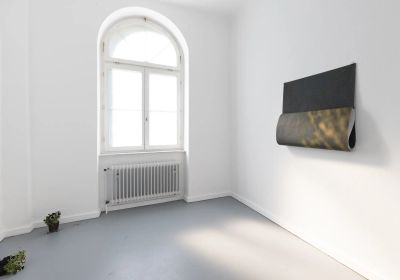
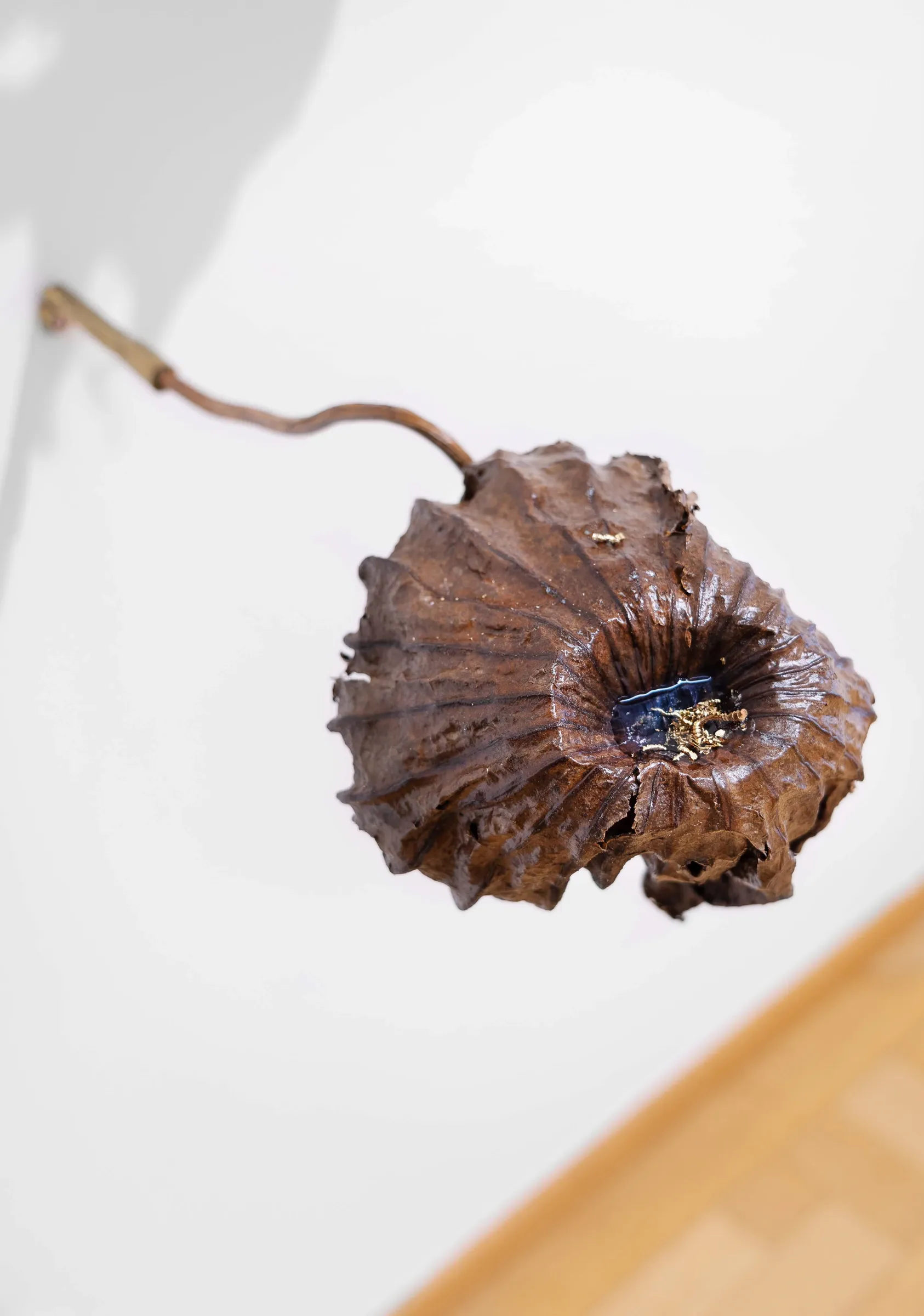
The materials here are not passive carriers. Latex rubber surfaces, degraded black sheeting, copper and brass slabs, epoxied lotus leaves, cyanotype prints on hand-sanded brass, each holds a processing history.
Kaja Clara Joo treats them as active participants in their own transformation rather than as mediums in service of imagery.
The gap between departure and arrival is where this exhibition lives.
Kaja Clara Joo
다시 : DASI
Korean Culture Center Vienna
Vienna, Austria
–
Kärntnerstraße 43, 1010 Vienna
Courtesy the artist
“Joo’s materials do not represent transformation, they perform it. What accumulates in latex, copper, and photographic emulsion is not metaphor but residue: the documented record of a thing having been acted upon.”
The Korean Culture Center Vienna occupies a formal Gründerzeit building on Kärntnerstraße, its rooms organized around the protocols of cultural diplomacy. Joo works across multiple spaces, from the third-floor enfilade of gallery rooms to a glass-walled rooftop pavilion overlooking the Vienna Ringstrasse.
The exhibition does not resolve into a single gesture, it accumulates across rooms, each adding a different register to the question the title poses.
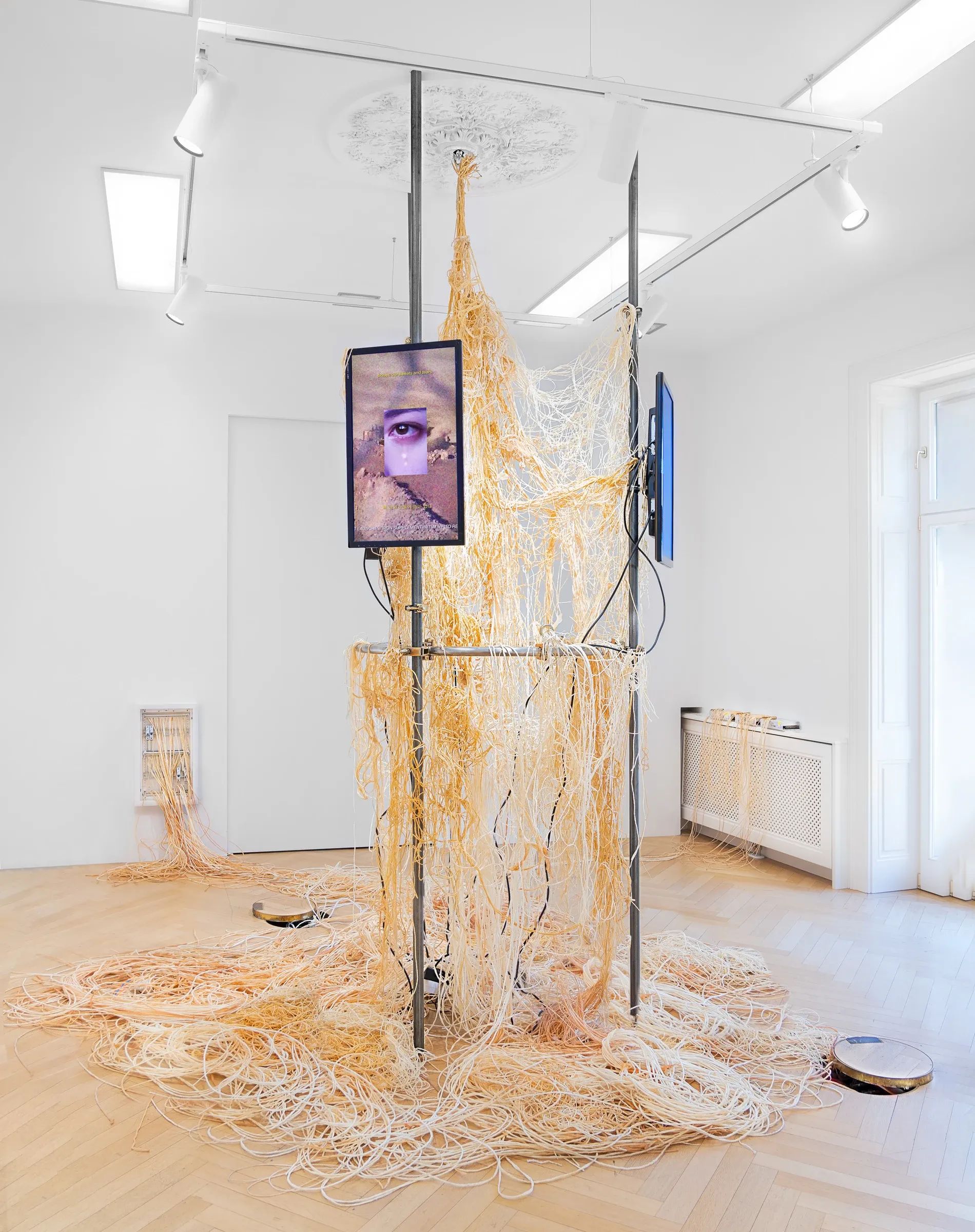
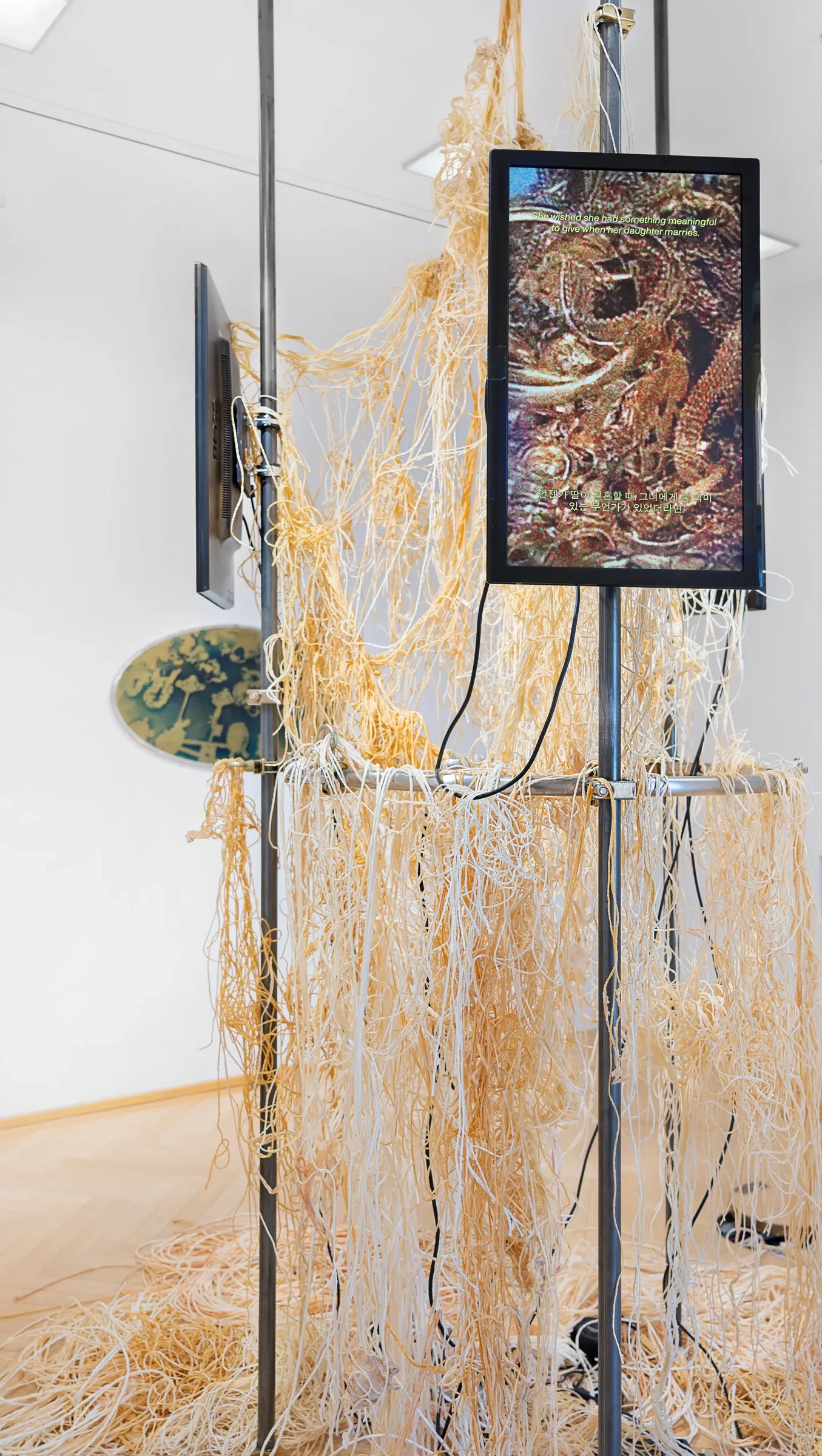
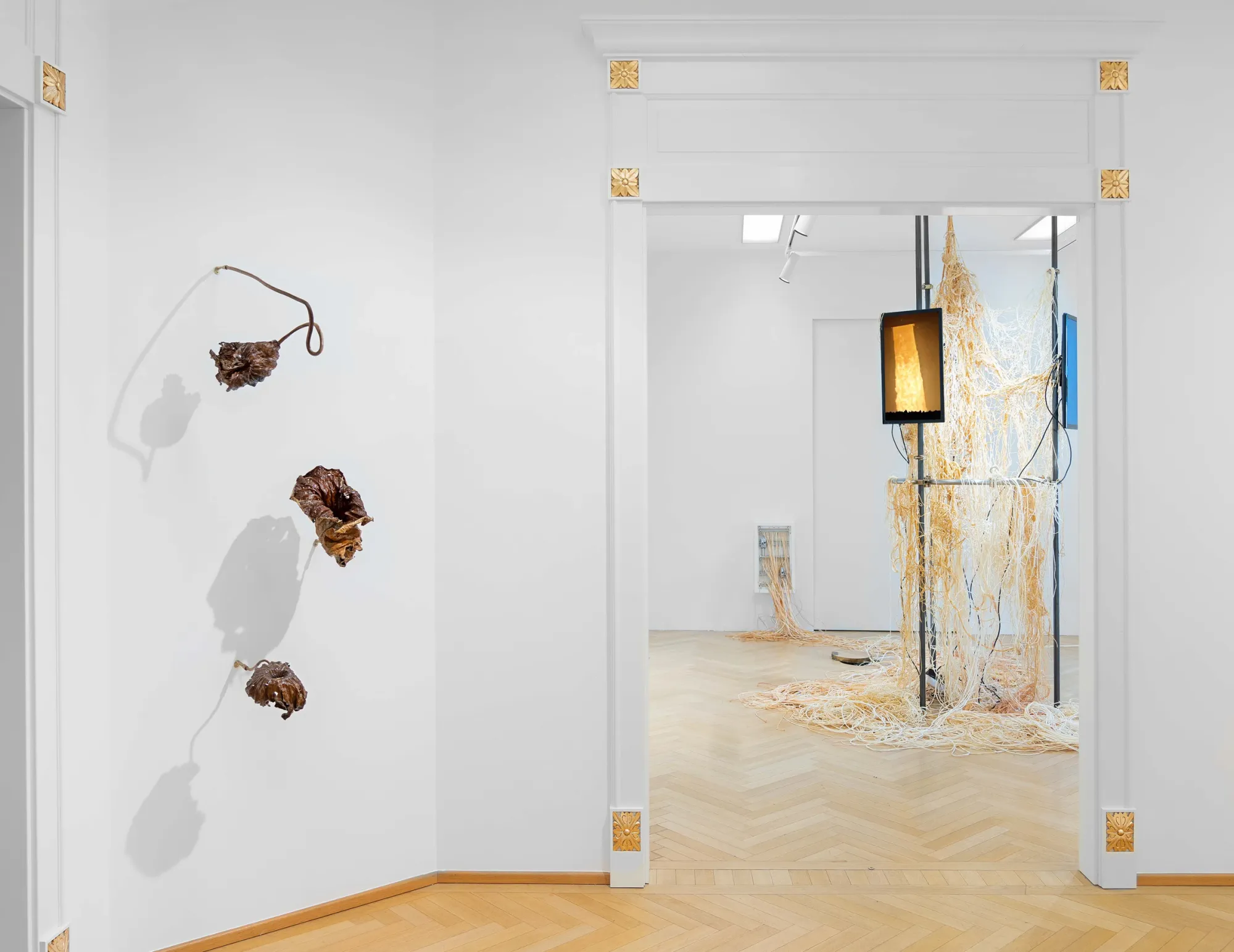
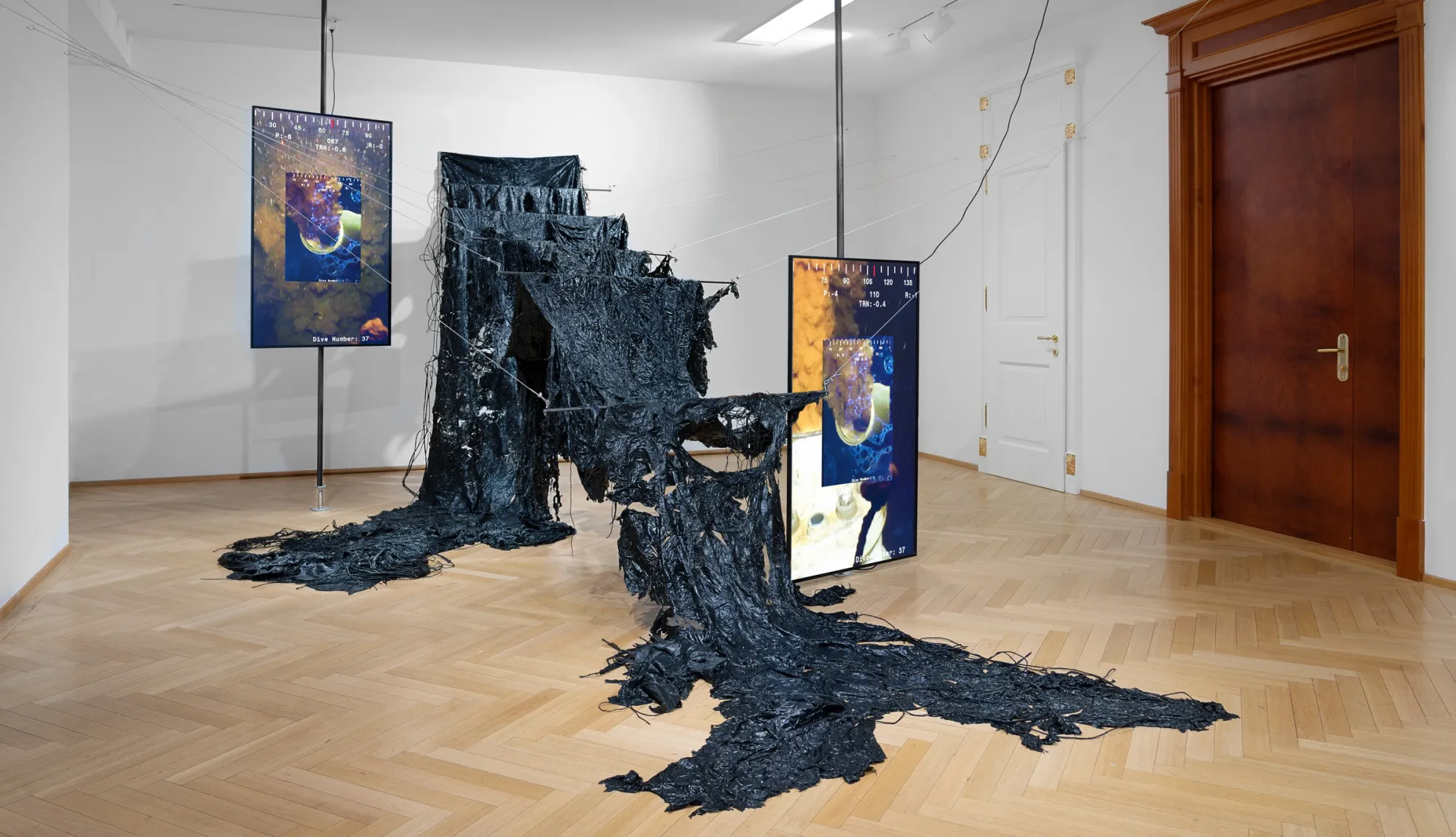
In the main entrance room, a steel scaffold holds two vertical video monitors cycling through deep-sea survey footage, dive cameras marked "Dive Number: 37", instrument readouts, close-up eye imagery layered over oceanic topographies.
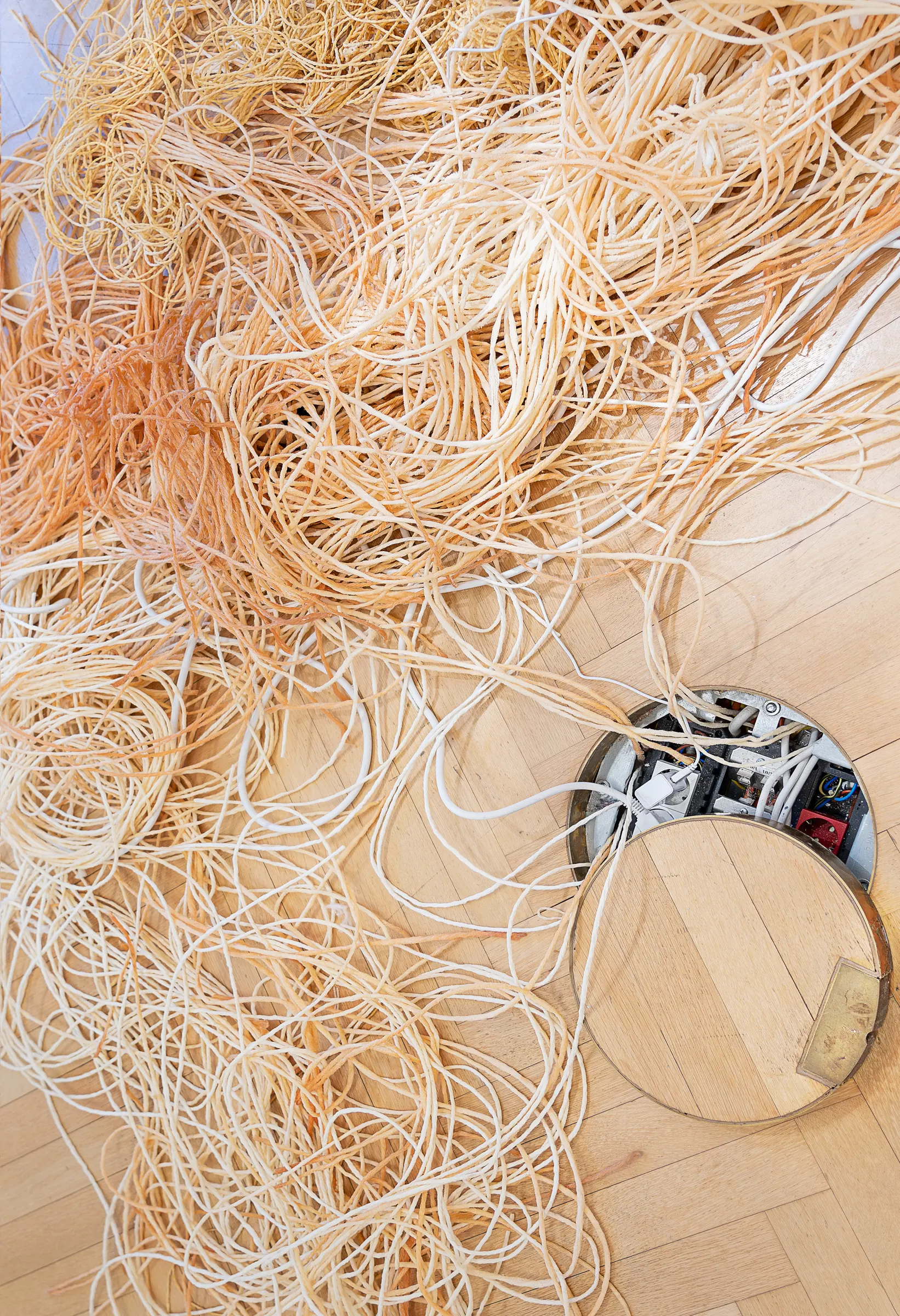
A massive surface of charcoal-mixed latex, burnt, torn, treated past recognition, is suspended between two steel poles and drags across the floor in shreds.
A massive surface of charcoal-mixed latex, burnt, torn, treated past recognition, is suspended between two steel poles and drags across the floor in shreds.
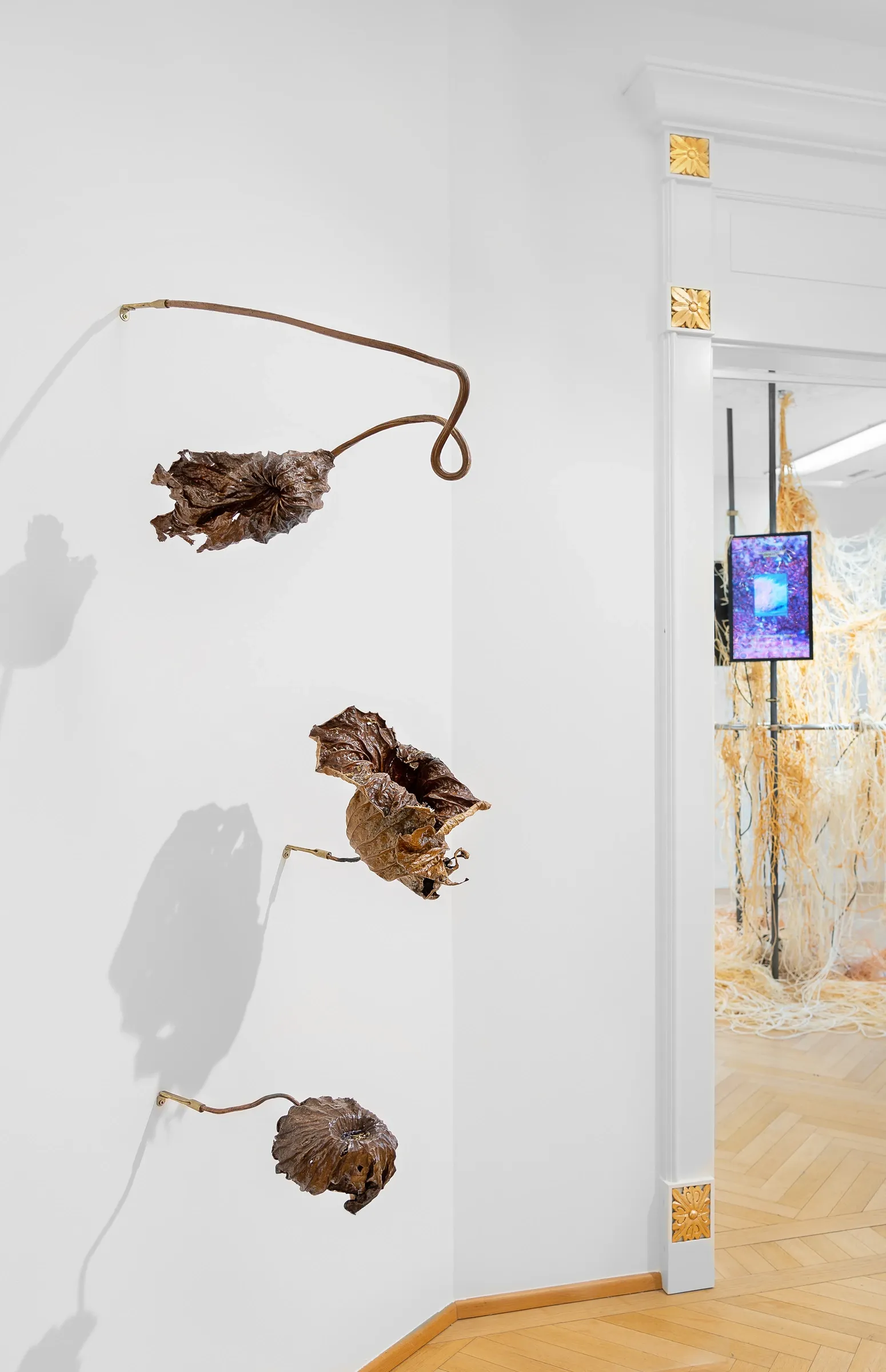
Three epoxied lotus leaves hang from brass wire stems on an adjacent wall, the lotus stripped of its symbolism, preserved in a state of simultaneous fullness and decay. Each surface still carries traces of brass dust and human intervention.
The deep-sea footage and the organic overflow share a logic, systems of extraction and systems of growth running on parallel circuits.
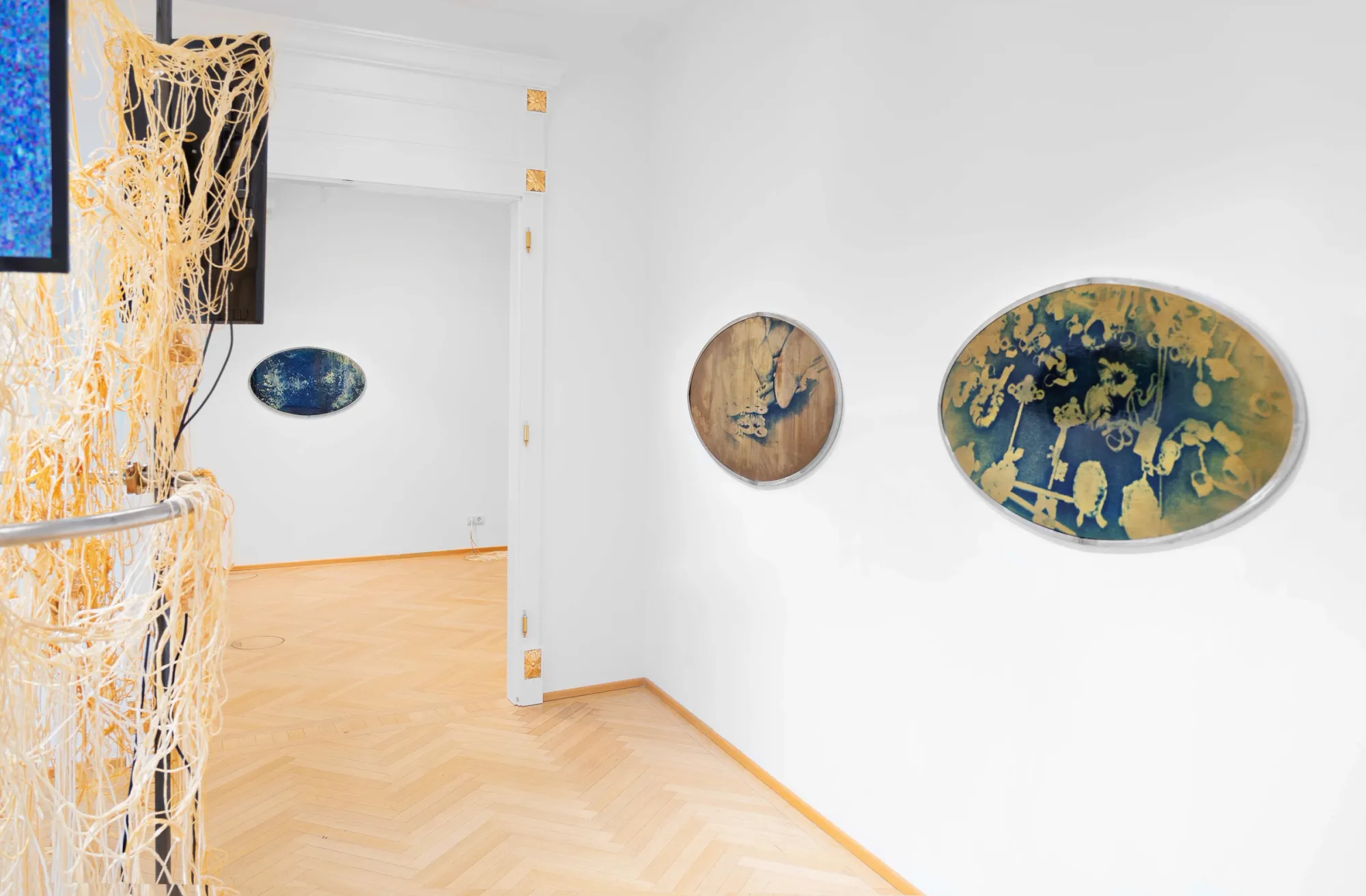
A second room holds two large freestanding frames in the geometric lattice pattern resembling traditional Korean changssal (창살), each holding cyanotype prints on hand-sanded brass sheets. The botanical imagery, fields of rice harvests and lotus ponds, is rendered in deep blue and gold through photographic and chemical processes, making the transformation inseparable from the landscape it records.
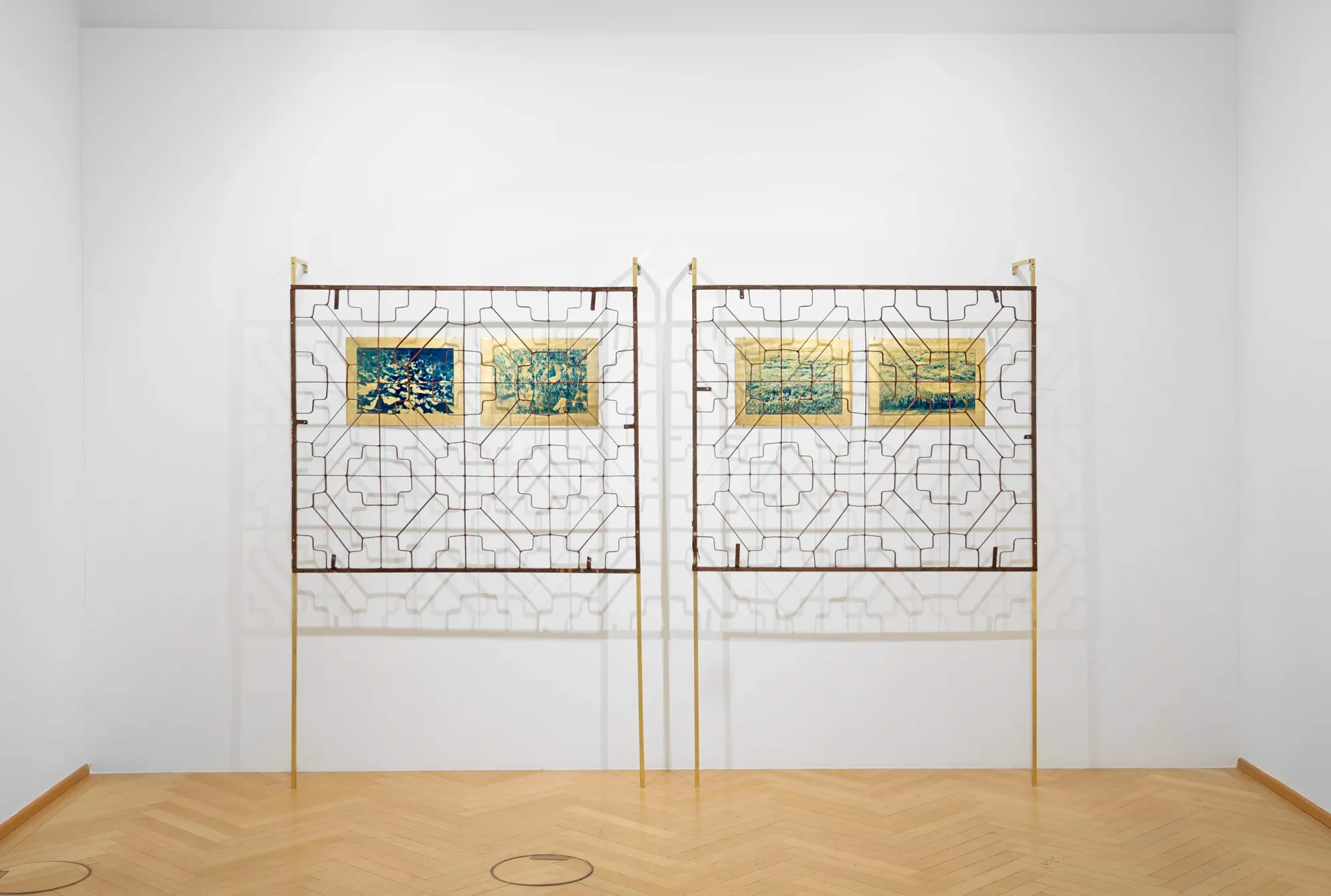
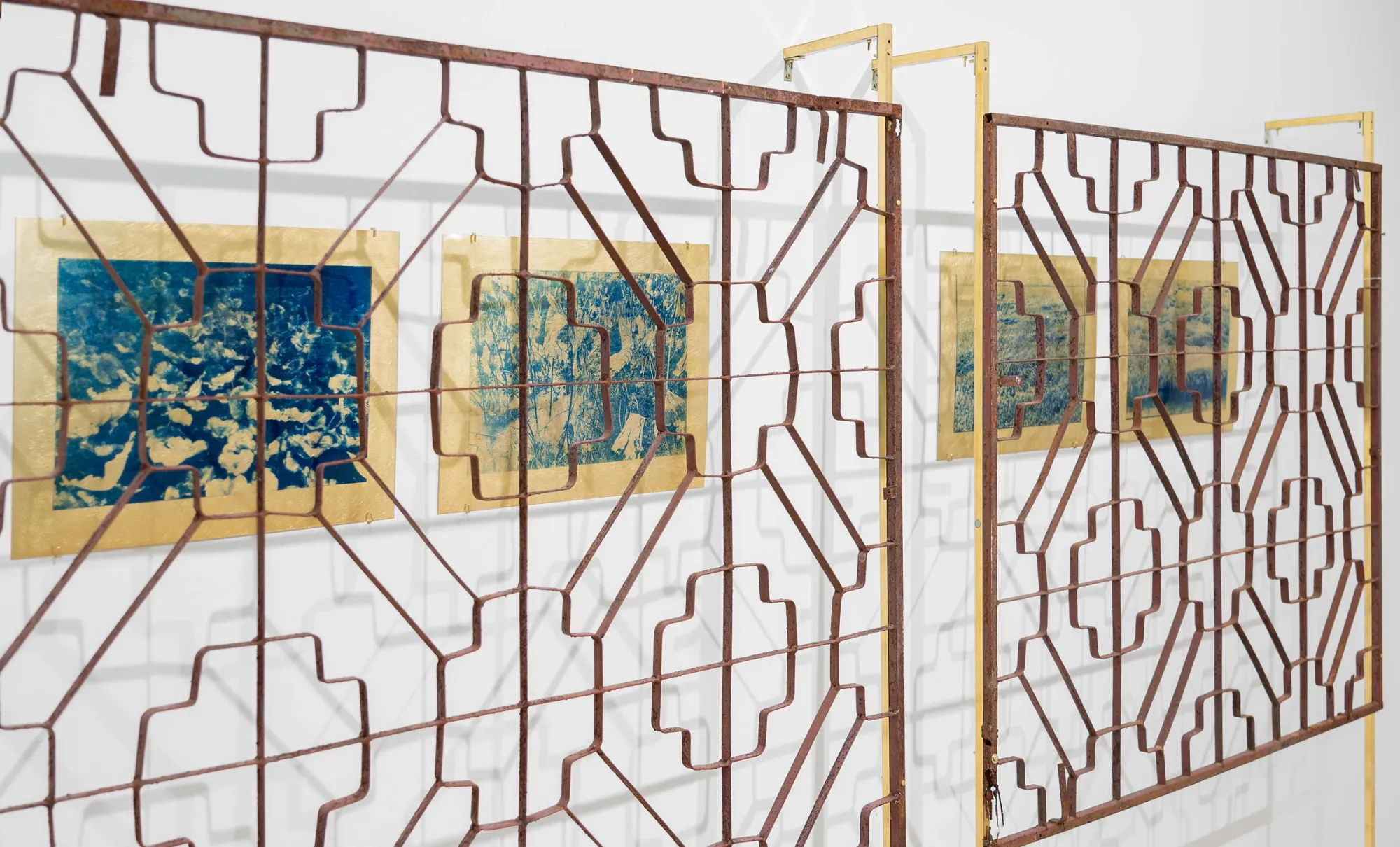
On adjacent walls, three oval works extend this thinking, photographic emulsions and cyanotypes in steel frames, their surfaces holding traces of artifacts that no longer exist in the same form: traditional Korean brass and gold ware lost during Japanese colonization and the economic restructuring surrounding the Asian financial crisis of the 1990s.
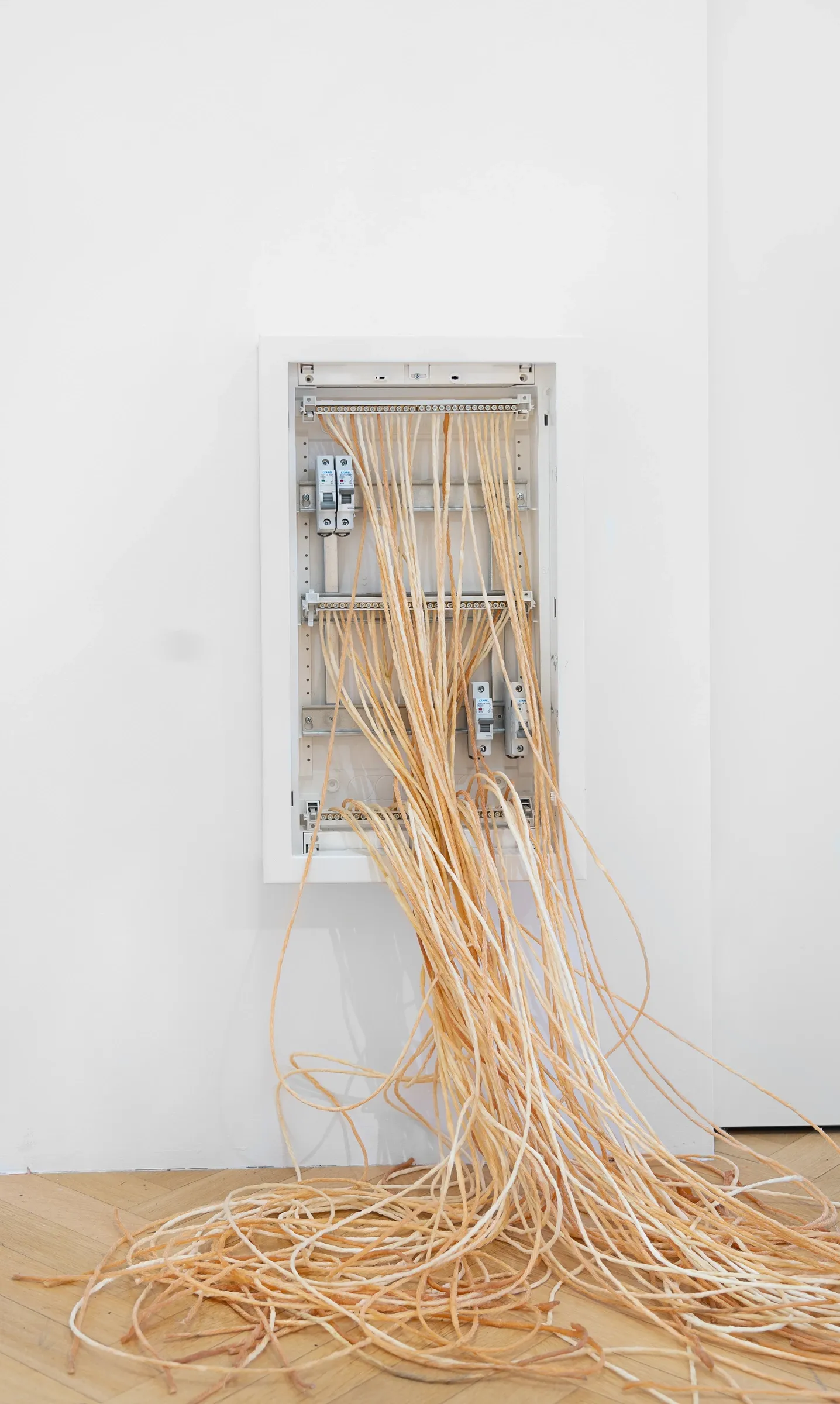
From the same structure and from an embedded fuse box in the wall, pale latex rubber tubing erupts and pools across the parquet floor.
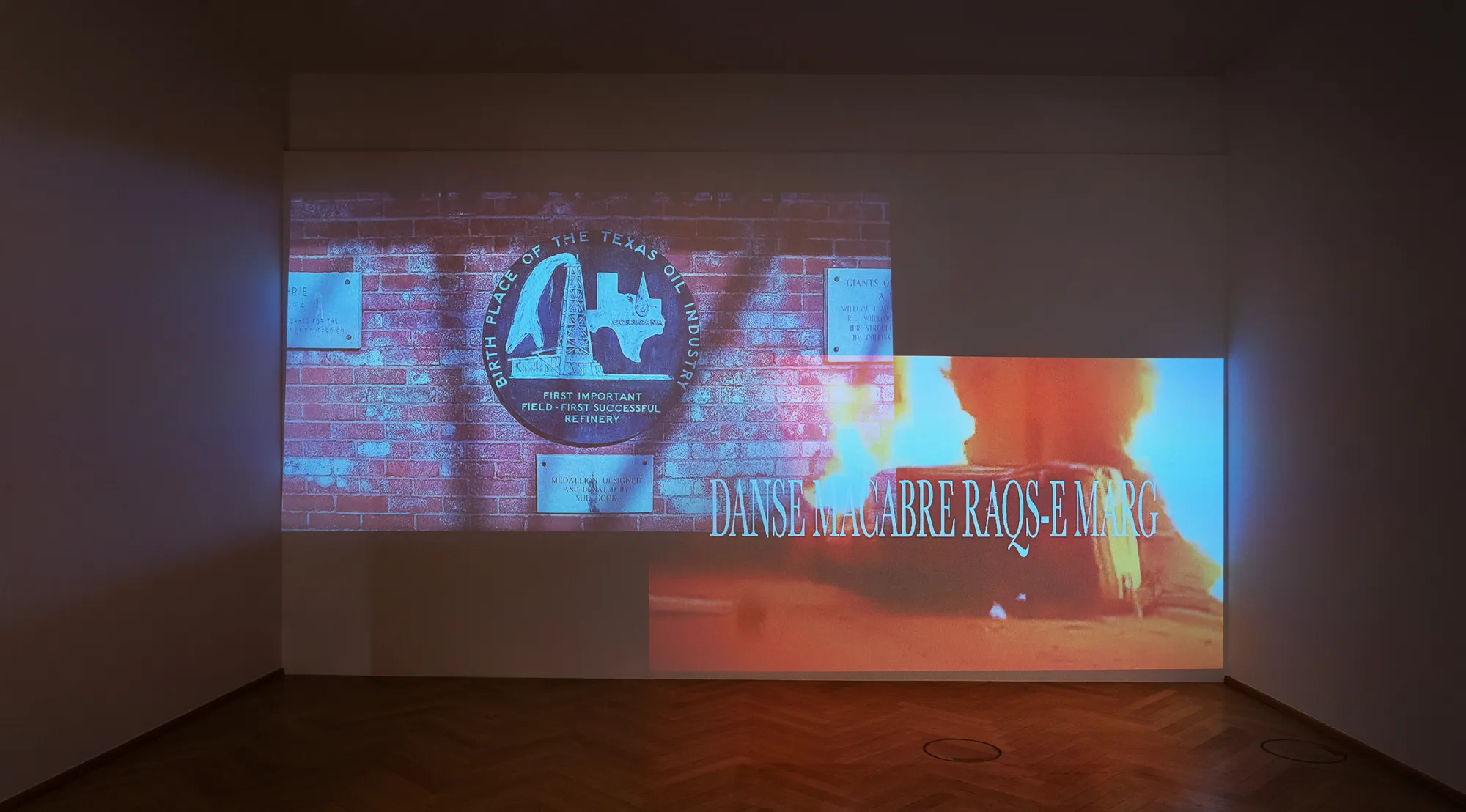
Through a doorway, the video work All These Dwellings Are Temporary projects across two segments, a commemorative plaque marking Corsicana, Texas as the birthplace of the American oil industry, and beside it, footage of demonstrations collapsing into smoke, fire, and unrest.
The work names directly what the rest of the exhibition approaches more obliquely, the metabolism of post-industrial extraction, combustion, political instability, and the residue left behind in transformed objects and damaged landscapes.
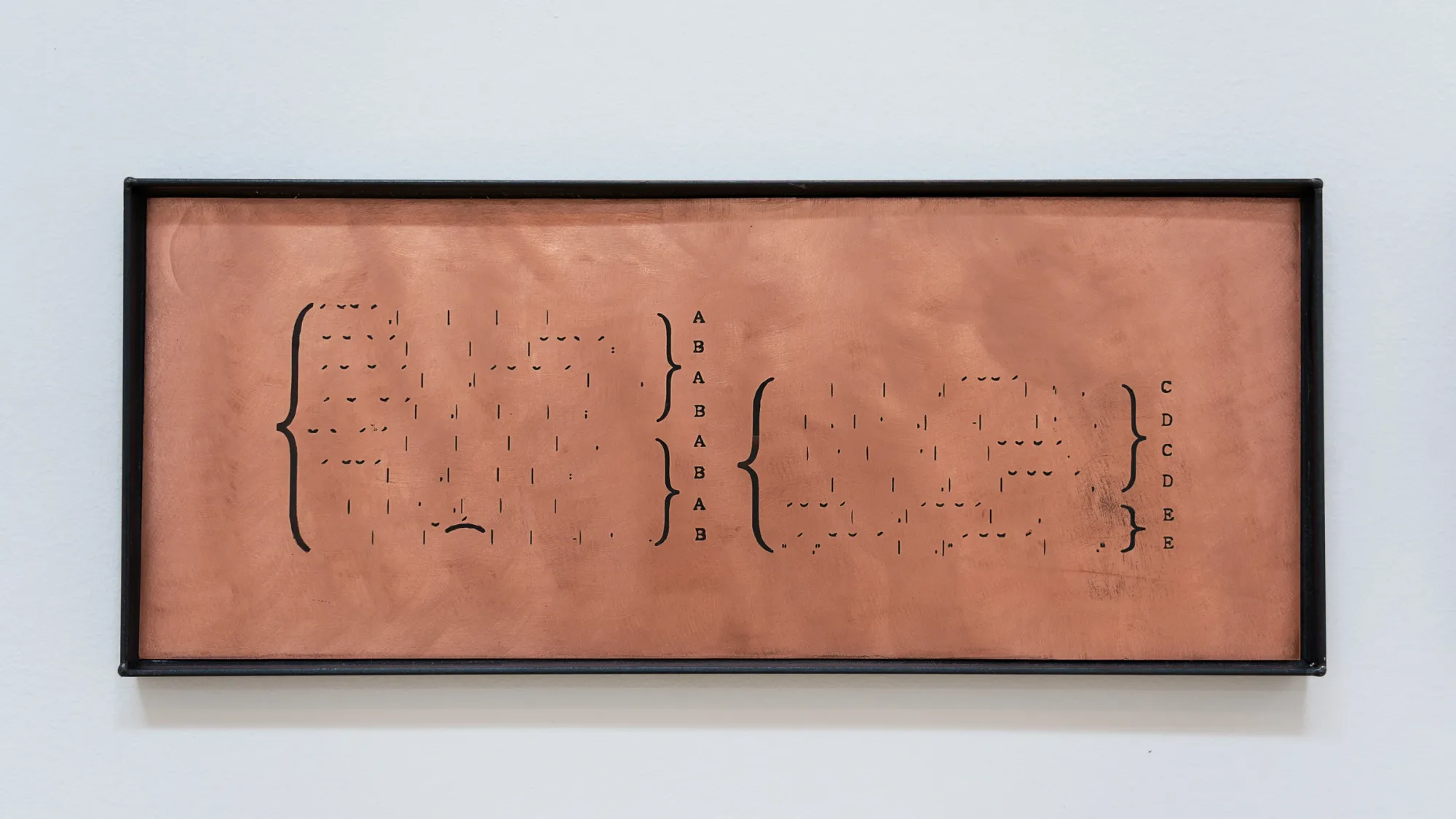
Two copper plates mounted nearby carry engraved scansion notations with embedded text fragments: "your self: | defects | of every friend, and every foe."
Score and corrosion occupy the same surface, language appearing measured, fragmented, and partially withheld.
The three residencies informing this work, Lee Ungno Museum in Hongseong (2024), the National Museum of Modern and Contemporary Art in Seoul (2025), and 100 West Space in Corsicana, Texas (2026), trace a geography that is also a material history.
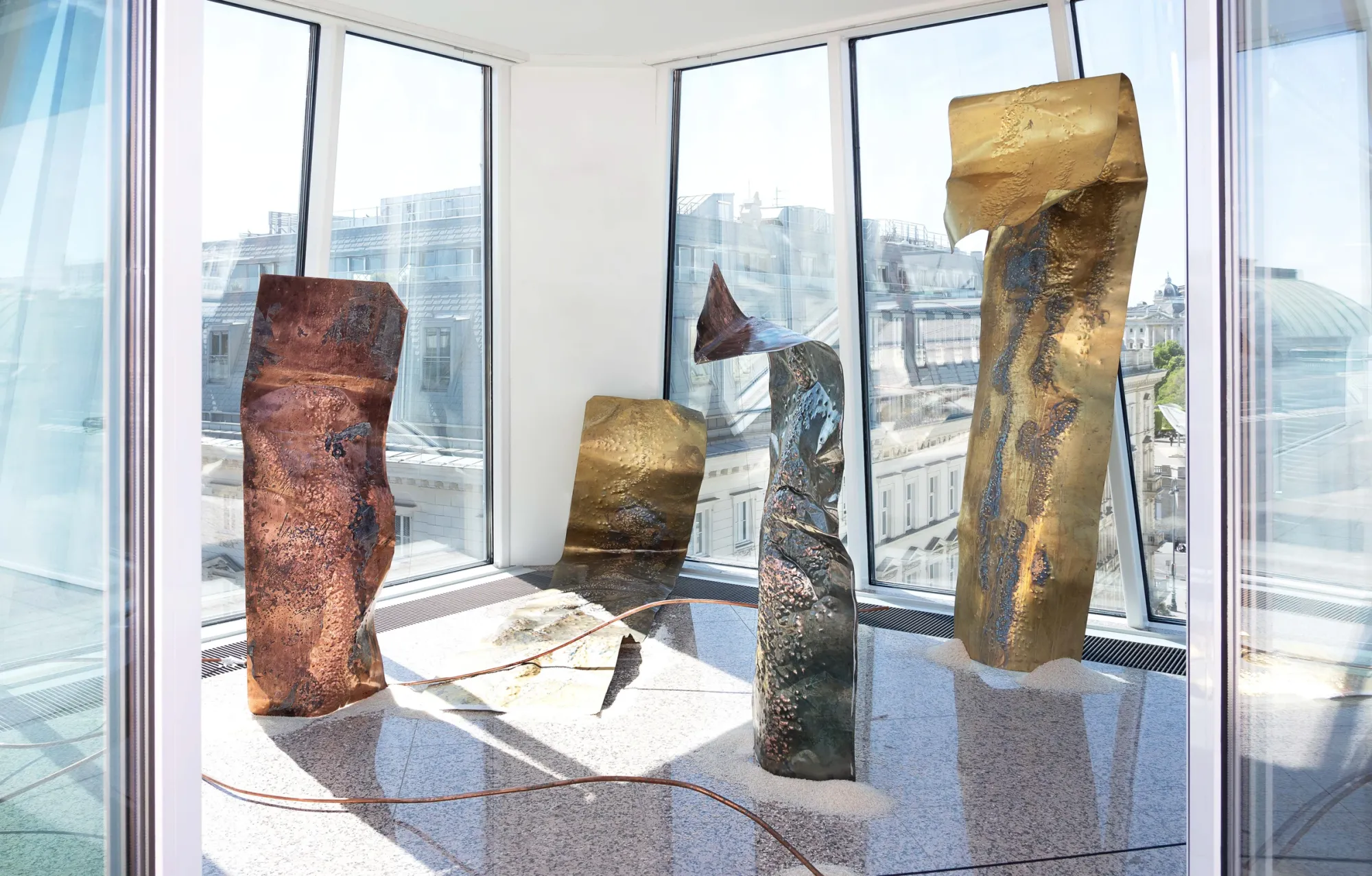
The rooftop glass pavilion holds the exhibition's most formally stark works, large sheets of copper, brass, and galvanized metal standing in shallow pools of rice, copper pipes running through the installation.
The Ringstrasse panorama outside, imperial Vienna, built in the same era that industrialized European extraction, provides no ironic frame. It simply exists alongside. The oxidized green copper domes surrounding the pavilion mirror the treated metal surfaces inside the exhibition.
What remains is not a verdict on what these materials have endured, but an inventory of how they arrived. The exhibition resists stable conclusions. Instead, it traces what survives after transformation, displacement, extraction, and reinterpretation, asking how such histories continue to be carried materially, politically, and emotionally.
Instagram Kaja Clara Joo
Korean Culture Center Vienna on Instagram
About Catapult
This is a exhibition review published by Catapult — an independent editorial platform for contemporary art, based in Vienna. We publish exhibition reviews, artist features, interviews, and critical context, with a focus on emerging and mid-career practices from Europe and beyond.
catapult.art
Want to be featured? Submit your work →