Can a Painting Prove It Has Hands? The Super Future Kid Interview on Catapult

Germany
1981, East Berlin, Germany
Painting, Ceramics, Mixed Media, Installation
KHB – Weißensee Academy of Art Berlin, graduated 2008
Mindy Solomon Gallery, Miami, 2025 Gana Art, Seoul, 2024 Over The Influence, Bangkok, 2023
Mindy Solomon Gallery (Miami), Over The Influence (LA / Bangkok / HK), Gallery Poulsen (Copenhagen)
superfuturekid.com
@superfuturekid
Courtesy the Artist
Super Future Kid Interview with Catapult-Contamporary about - Painting, Ceramics, and the Art of Staying Real
The word that follows Super Future Kid everywhere is "digital." She has been correcting it for years.
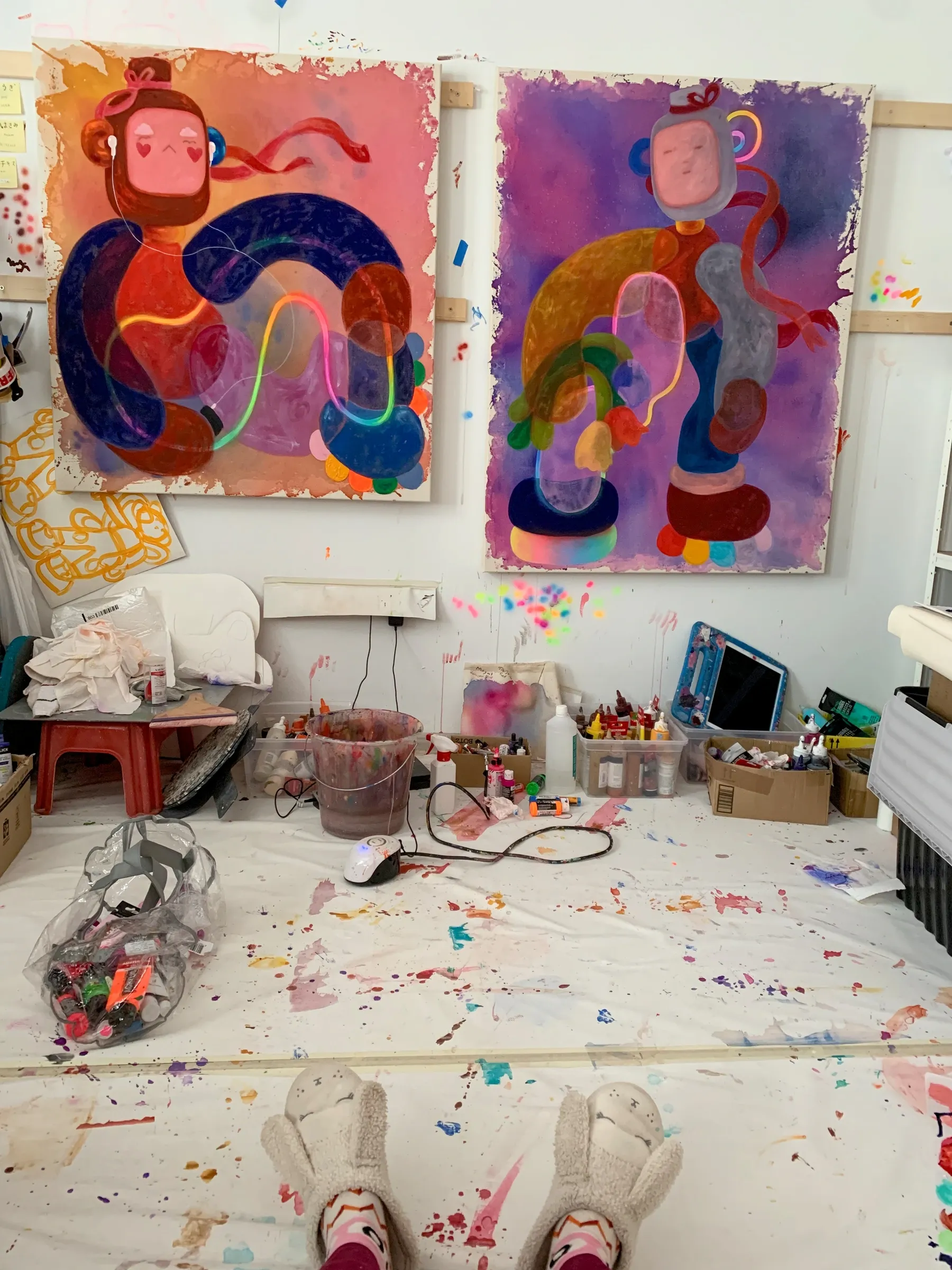
The paintings are made by hand, on raw canvas, with brushes that leave visible streaks, with drips she does not remove, with pastels that bleed into fluid acrylic. The surface reads differently on a small screen. That is not the painting's problem.
"I am a human being and I want that to be apparent in my work." - Super Future Kid
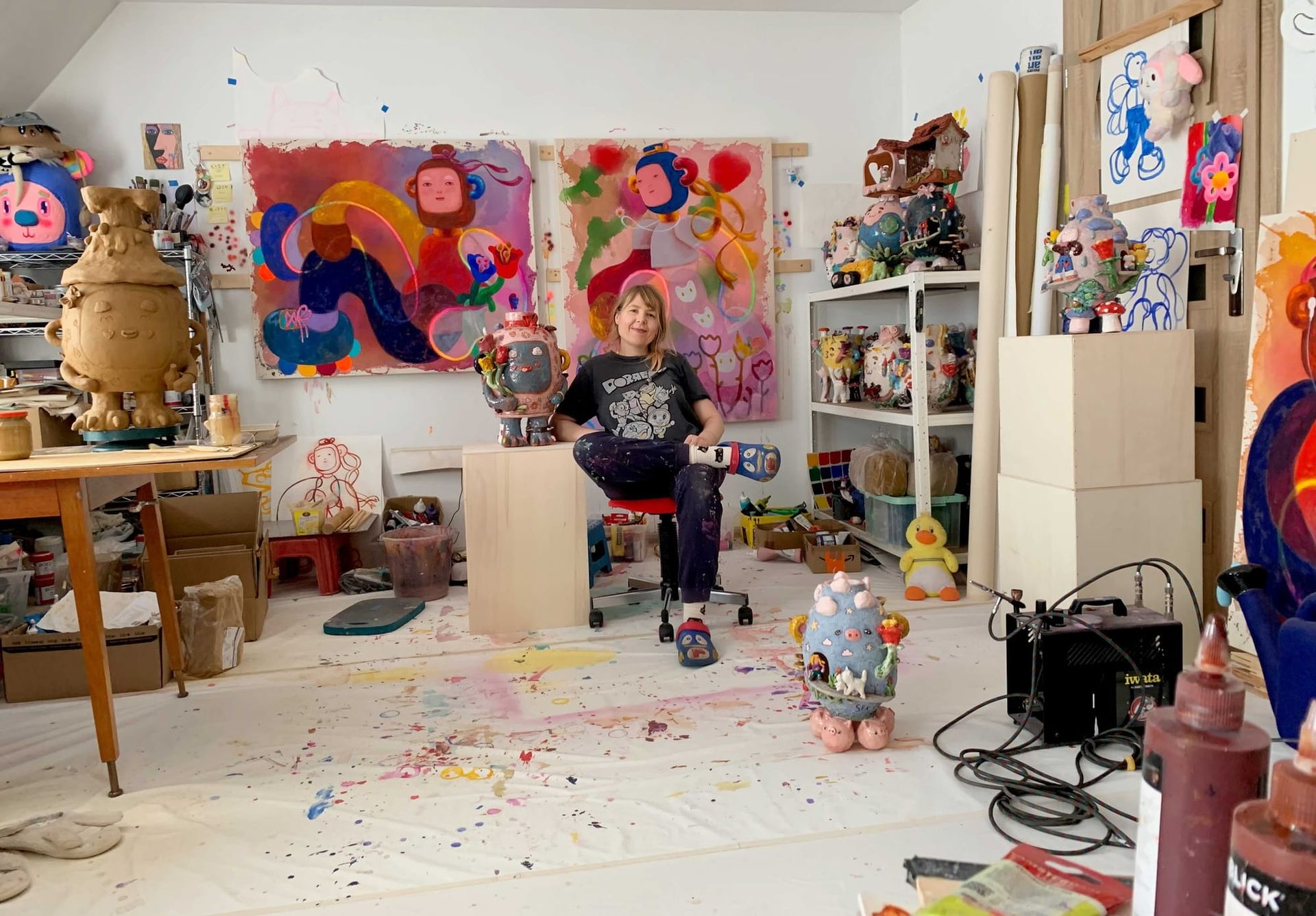
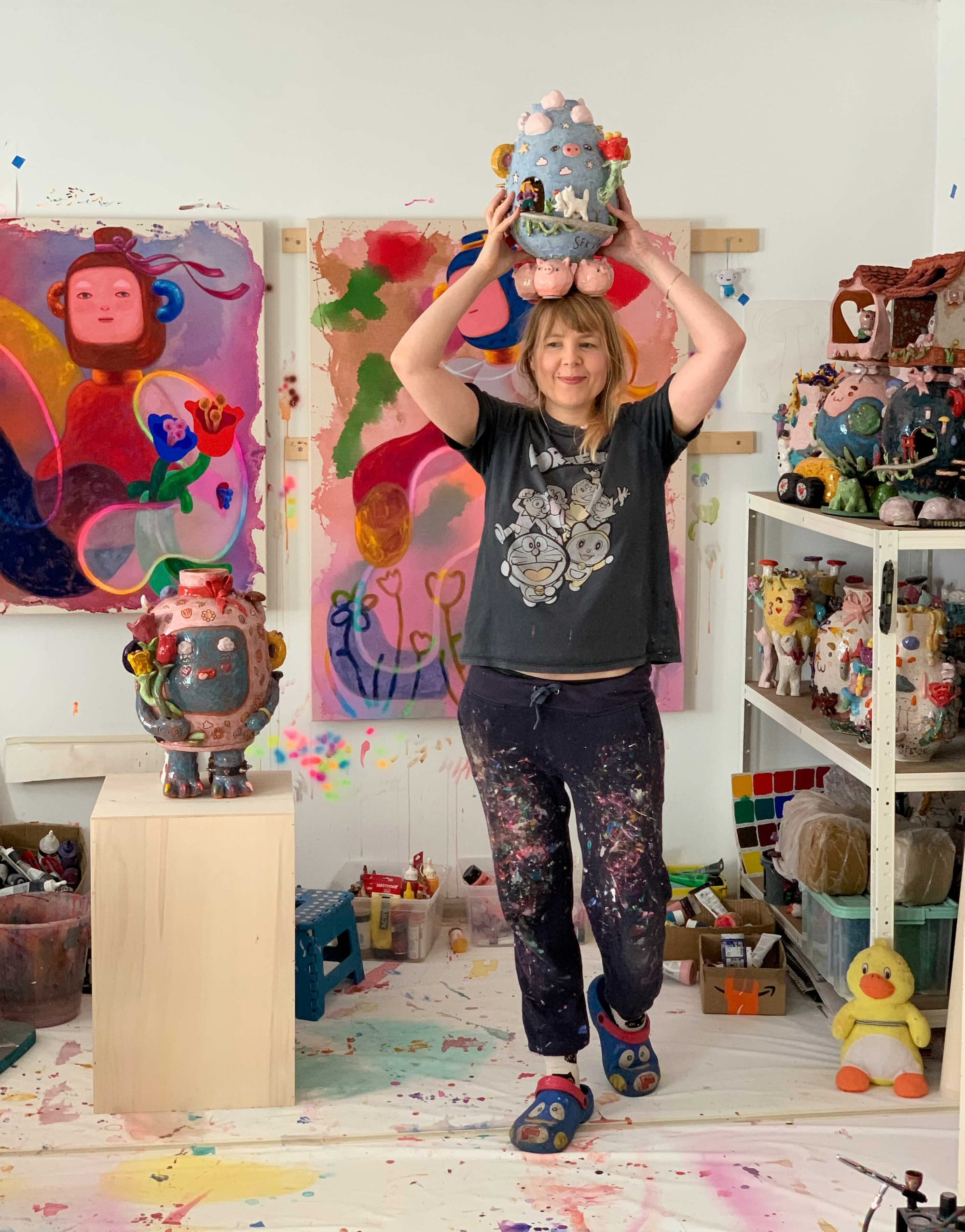
Super Future Kid left New York at the beginning of last year and moved back to her hometown in rural Germany, a small town, a studio rebuilt from a converted living room, a practice reconstructed from nothing.
A few weeks after arriving, she found a ceramics class nearby.
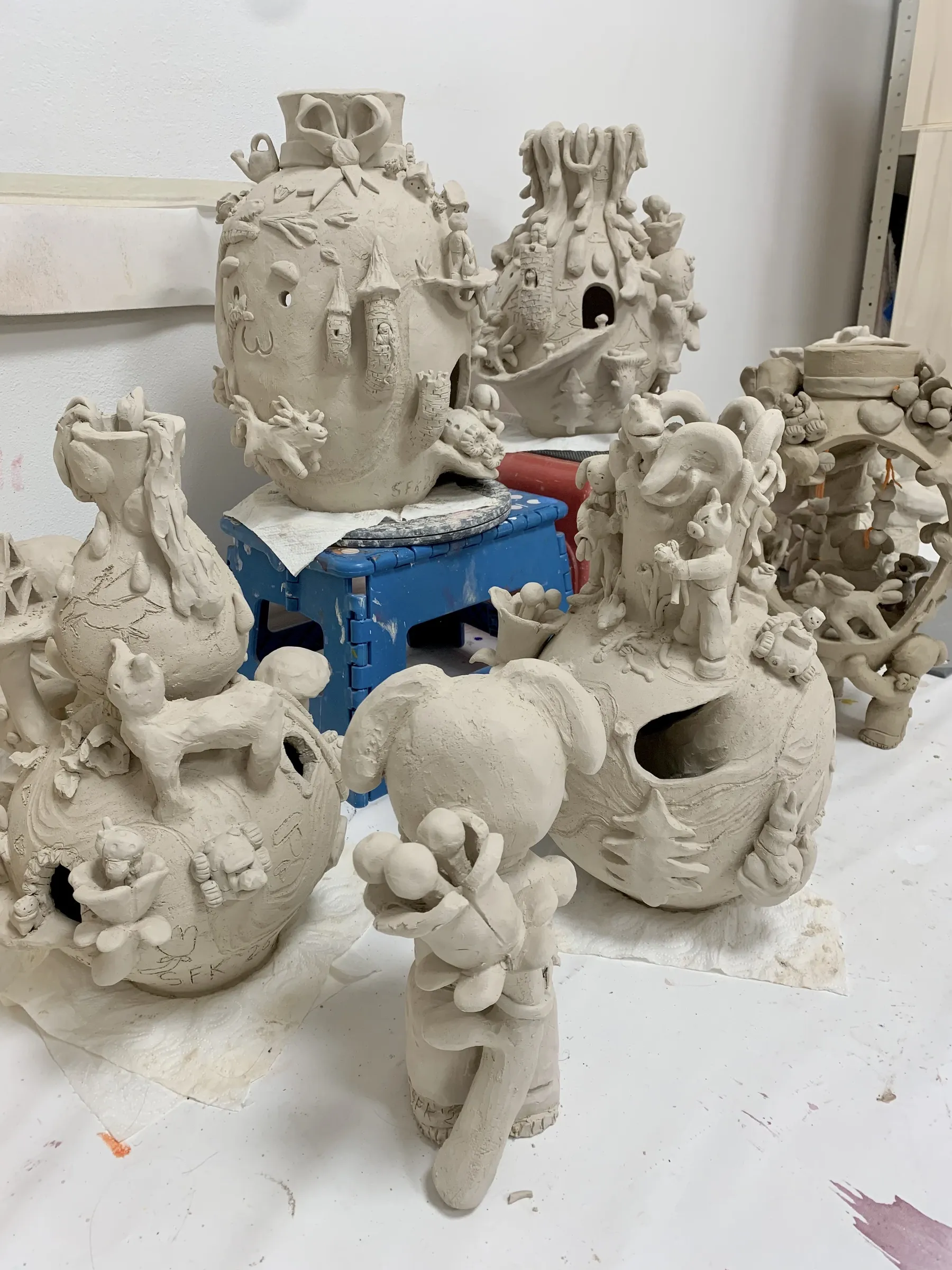
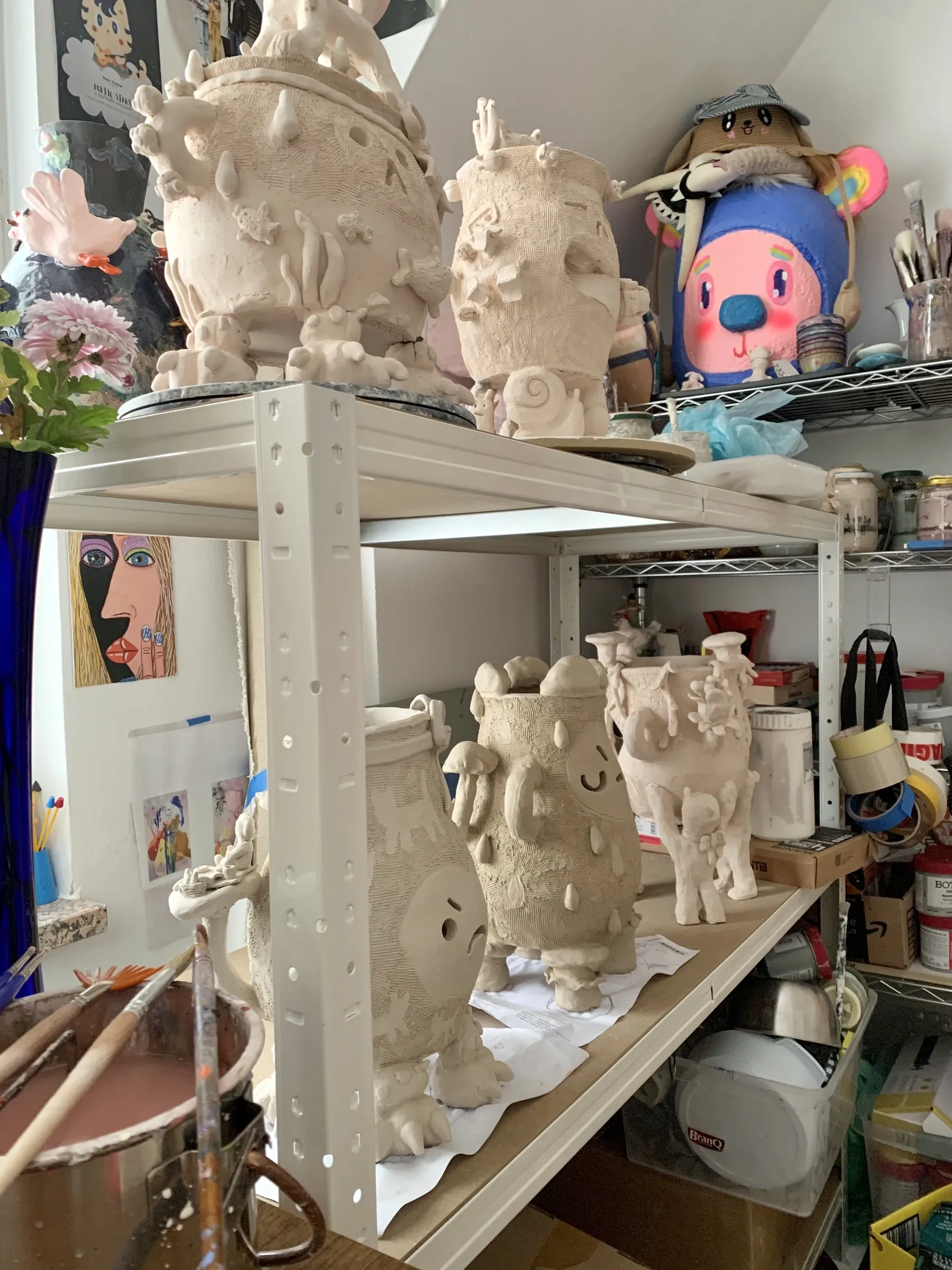
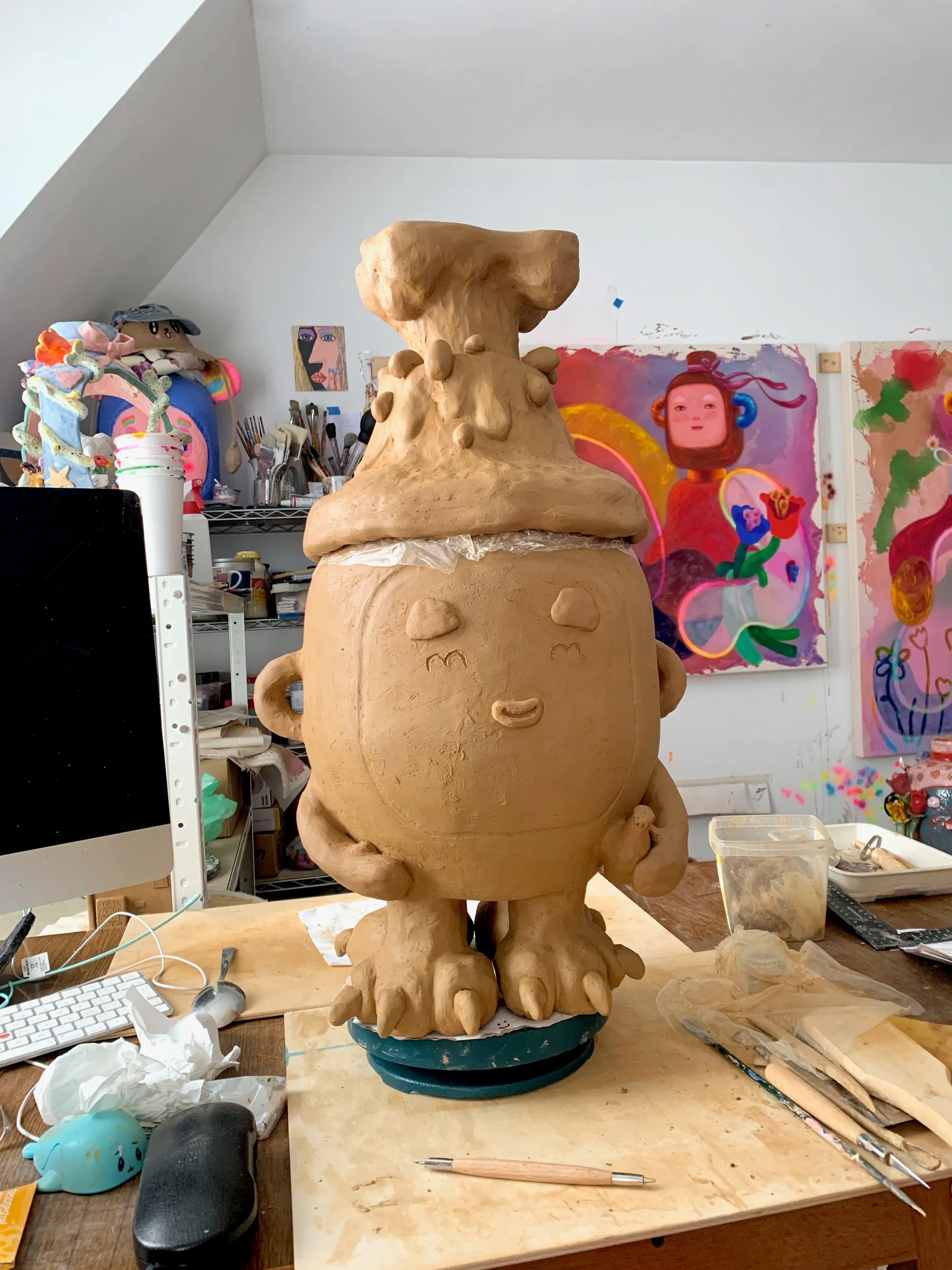
She bought a kiln. She stopped painting for an entire year. The clay took over completely: an entire year of engobes, oxides, glazes, fire, and the slow education of losing control at 1200 degrees.
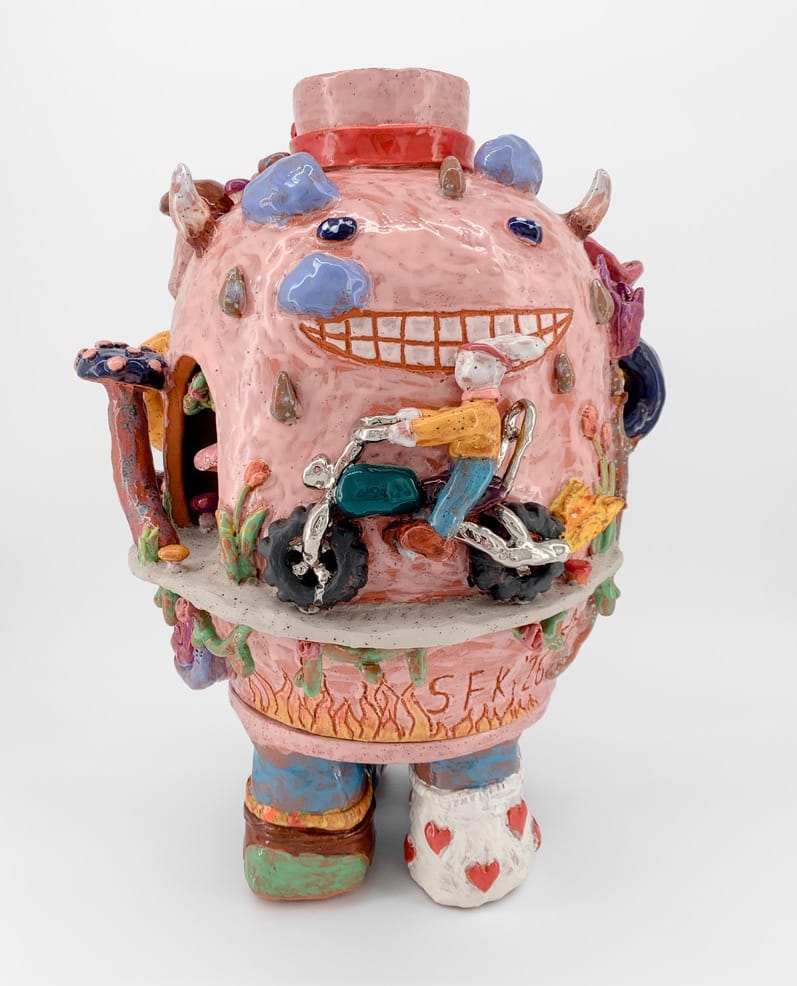
Her Dirt Spirits show in 2025 was the first time she presented the ceramics as a full body of work, and for the first time, she says, she truly understood what she was doing with them.
The paintings are back now, running parallel to the clay. This conversation happens at that junction between two materials, two image-worlds, and a decade-long misread the work is still in the process of correcting.
Interview mit Superfuture Kid :
Interview mit Superfuture Kid
- You moved from New York to Germany at the beginning of last year and had to rebuild your studio from scratch. For most artists, that kind of upheaval is purely logistical, but for you it seems to have opened something unexpected. What actually happened in that transition?
Super Future Kid: I moved my studio so many times and it is essentially a logistical thing, but there is more happening than just relocation. I’ve had studios in London, New York and rural Germany.
With every move I entered a different reality, shaped by the space and everything around it, the city, the people, nature /or lack of there of, etc. It impacts me mentally and physically, each studio brings different restrictions but also opportunities.
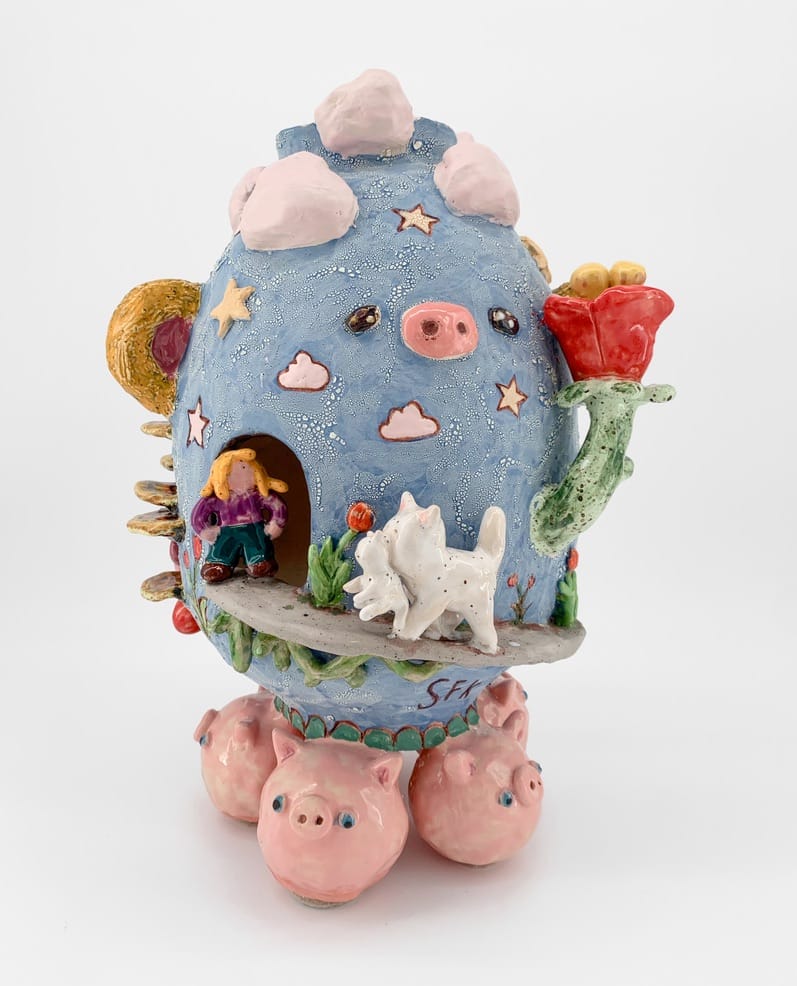
Right now my studio is a converted living room in a small, rural town, my hometown actually. It was a huge transition from NYC. Everything is smaller, quieter and greener.
I feel a lot less pressure or expectations here. And I started working with clay, something I’ve always wanted to, but it couldn't happen until now.
- You discovered ceramics here almost by accident, a class nearby, a kiln, then an entire year without painting. Looking back, was that actually chance? And now that both are running in parallel again, does it feel like picking up a conversation you left mid-sentence or something else entirely?
Super Future Kid: Oh god yes, it was luck or fate or something like that. I’ve been in awe with ceramics for a long time and admired the work of Rubi Neri, Joakim Ojanen and En Iwamura for ages to name just a few.
But I always thought it’d be a difficult medium. Not just because of the science involved but also because you need a place to fire it, it felt out of reach. So when a few weeks after moving here I discovered this weekly ceramics class I jumped at the opportunity to finally try this.
It pretty much made boom from day one. I decided to take a break from painting and instead bought a kiln, a ton of clay and glazes and did nothing else for the entire year. It was mind-blowing, like a dream come true.
I now believe that clay/ceramics has been this missing piece to my puzzle. I’ve always loved making sculptures as part of my work but clay is entirely different because it’s so immediate, you take a lump, shape it, and bam!! I am now very happy to also be back at painting again.
So I now work parallel in painting and clay - a bit like walking with 2 different shoes on, but it feels really good and looks even better.
- Your ceramic surfaces combine engobes, oxides, glazes and gold lustre, each one changing how light and depth behave on the form. How do you decide what goes onto a surface, and how do you experience the moment the kiln takes over and the final result is entirely out of your hands?
Super Future Kid: I’m still exploring all the different materials and techniques. Engobes are so chalky, oxides behave like washes, glazes are super glossy and lustre is incredibly metallic, you can really play with many different surface qualities. I look at each piece as an experiment, so like what would happen if I apply this over that or that next to this.
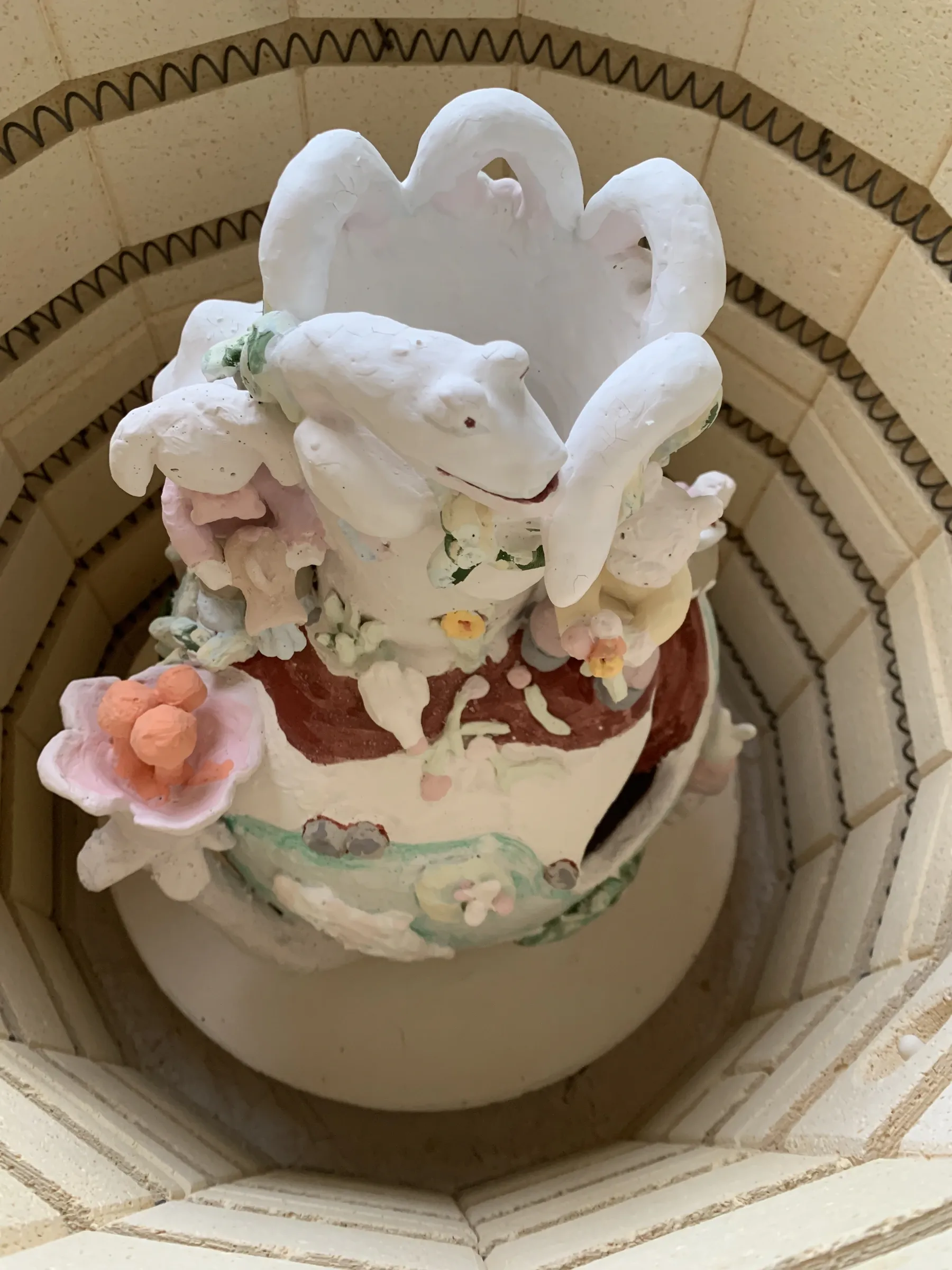
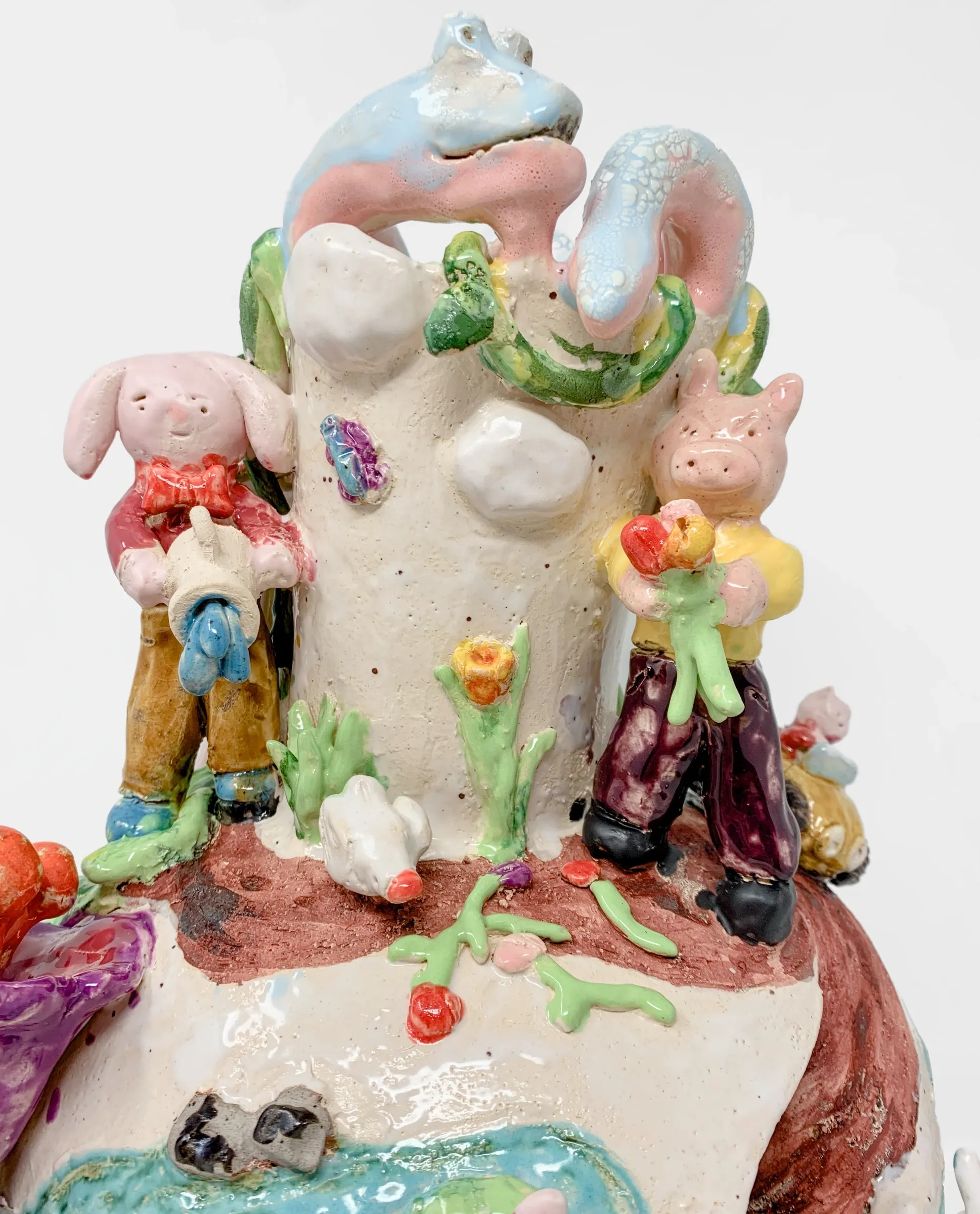
The unknown factor makes itthrilling to open the kiln every time. There have also been a lot of ‘meh’ moments when I finally see the fired piece but with each “fail” I’m learning something.
Glazing really is the trickiest part of the entire process because of how little control you have, you can only make a guess over what a piece might look like after firing but you’ll never really know until you open the lid.
- You shifted to painting on raw canvas so that paint can remain paint, visible streaks, brushmarks, nothing smoothed away. Then clay, which registers every touch, hesitation and pressure of the hand. What does moving between these two materials teach you about your own presence in the work?
Super Future Kid: There’s usually a digital vibe to it but my work is actually quite painterly. I love it when paint is allowed to be paint and when brushes leave visible streaks. But I shifted to painting on raw canvas a while ago to amplify this even more. Everything is digital now, especially with AI, so there is no desire for me to create anything that appears like it lives inside a screen. I am a human being and I want that to be apparent in my work.
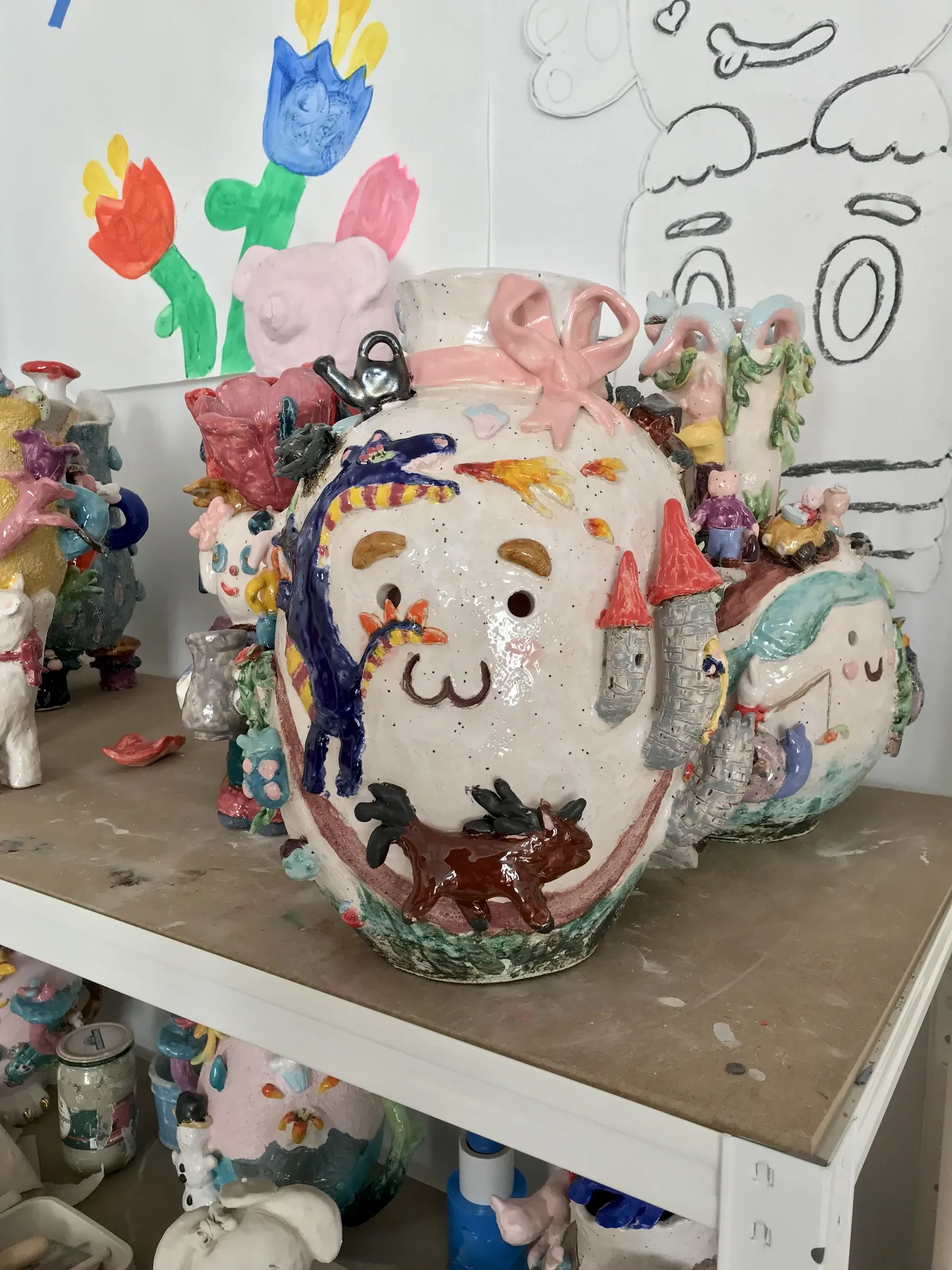
This realisation has probably also been a driving factor in my desire to work with clay and to stop painting for a while. There is something so grounding and real in touching earth and shaping it.
It made me think about painting and what it means to create “images” when we already live inside an image tsunami. So yes, the touch of clay, the rough quality of raw canvas, the struggling brush over the rugged surface, dirt under my finger nails, fire, water, earth; these are things thatmatter to me now.
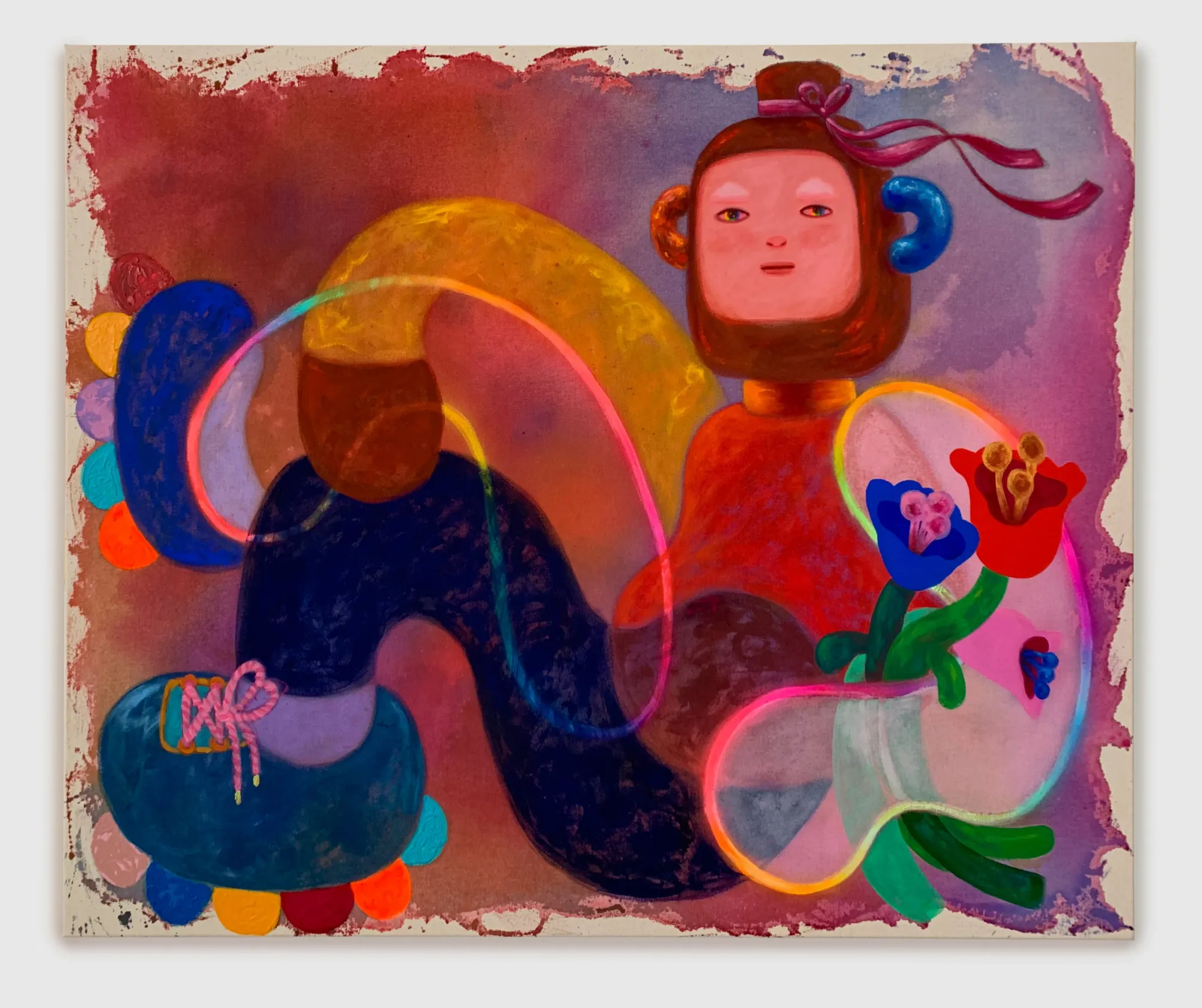
- “I bring you flowers” marks your return to canvas after a year of clay. Your characters have always functioned as emotional mirrors, ways of making something inner visible. What was the first mark you made back on canvas, and what were you trying to reach for?
Super Future Kid: I picked up on a technique I’ve already started developing about 3 years ago, working with lots of water, fluid acrylics, gouache and pastels on raw canvas.
I’m building bodies out of amorphous shapes and lines aiming to create some sort of energy or dynamic flow.
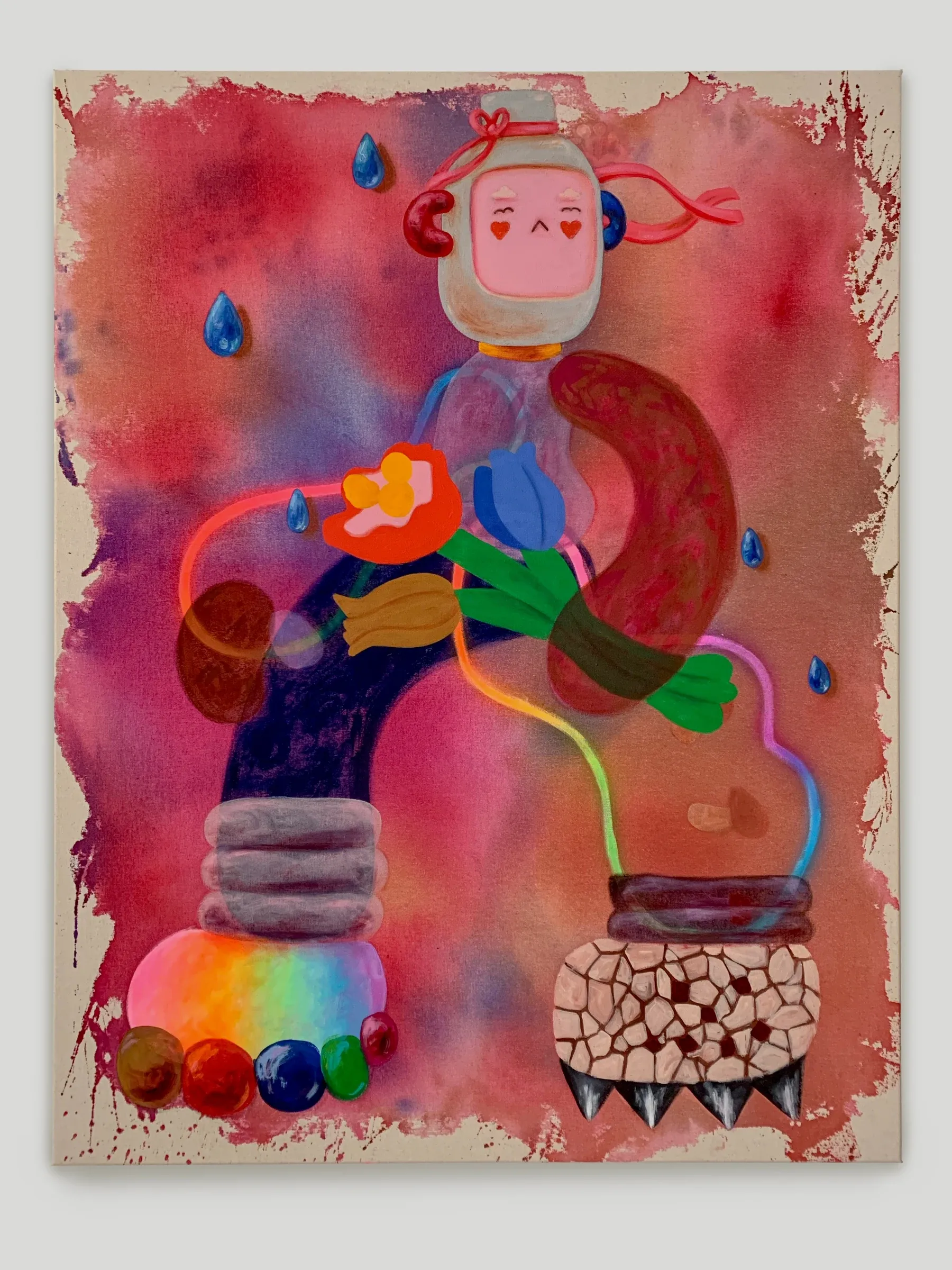
I’m trying to capture a certain vibe or feeling that responds to me, that reflects something from within me, which is what I meant by emotional mirror. I’m trying to produce something touchable and visual out of something from the within me that is intangible and invisible.
And the first mark I made was a chalky line, the outline of a body part!
- Your vessel titles move between the mythic and the completely casual, from Rapunzel and Damsel in Distress to Spilled my Cola or Cheers. What draws you to that collision between narrative weight and everyday language, and do titles function for you as part of the work itself?
Super Future Kid: My work is bouncing off what captures me in the very time that I am making it. I like to play with whatever matters or mattered to me, so it can involve many things from my childhood up to the present day.
The titles are usually a casual notion of what is happening. Titles are important to me but I don’t feel like they have to sound important, they are the verbal element of the whole piece.
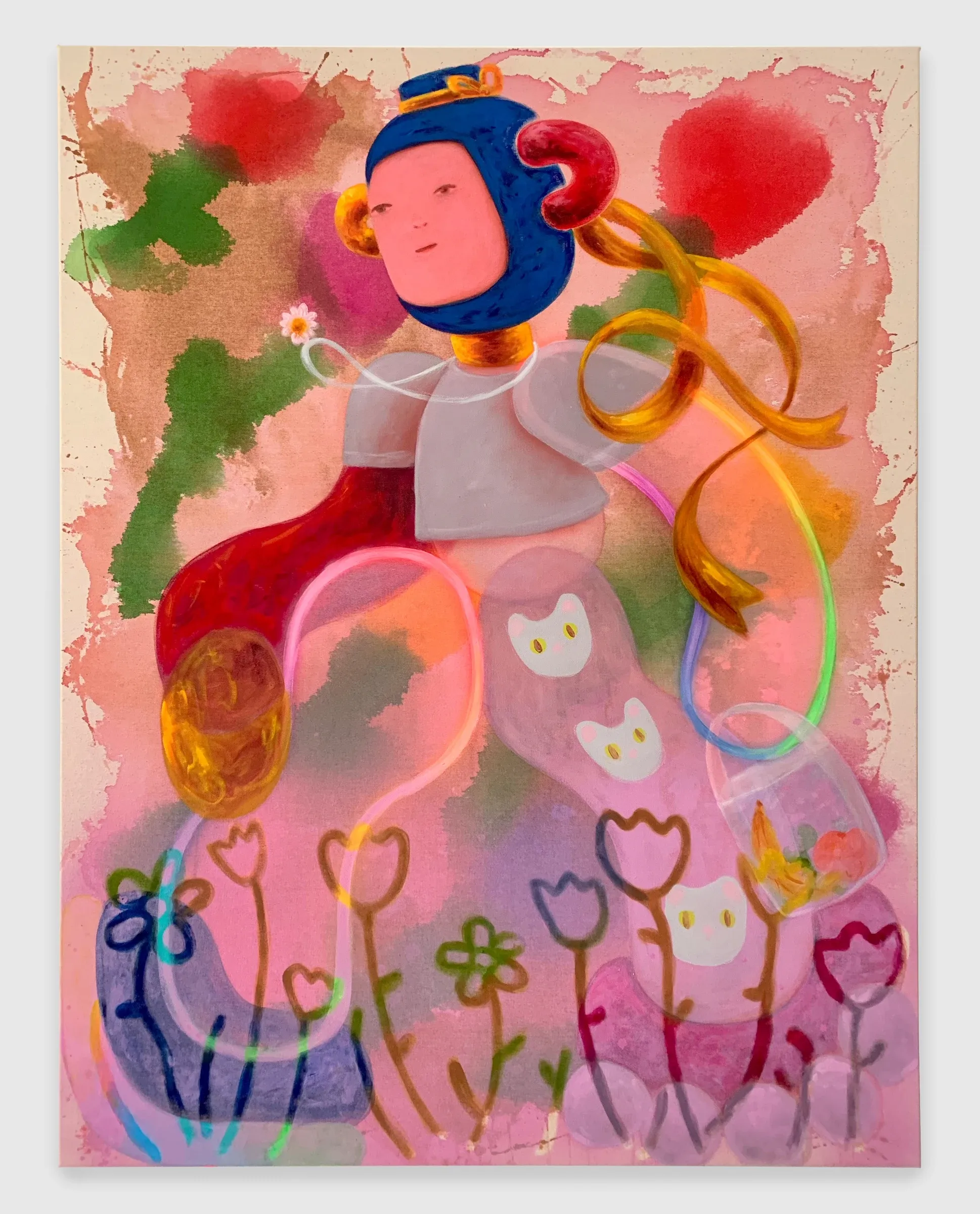
- For years, digital aesthetics and internet imagery shaped an entire generation of painters, yourself included. But your work also insists on material presence: raw canvas, visible brushmarks, drips, stains, touch. How did that transition happen for you, and what gets lost when tactile paintings are primarily encountered through screens?
Super Future Kid: So I don't see my work as “hyper-real” or “ultra smooth”. (to me this sounds like Oil Epp, Cesar Piette, Phillip Gerald, etc) but my work doesnt really belong in this category.
I’m not denying that my paintings have a digital vibe to them, but the human hand has aclear presence in all of them. I intentionally leave my brushmarks, drips or splatters visible.
I’m a sloppy and messy person and that reflects in my work. I suppose the painterly quality gets easily overlooked when viewing paintings on a tiny screen.
But thats why it's even more important for me to point this out.
I think for the past 10 years or even longer, a digital aesthetic was a very inspiring for many artists, including myself, so the question could focus more on how the transition happened from being inspired by the digital/internet aesthetics back in the day to me now wanting to reconnecting with the natural world.
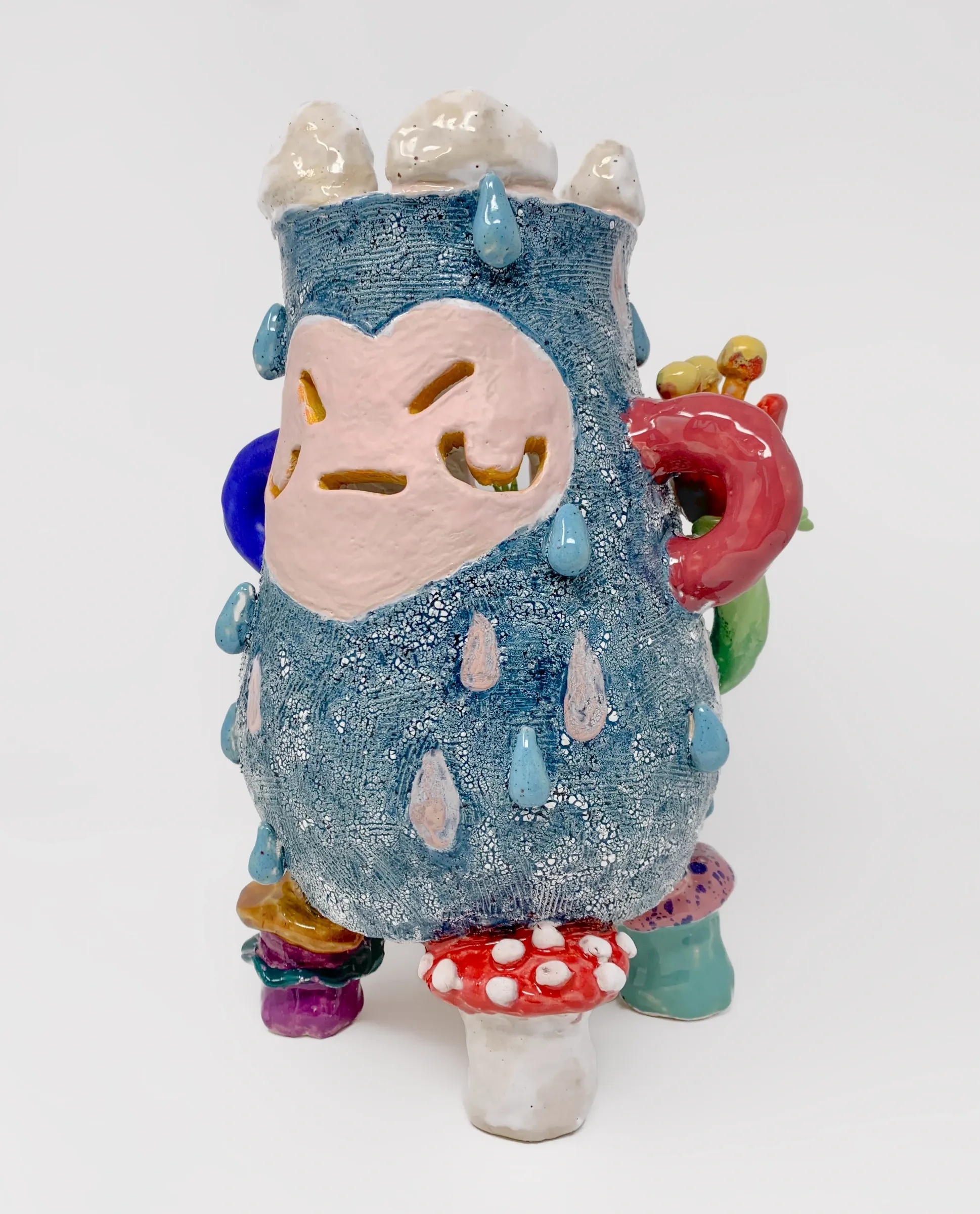
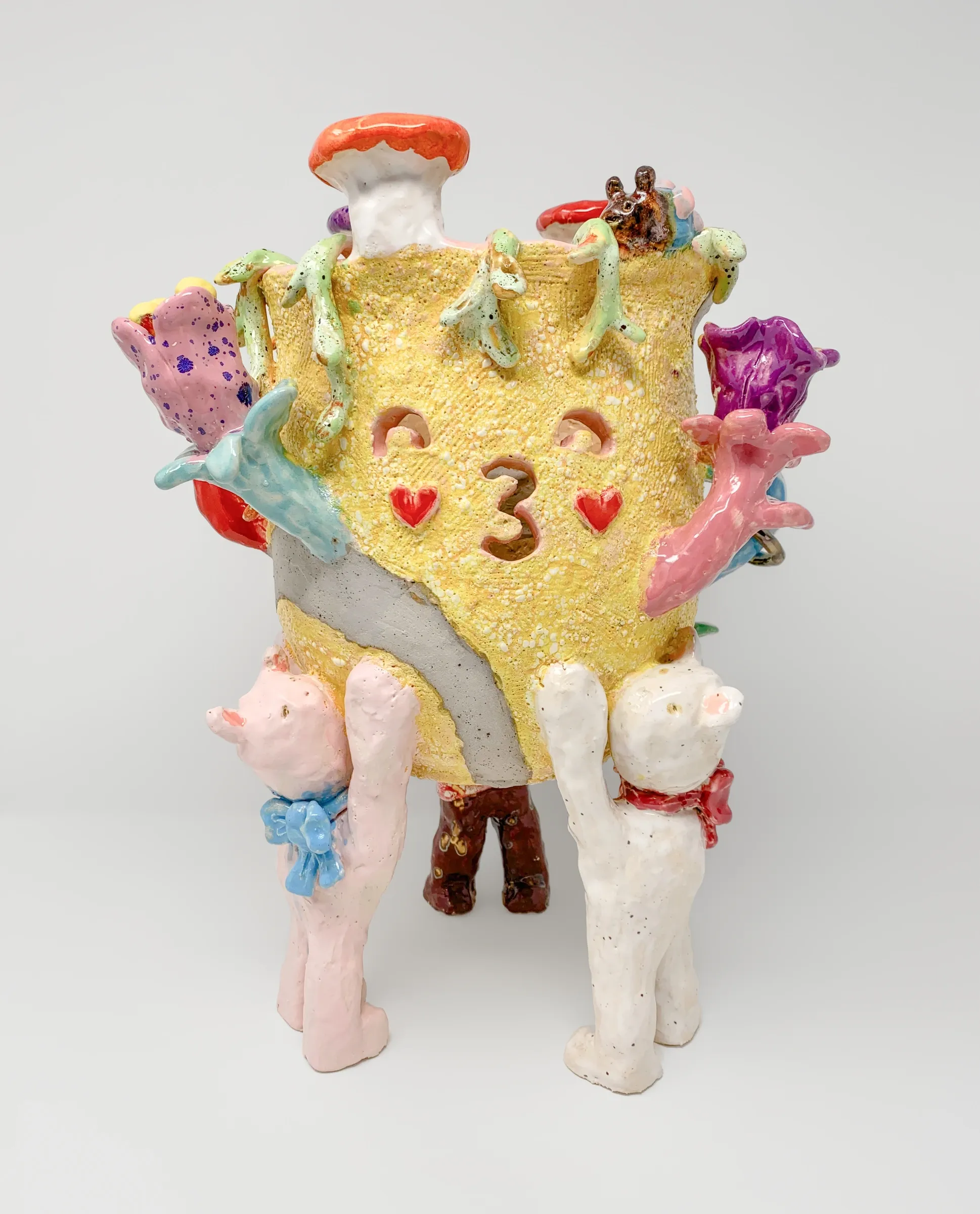
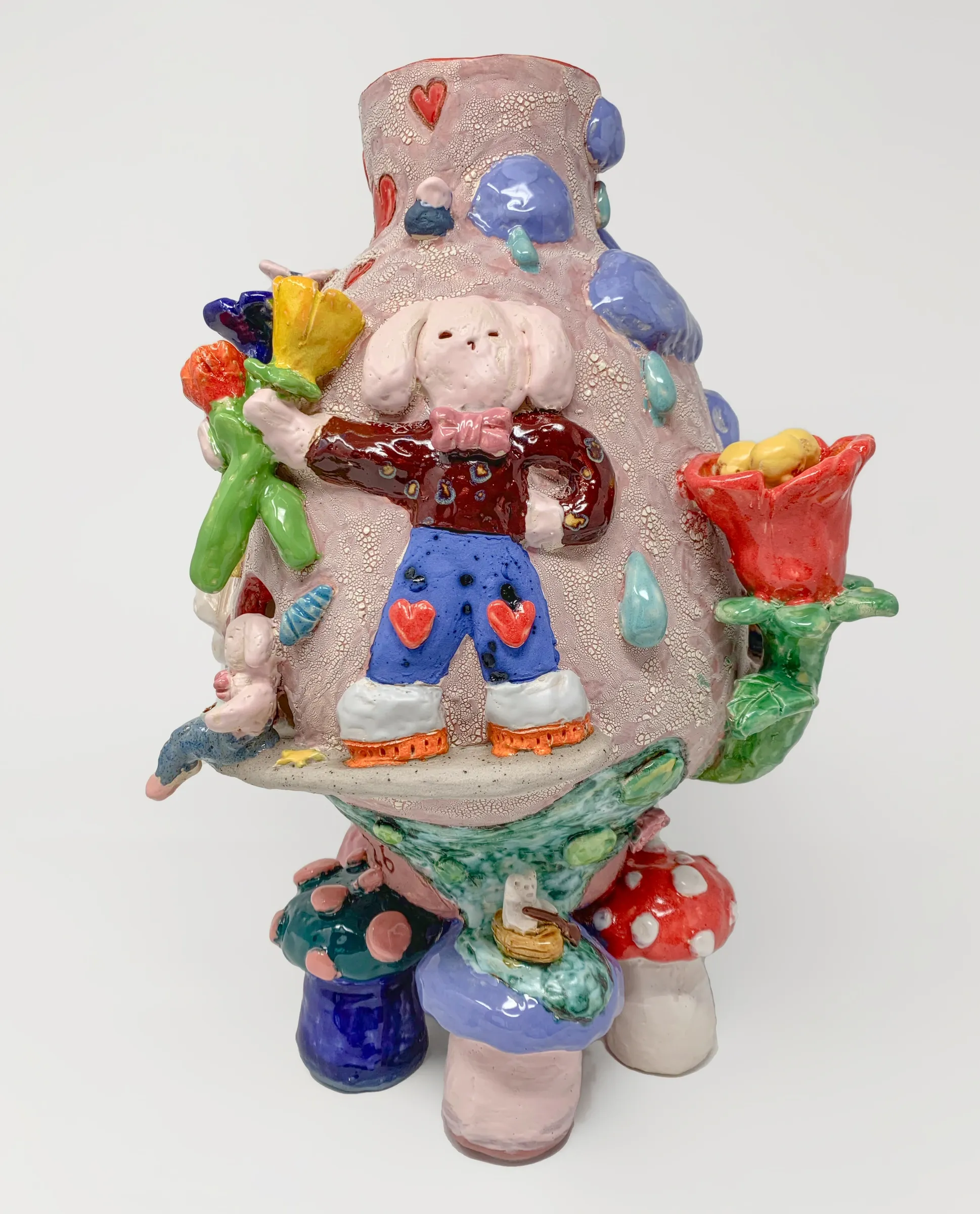
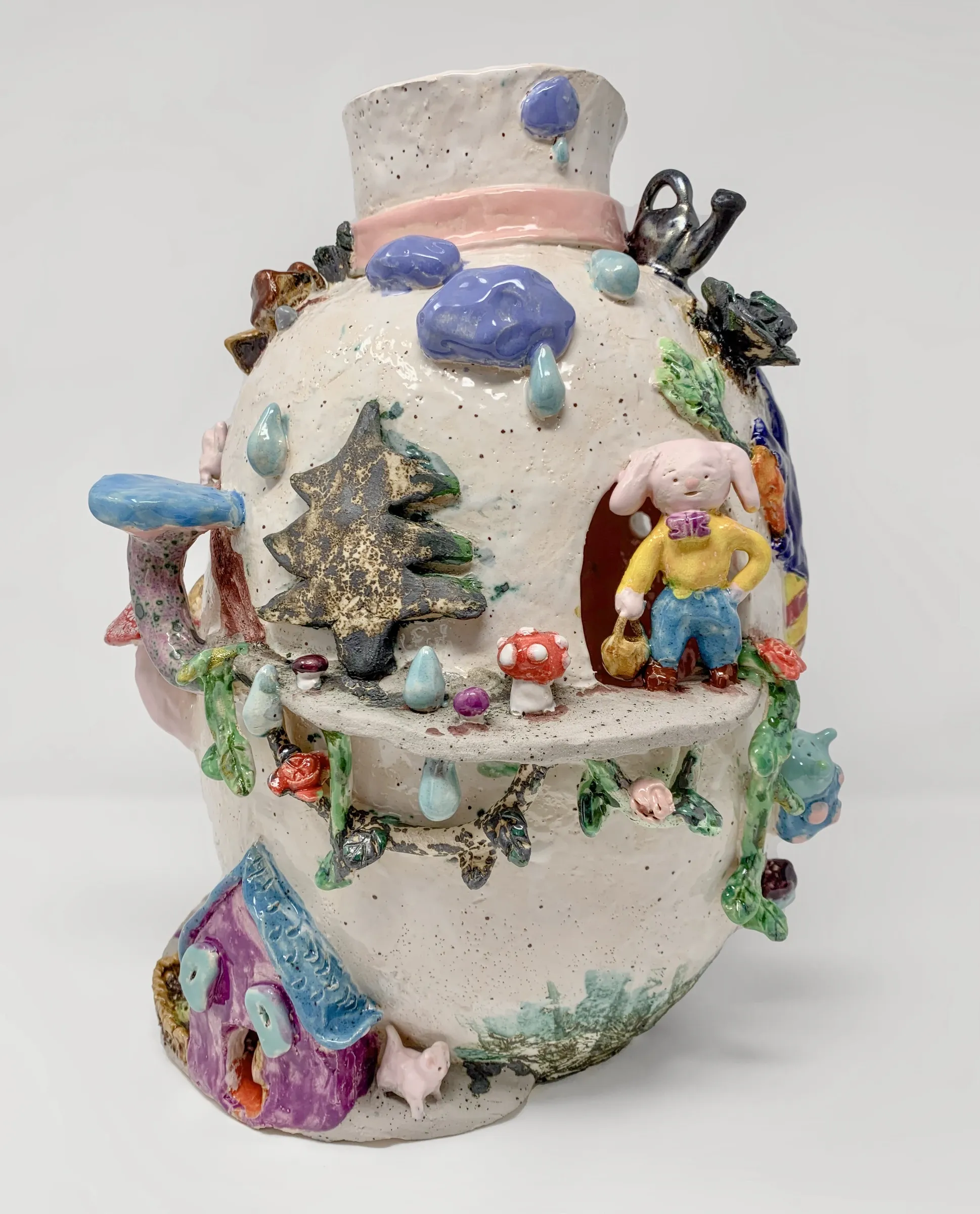
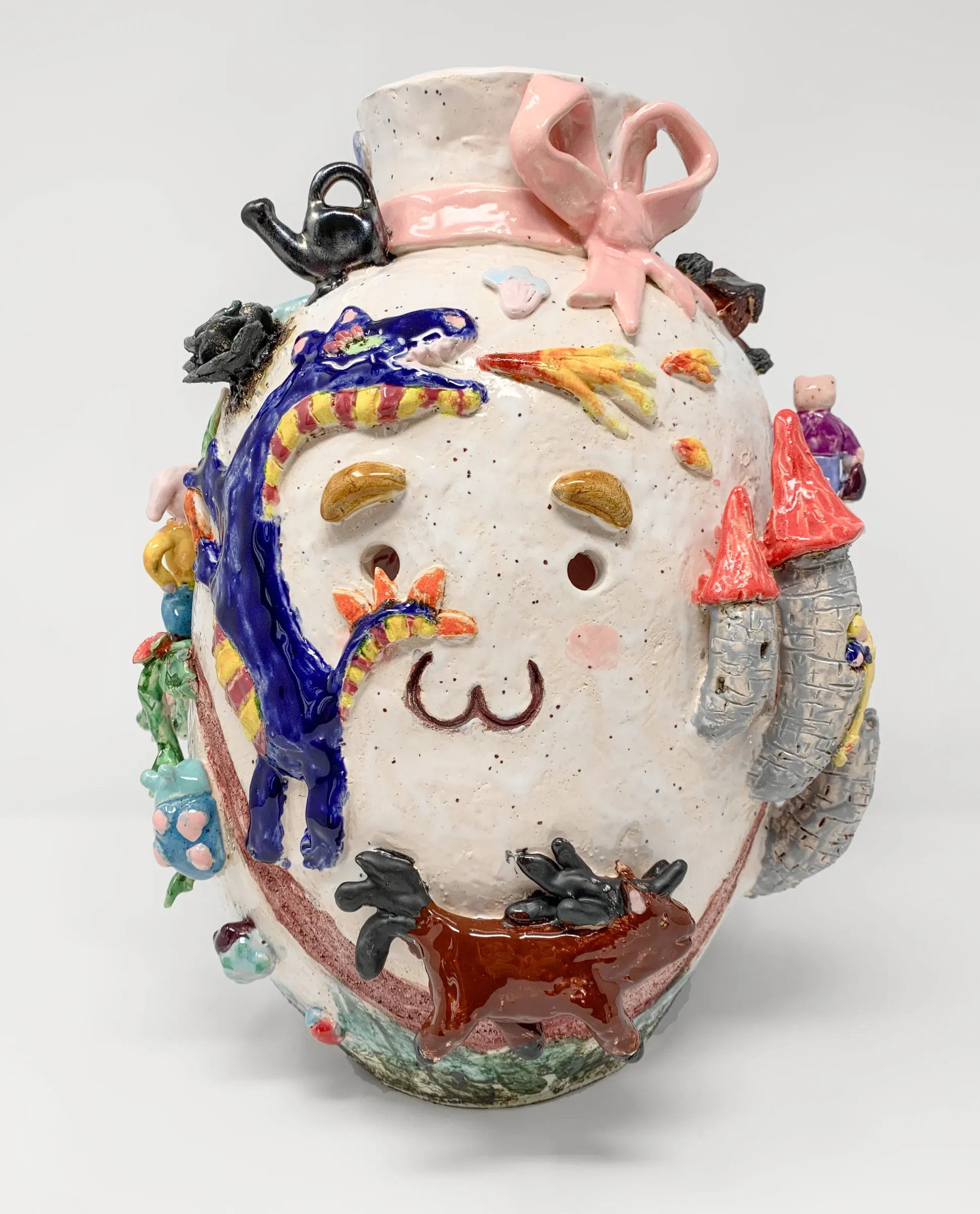
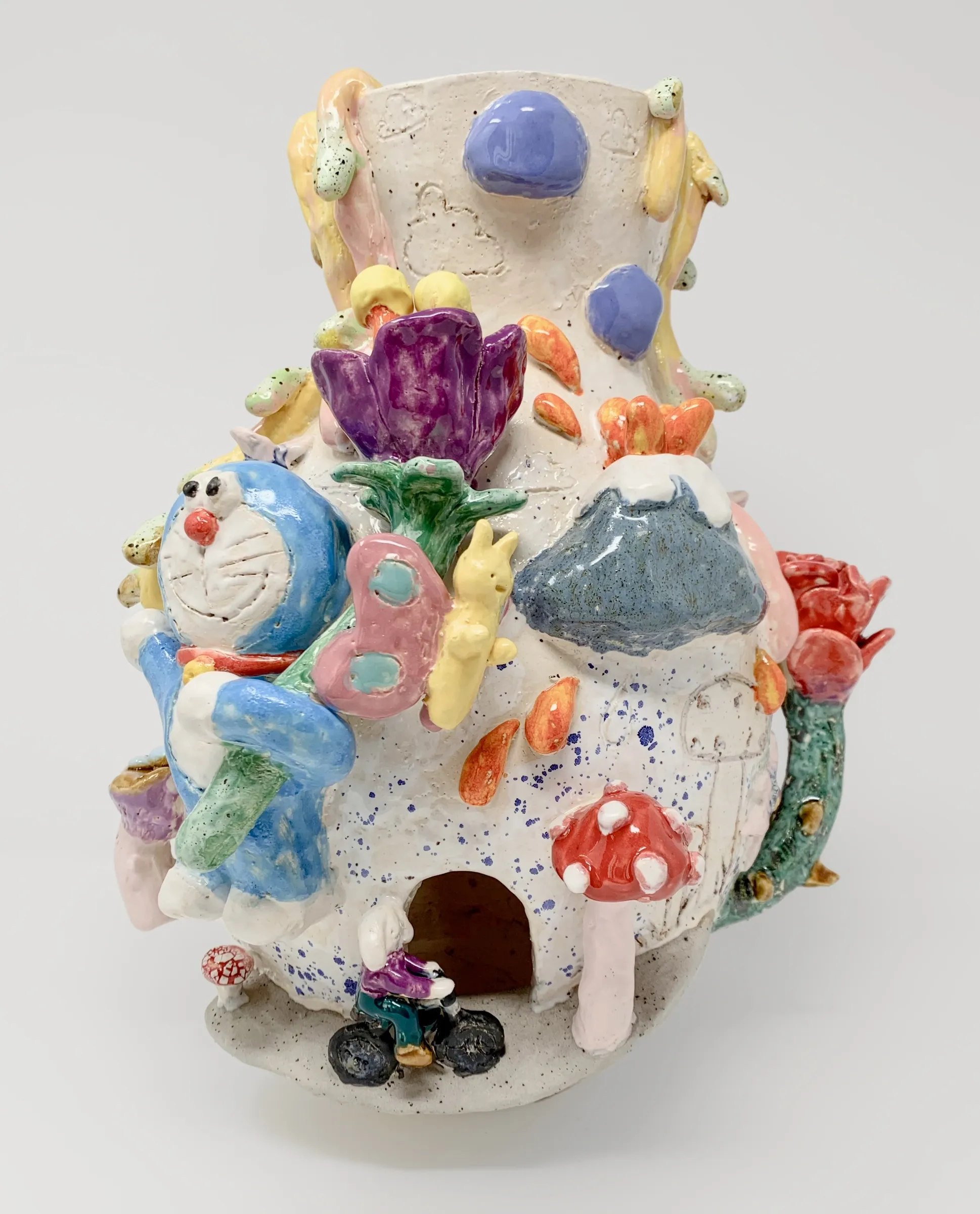
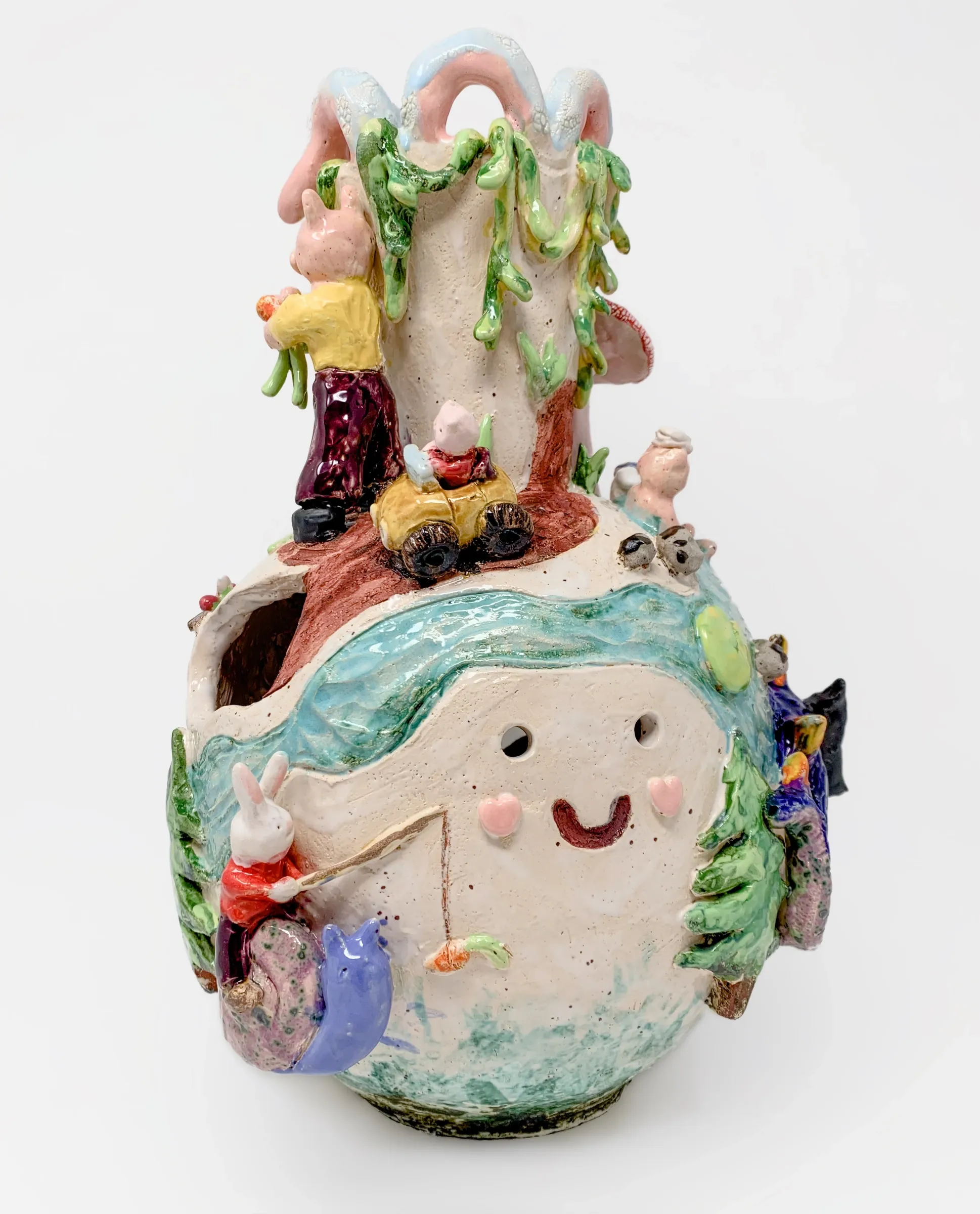
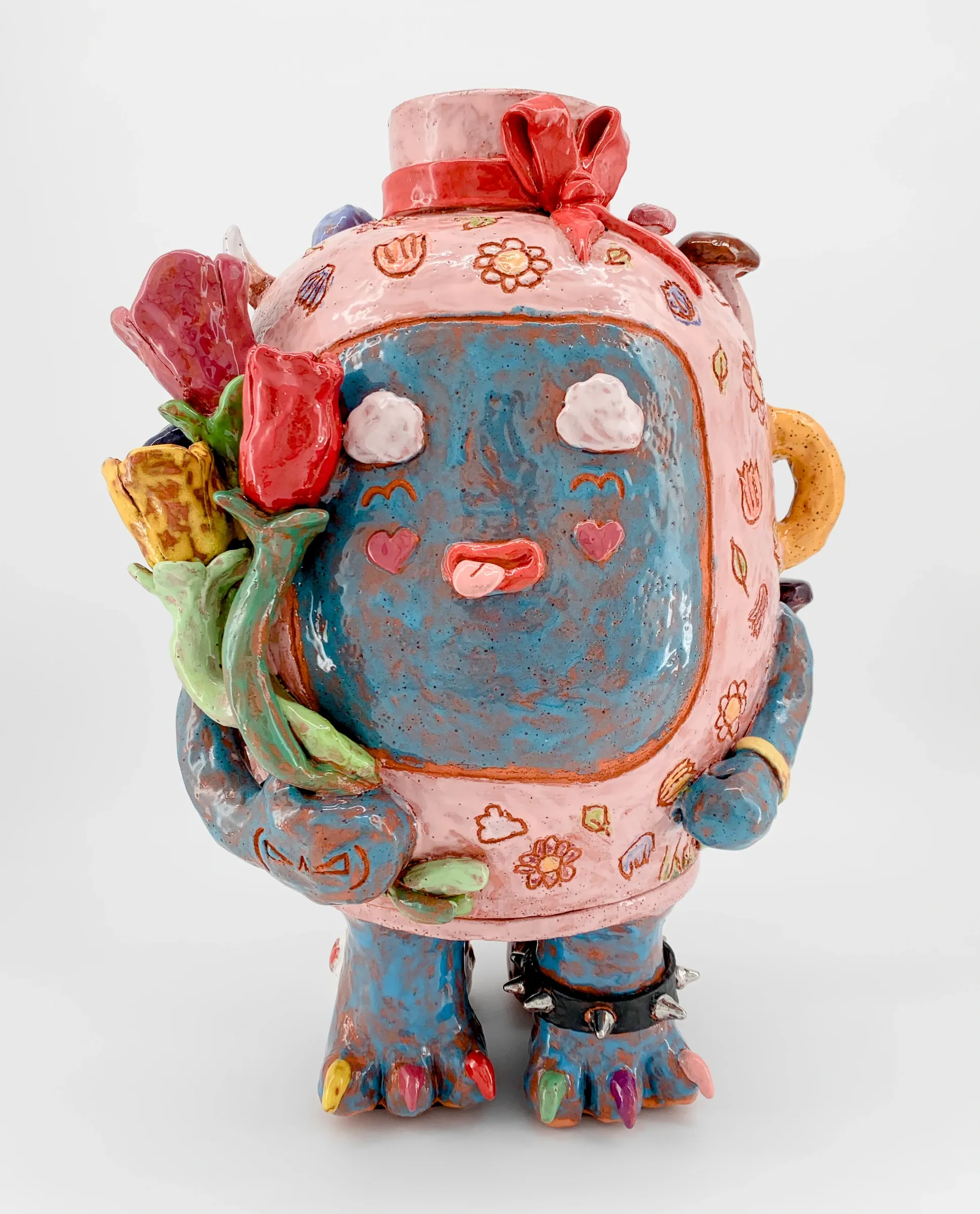
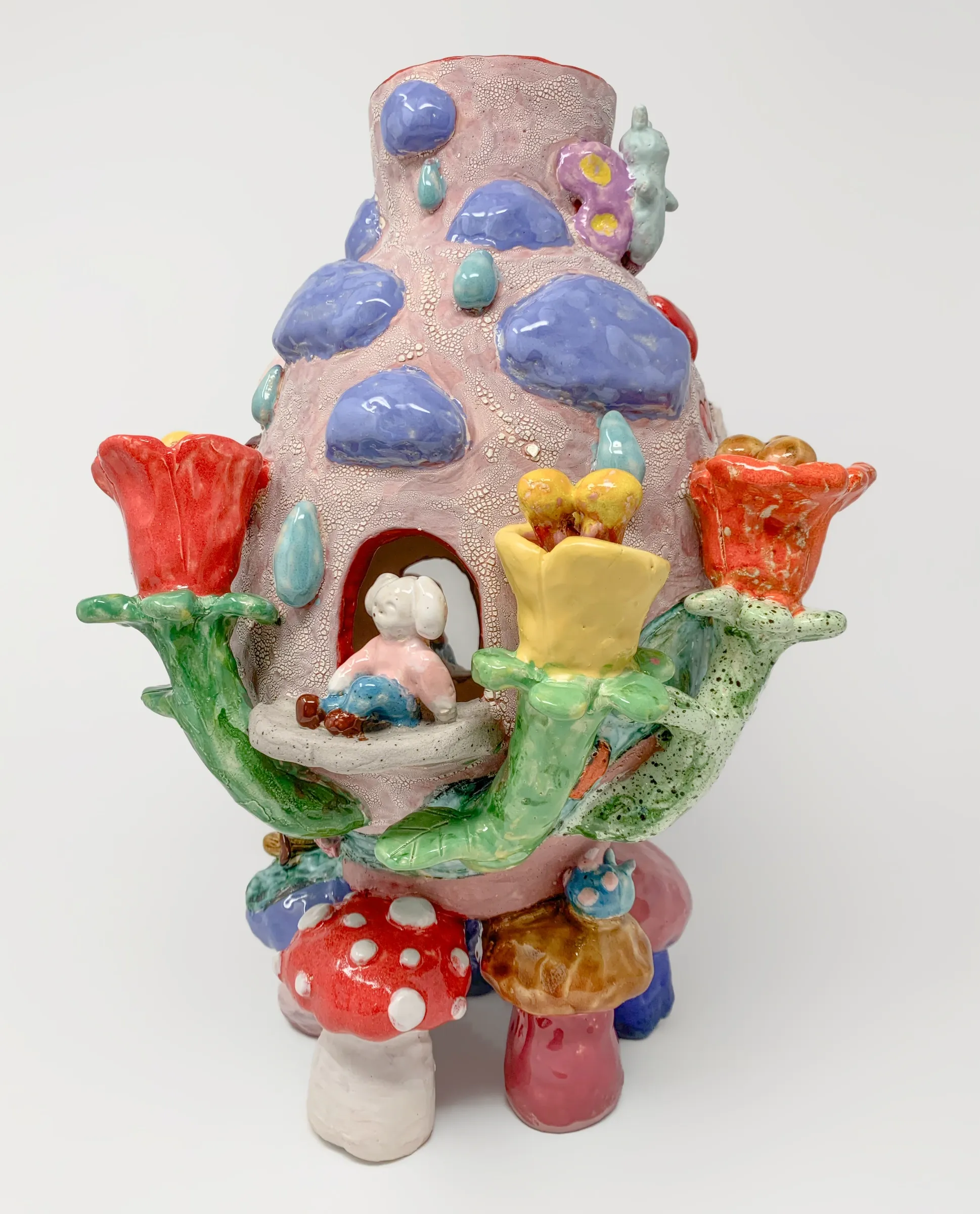
Super Future Kid, (left) Nimbus, 2025, 34cm x 24cm x 22cm, Ceramic, Engobe, Underglaze, Glaze (right) - Trophy, 2025, 35cm x 26cm x 22cm, Ceramic, Engobe, Glaze, Image Courtesy of the Artist
I really don't want to tell you what to ask me, I’m only trying to avoid misconceptions by correcting what I feel is a misrepresentation of my intentions.
- You've described clay as a way to reconnect with the natural world and reclaim a sense of realness as contemporary life becomes more artificial. At the same time, your paintings still operate through fantasy, heightened colour and imagined figures. How do these two impulses exist together inside the work?
Super Future Kid: To me my painted avatars live on a tangible surface. My paintings have an organic quality, the applied paints vary from shiny to velvety and they leave different traces from stains and bleeds to scuffs and blobs, all of which have tactile qualities to me.
But yes regardless of the work being a painting or a ceramic vessel, they do indeed present a fantasy reality. That doesn't mean tho that it isn’t just as real or meaningful as ordinary life. Every person perceives life through their own lens, and as artists we make ours visible to other people.
- You had a solo exhibition titled Dirt Spirits in 2025, the first time you presented ceramics as a full body of work. Now that painting and ceramics run in parallel again, do you see them as two distinct voices, or are they moving toward each other? And what does the vessel, specifically, allow you to say that a painting cannot?
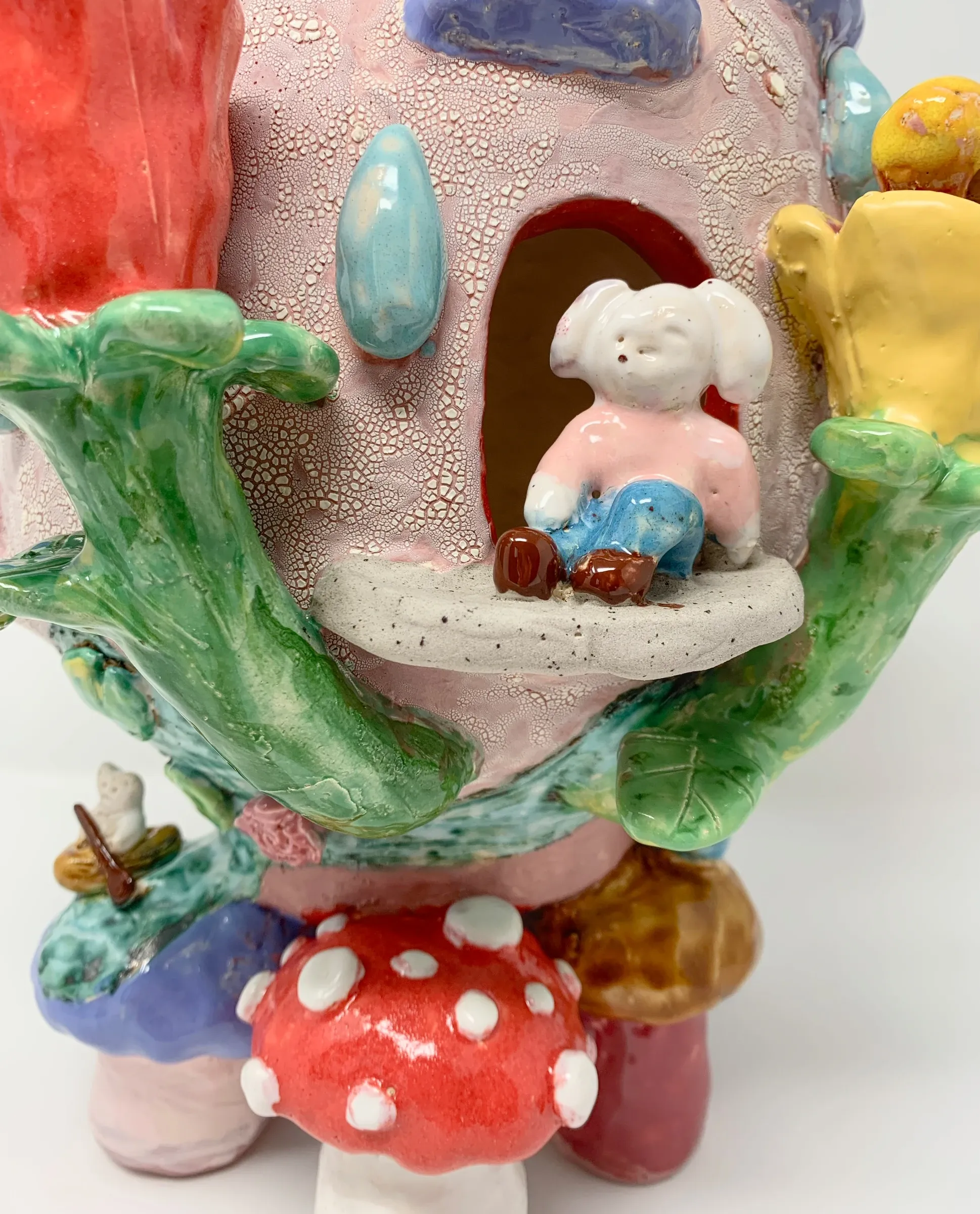
Super Future Kid: Yes this show was my first time presenting a series of ceramic sculptures. These piece were the first in which I truly understood what I am doing with the clay.
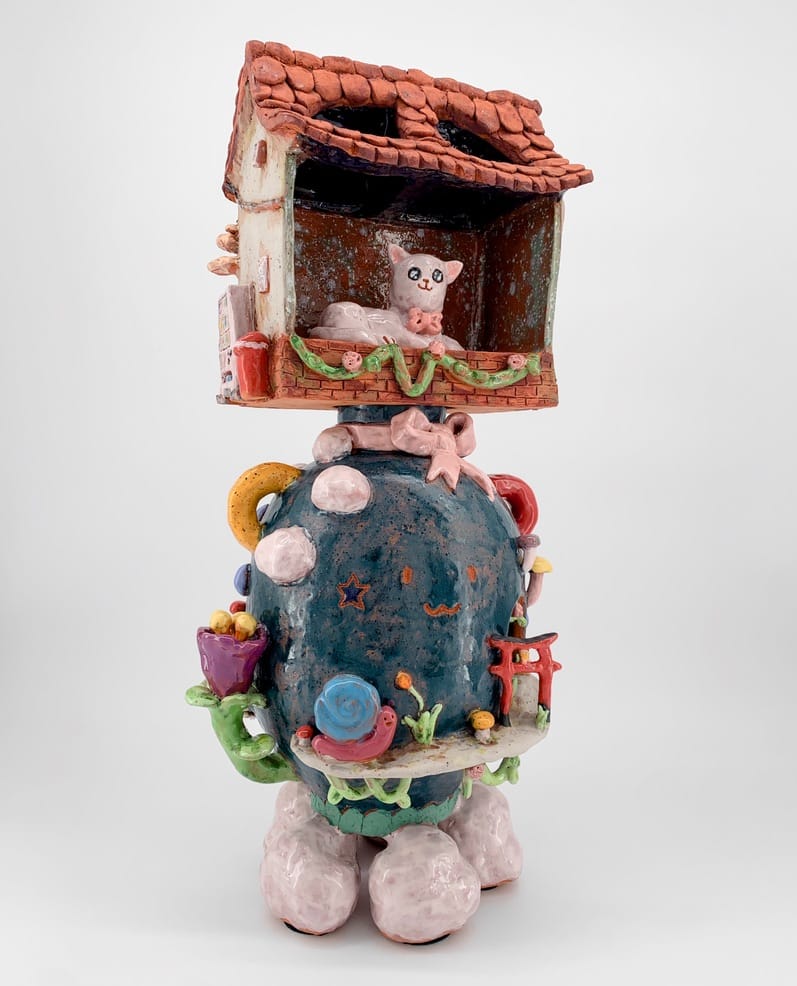
If I think of it now, it is very similar to painting, I’m extracting a character, a soul or a spirit from within the clay and create narratives by surrounding it with many different elements like plants, water, mushrooms, bridges, volcanos, ponies etc etc.
The only difference to me is the 3- dimensionality, so depending on what side of the vessel you are looking at you get to see a different view of story. Clay literally gives an extra dimension to my work.
As for connecting my ceramics with my paintings, they are separate entities but they speak the same (visual) language. They coexist in the way that I see the bodies in my paintings as personifications of the vessels. So the paintings show ‘the person’ and the vessels show the story of the person.
What the practice has arrived at is not a synthesis but a coexistence, two materials running in parallel, each sharpening what the other has to do. The vessels carry the story.
The paintings carry the person. That distinction is simple, and the more you sit with it, the less simple it gets.
Super Future Kid's work has always lived in that kind of productive gap: between the handmade and the digital-looking, the mythic and the mundane, the immediate lump of clay and the slow burn of the kiln.
Catapult previously spent a week in Super Future Kid's New York studio , what has changed since then is not the image-world, but what the image-world now has to justify.
 Dominique Catherina Foertig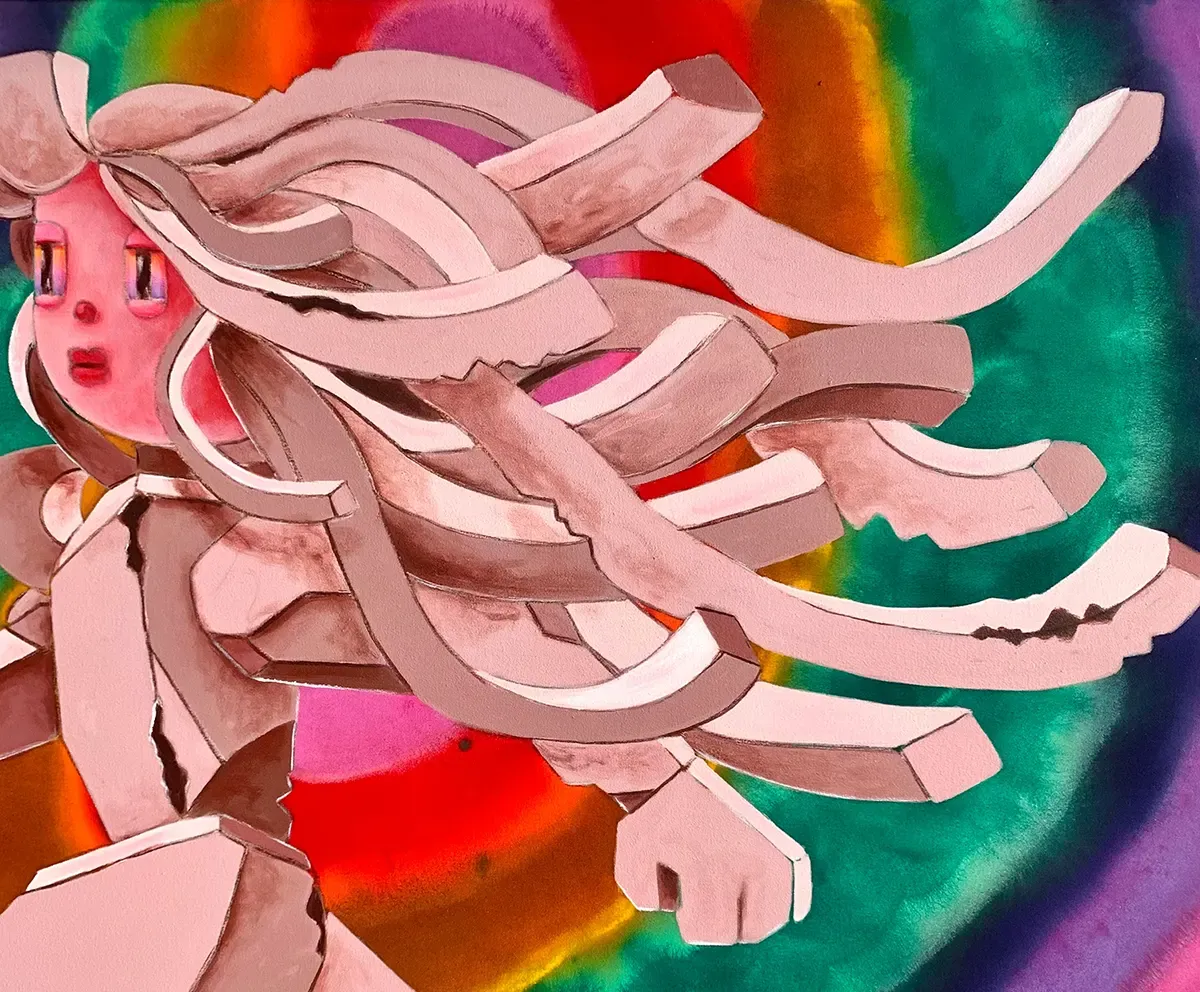
About Catapult-Contemporary
This is an artist interview published by Catapult — an independent editorial platform for contemporary art, based in Vienna. We publish exhibition reviews, artist features, interviews, and critical context, with a focus on emerging and mid-career practices from Europe and beyond.
catapult.art
Want to be featured? Submit your work →