What the Moth Does at Night, the Guest Does at Dusk

Laurynas Skeisgiela’s Liump! Fitness? at Vartai Gallery in Vilnius
Laurynas Skeisgiela at Vartai Gallery presents Liump! Fitness?, curated by Milda Dainovskytė, through May 29, 2026.
Mimicry in biology is an adaptive mechanism, something resembles something else to survive, to feed, to make contact. In Laurynas Skeisgiela's practice, the mechanism shifts, and resemblance is not protection but encounter, a structure that places two different responsive systems inside the same field.
Liump! Fitness?, his multi-room installation at Vartai Gallery in Vilnius, builds that situation across several rooms and several media.
The title is the artist's own coinage, a word that names a sound or signal before it has stable meaning. That is roughly where the exhibition operates, before the distinction between instinct and decision, at the moment when a creature is already moving and has not yet understood why.
Mimicry here is not a disguise. It is an infrastructure for encounter, a field condition in which moths and guests, insects and drinkers, are running identical logic toward one shared light.
Laurynas Skeisgiela
Liump! Fitness?
Vartai Gallery
Vilnius, Lithuania
–
Vilniaus g. 39, Vilnius
Milda Dainovskytė
Laurynas Skeisgiela
Courtesy Vartai Gallery
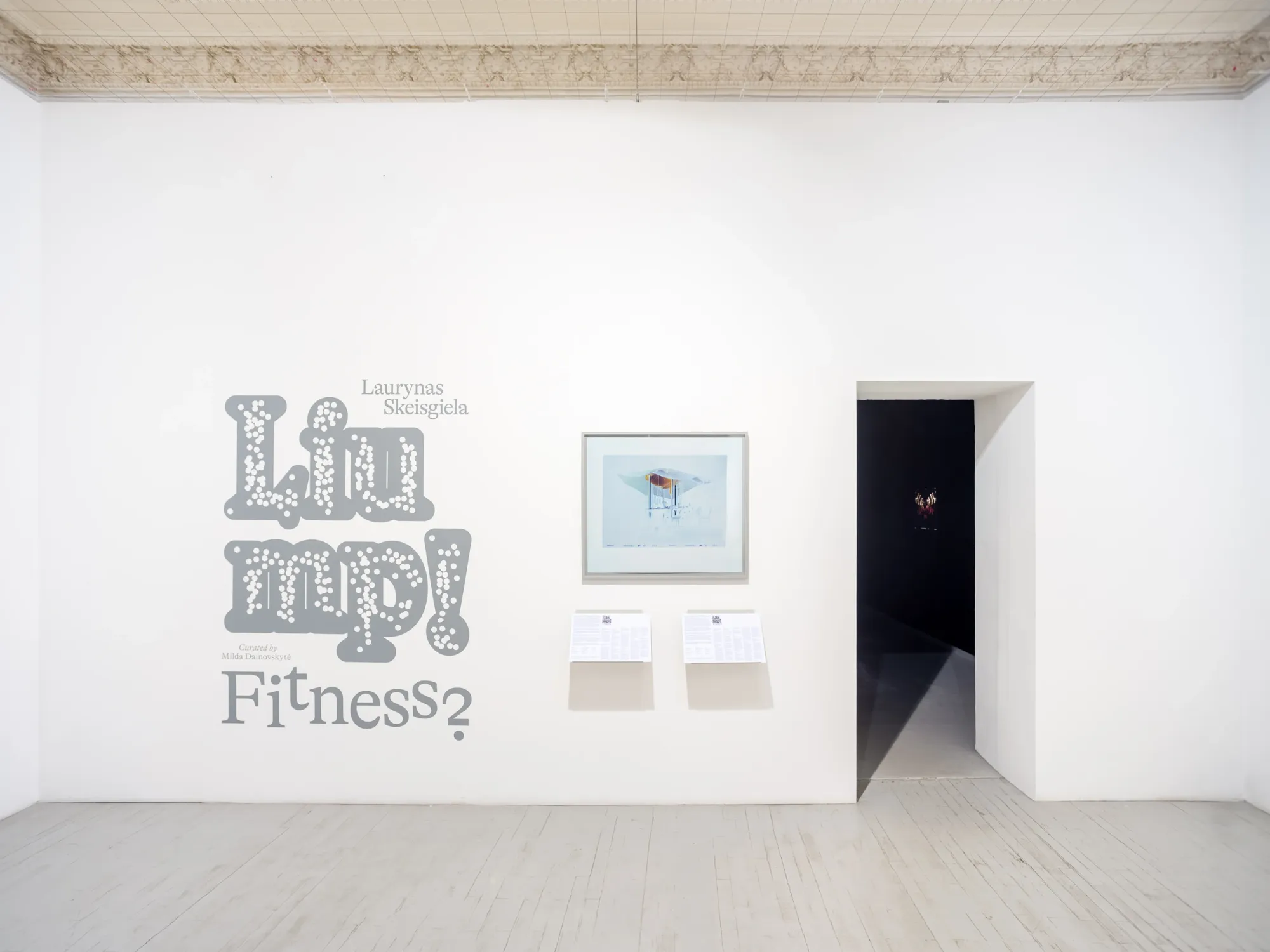
Vartai Gallery occupies a historic building in central Vilnius, its high ceilings and plaster molding carrying the weight of a different era. Skeisgiela uses the full run of its rooms, each calibrated to a different sensory register.
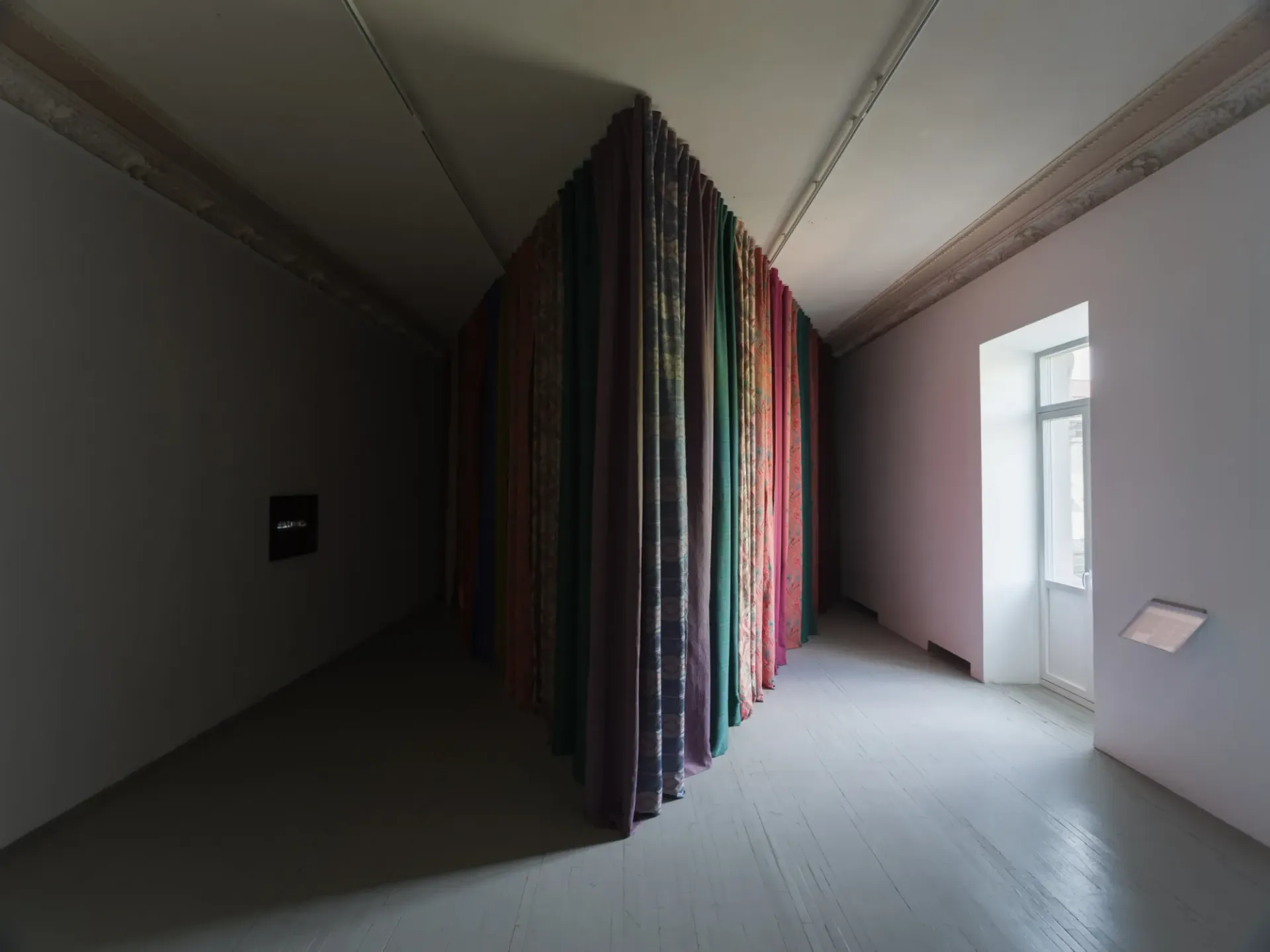
The sequence moves from a white entry hall through a completely blacked-out room, into a long corridor divided by curtains, and finally to a projection space. What shifts between them is not only light level but the logic of attention.
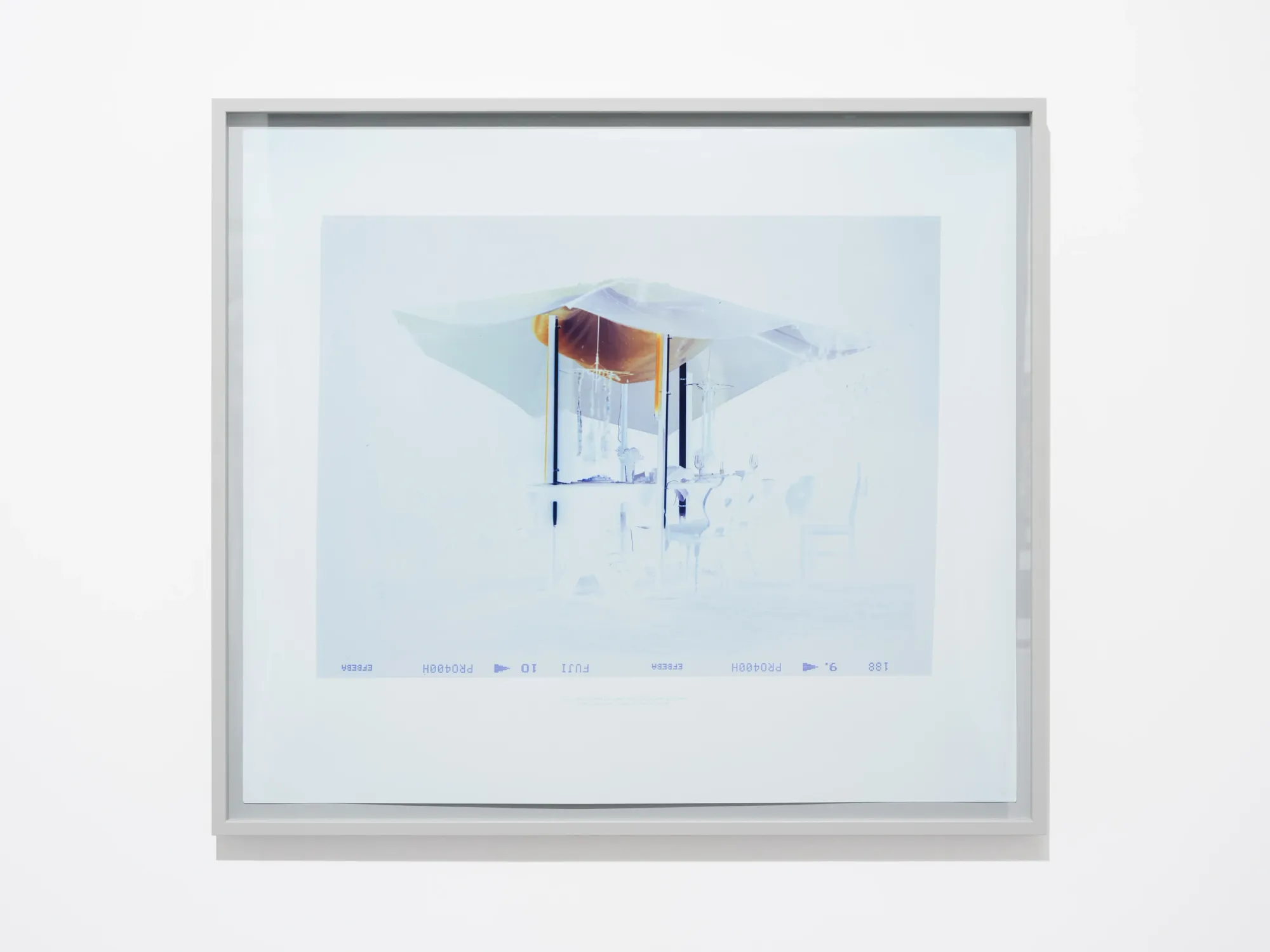
The entry space holds a single framed C-print, a wine-table setting photographed on Fuji PRO400H analogue film, overexposed to near-dissolution. Chairs, glasses, a makeshift canopy structure that might be a garden kiosk or a market stall.
The image is almost gone, bleached to pale blue and cream, the film's edge markings still legible at the bottom margin. Below it, two printed sheets carry the artist's words. He invites you to sit, to drink, to accept whoever else arrives at the table.
The photograph documents the Heuriger setup at the center of Skeisgiela's ongoing Liump! research, a temporary Austrian wine-gathering structure that doubles, after dark, as a moth trap. A UV fluorescent tube draws tiger moths toward the guests`table. The overexposure of the image does something quiet to this. The scene holds together by light the way a moth holds to light, which is to say provisionally, while the conditions last.
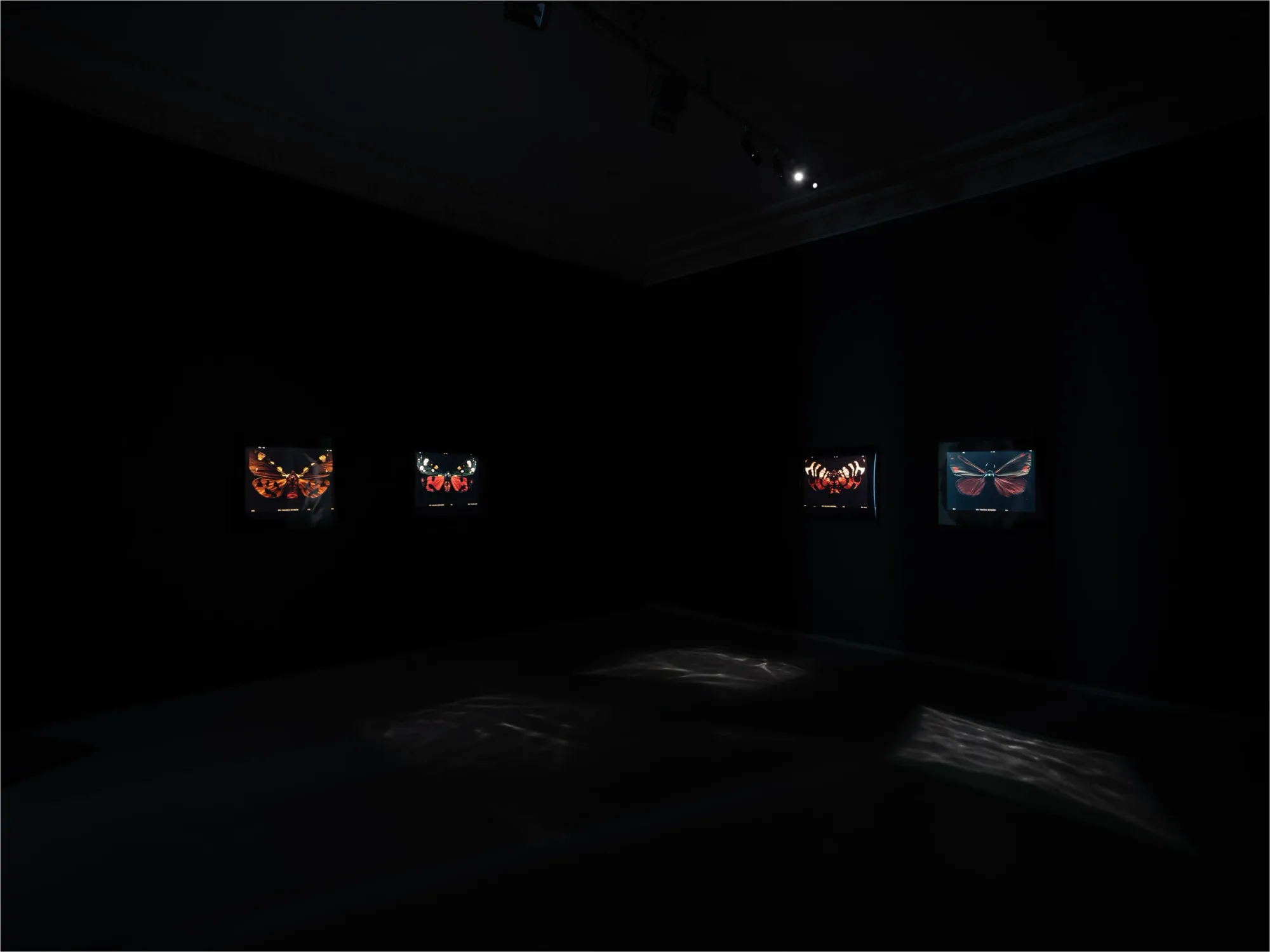
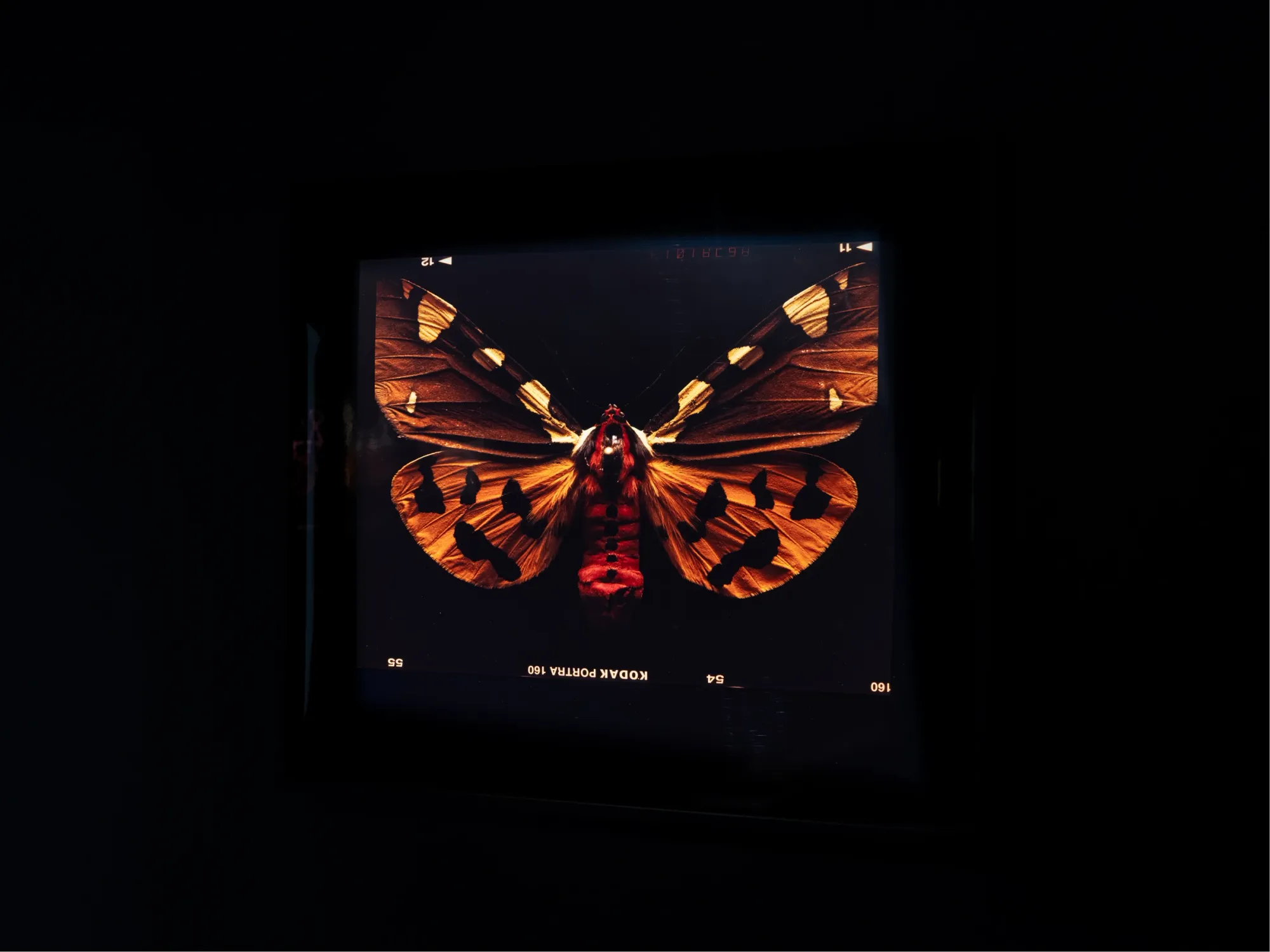
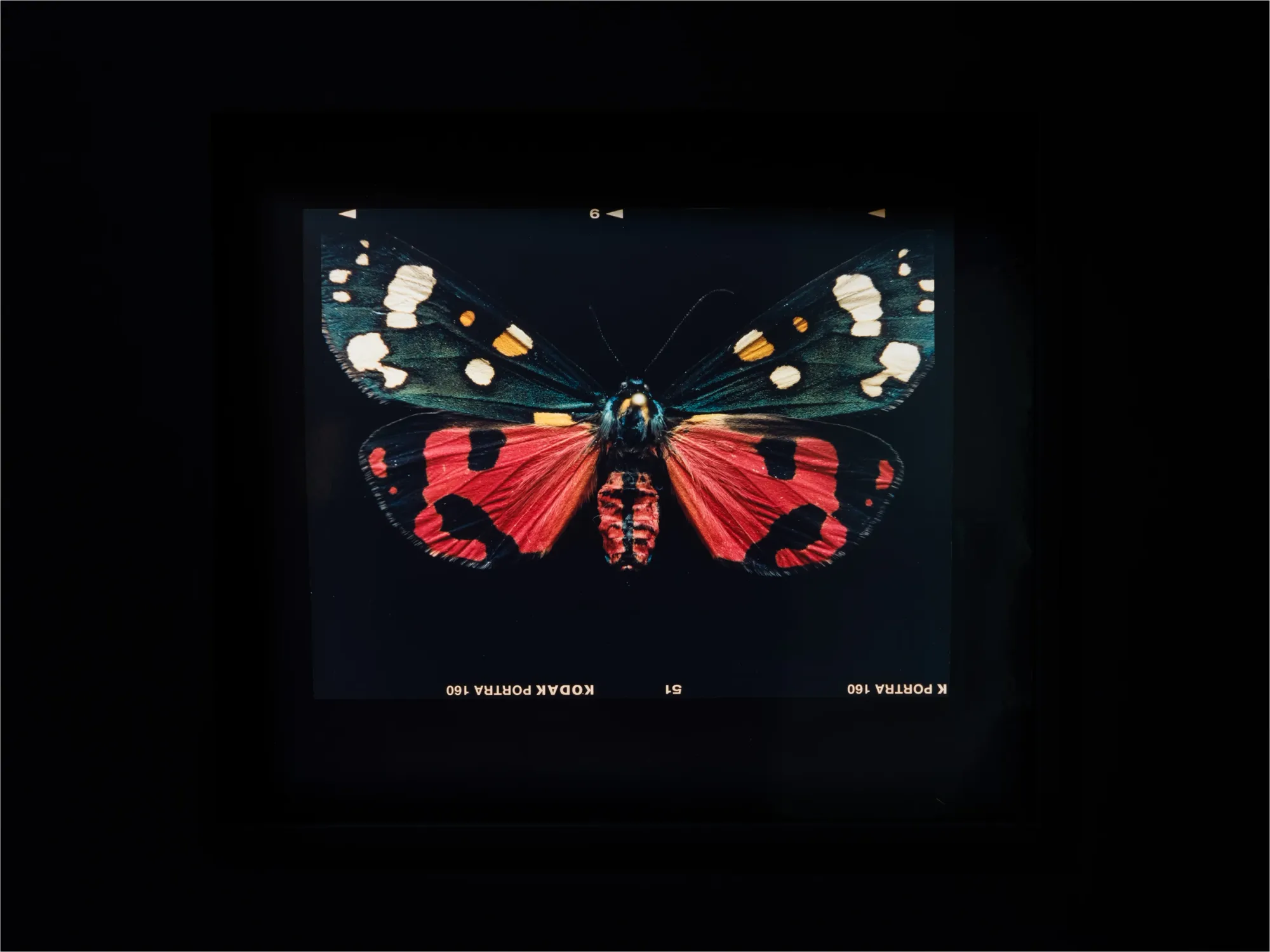
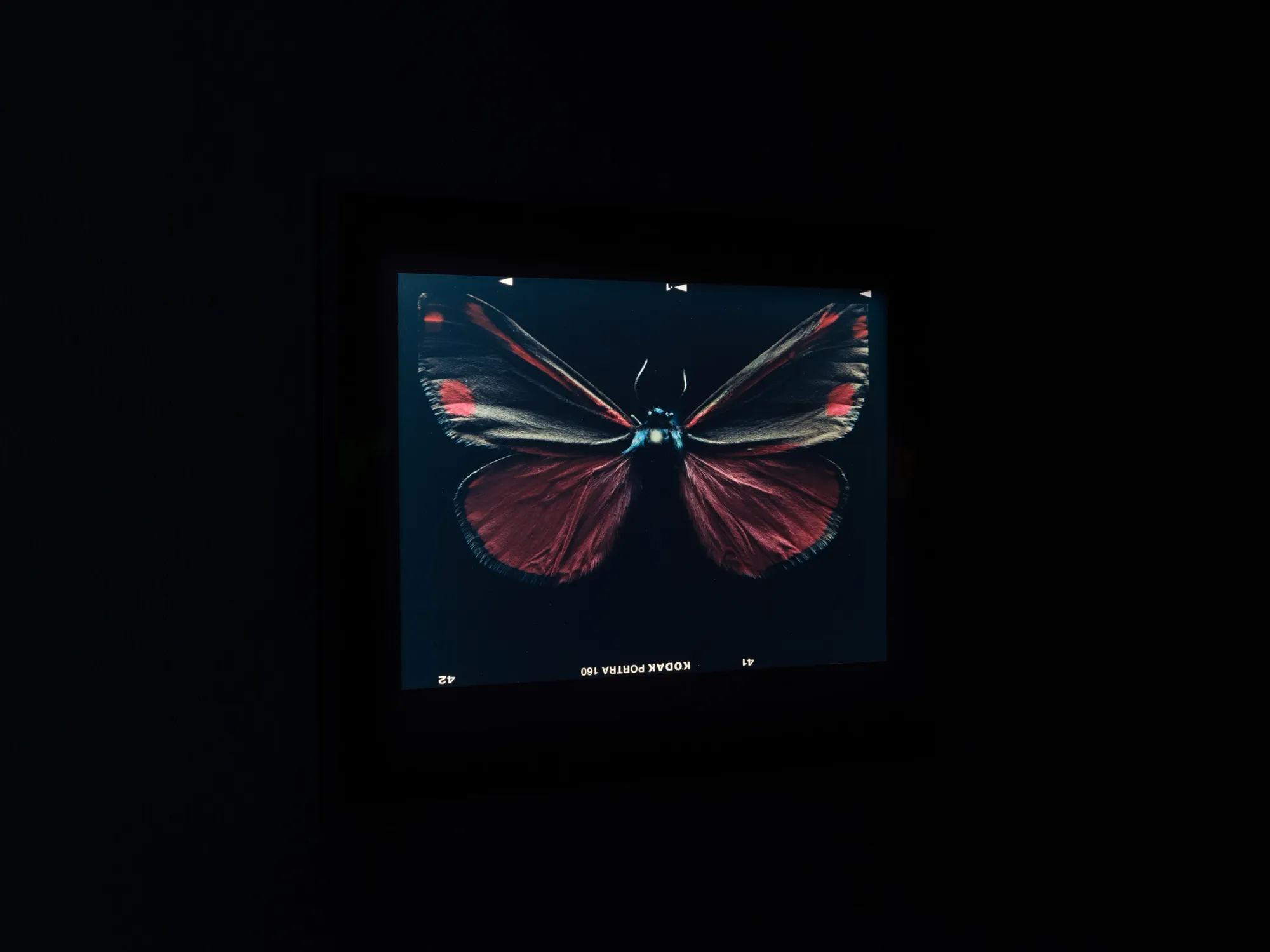
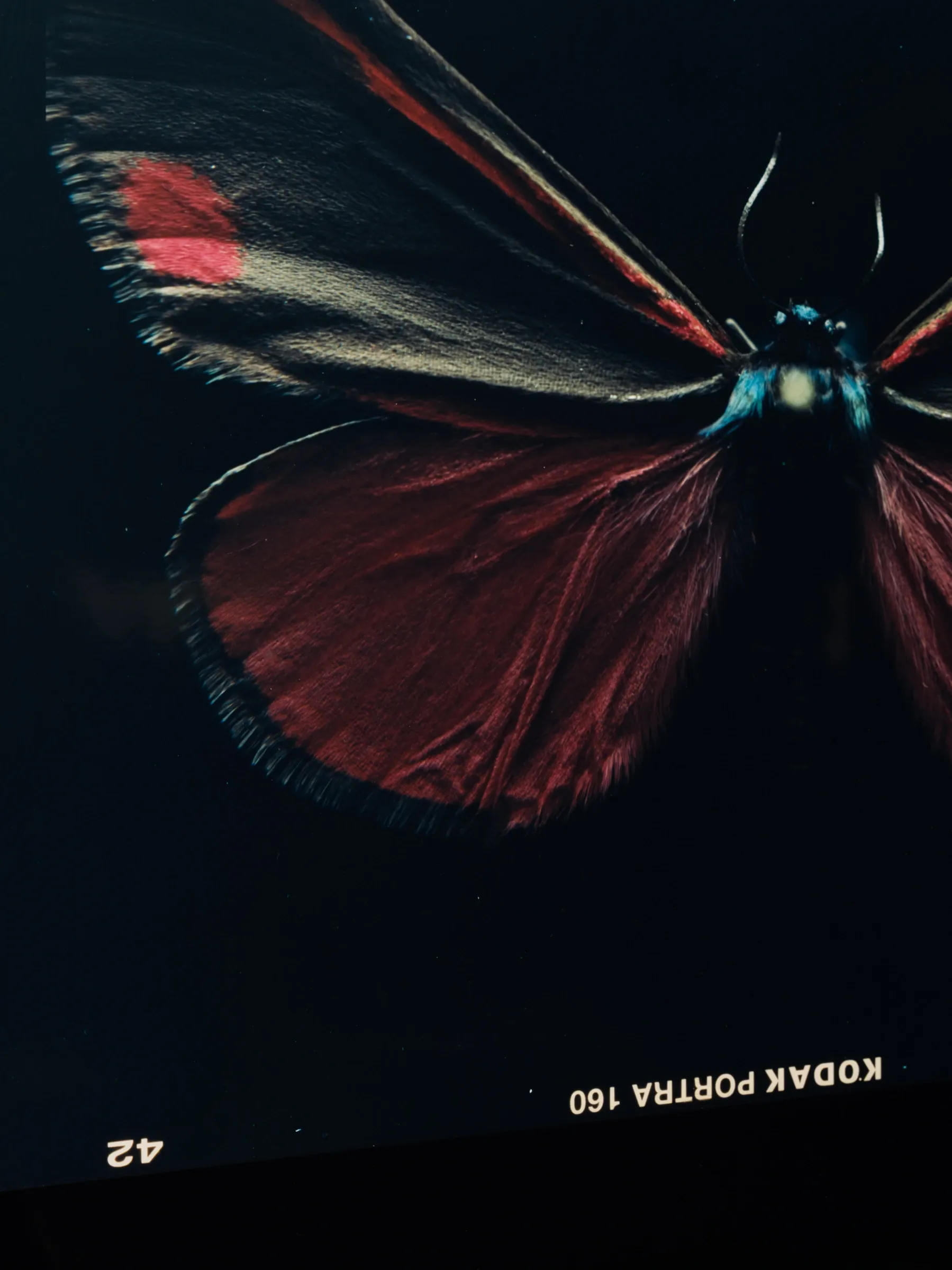
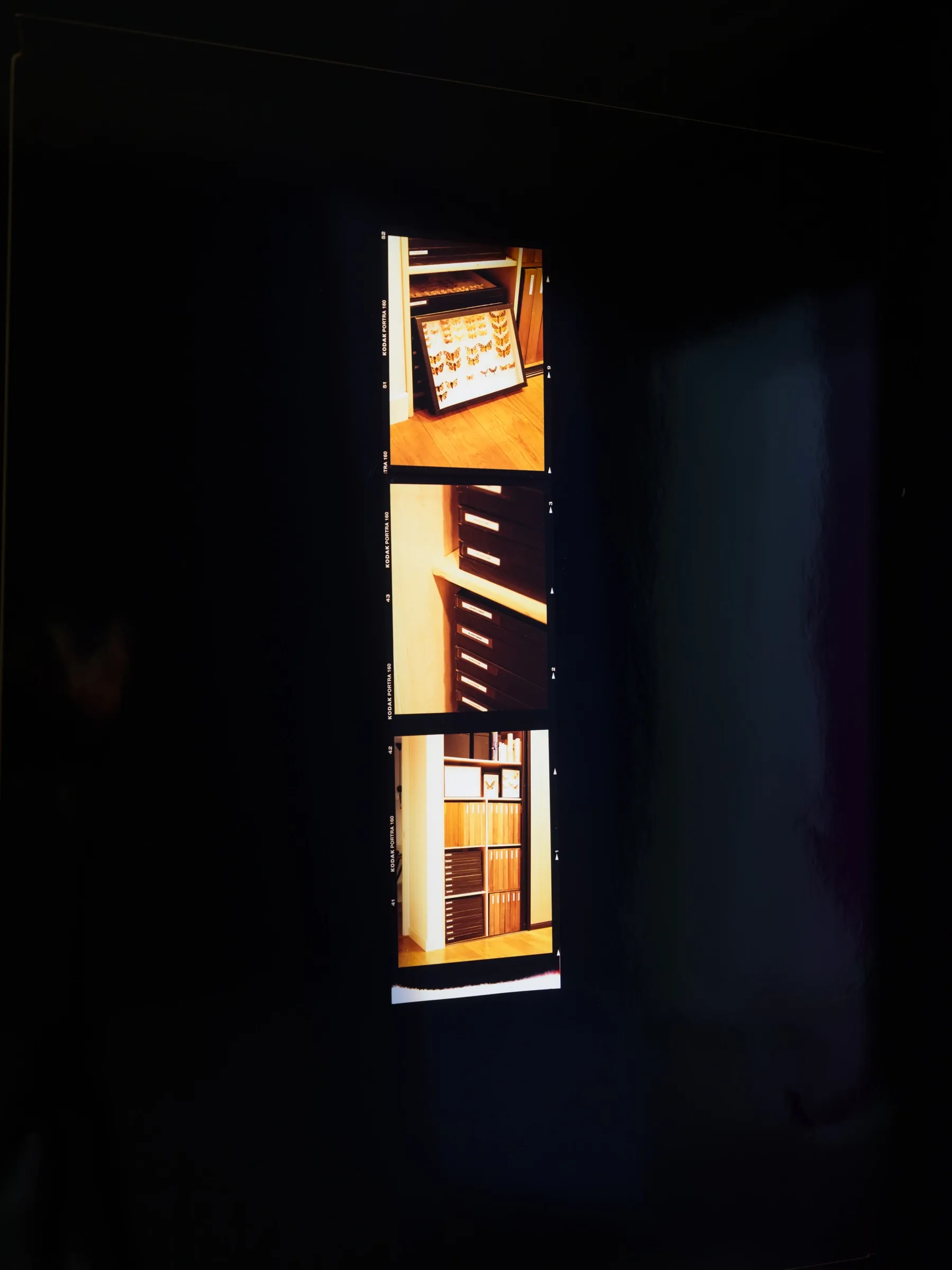
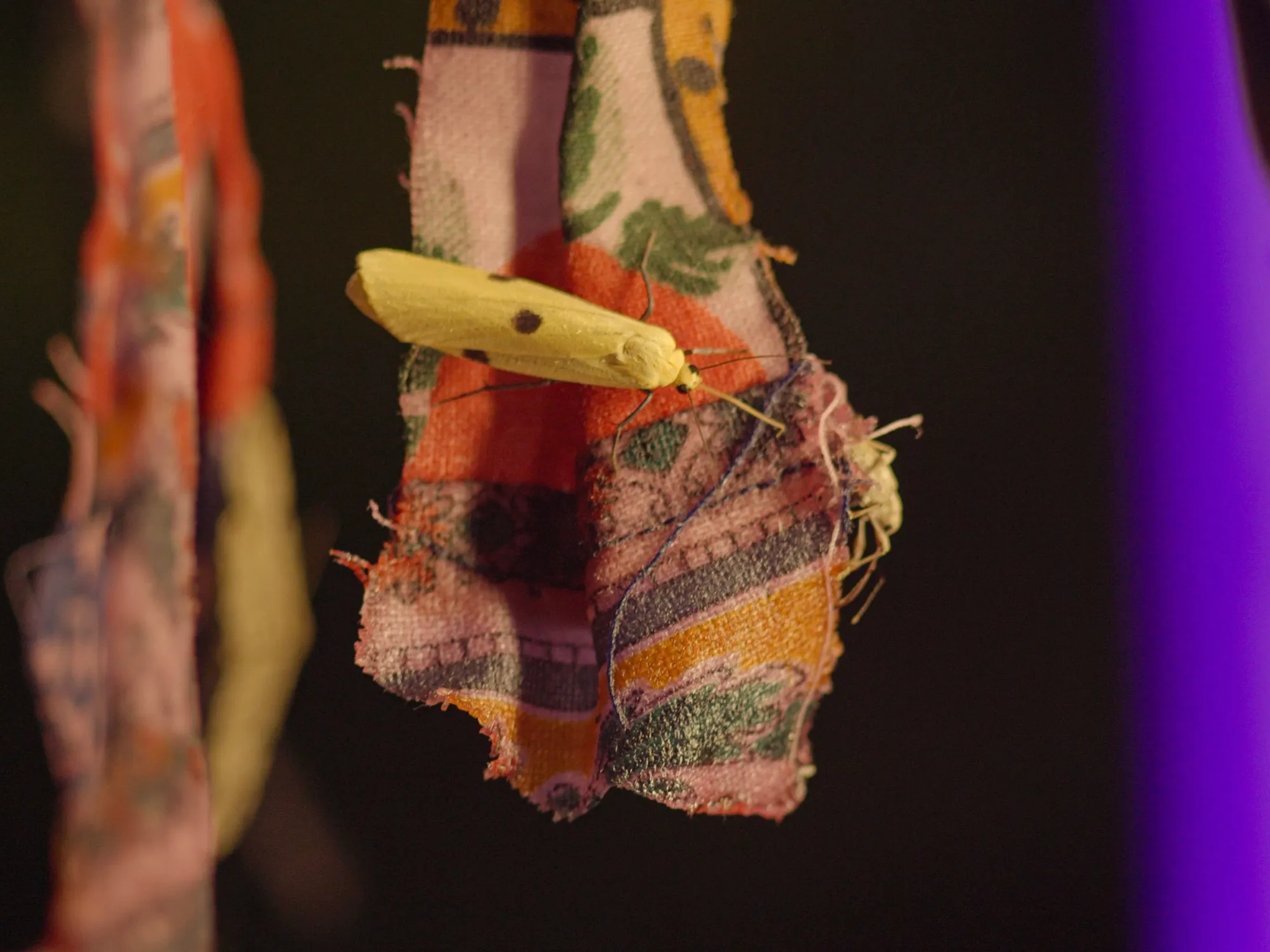
The next space is completely dark. Four backlit analogue prints hang across its walls, each showing a close-up of a tiger moth photographed on Kodak Portra or Fuji film stock, with the frame edges and emulsion markers visible, the specimens pinned and spread against black. Amber forewings with dark chevron markings. Red-and-teal hindwings with white spots.
A translucent grey specimen with dense patterning. In the dark, the prints become the only light sources in the room. From a distance they appear as small glowing rectangles; up close the detail is overwhelming. You are not looking at the moths from across a gallery, you are in the dark with them.
The decision to keep the analogue process visible insists on a parallel, because the photograph was also drawn toward light. The camera, the film, the lamp. Each image is a specimen and simultaneously a record of the photographer's approach, of having come close enough to see.
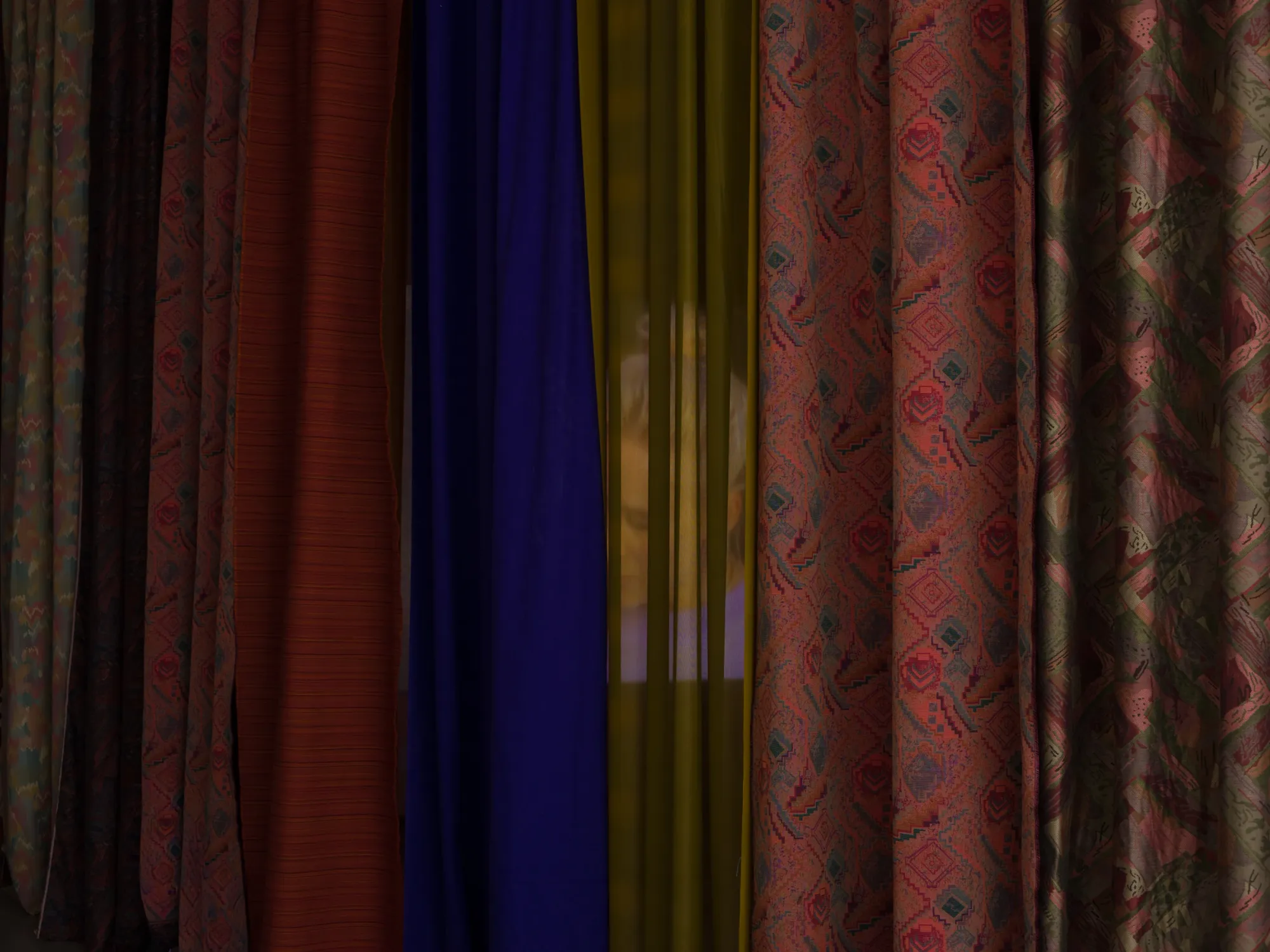
A long corridor follows. One wall is covered entirely by floor-to-ceiling curtains in different fabrics hung edge to edge, lavender, teal, deep red, floral burgundy, olive, navy. They do not form a clean barrier.
They form a texture, a surface more interested in accumulated density than in division. On the opposite white wall, a small framed monitor plays footage too small to read without walking toward it.
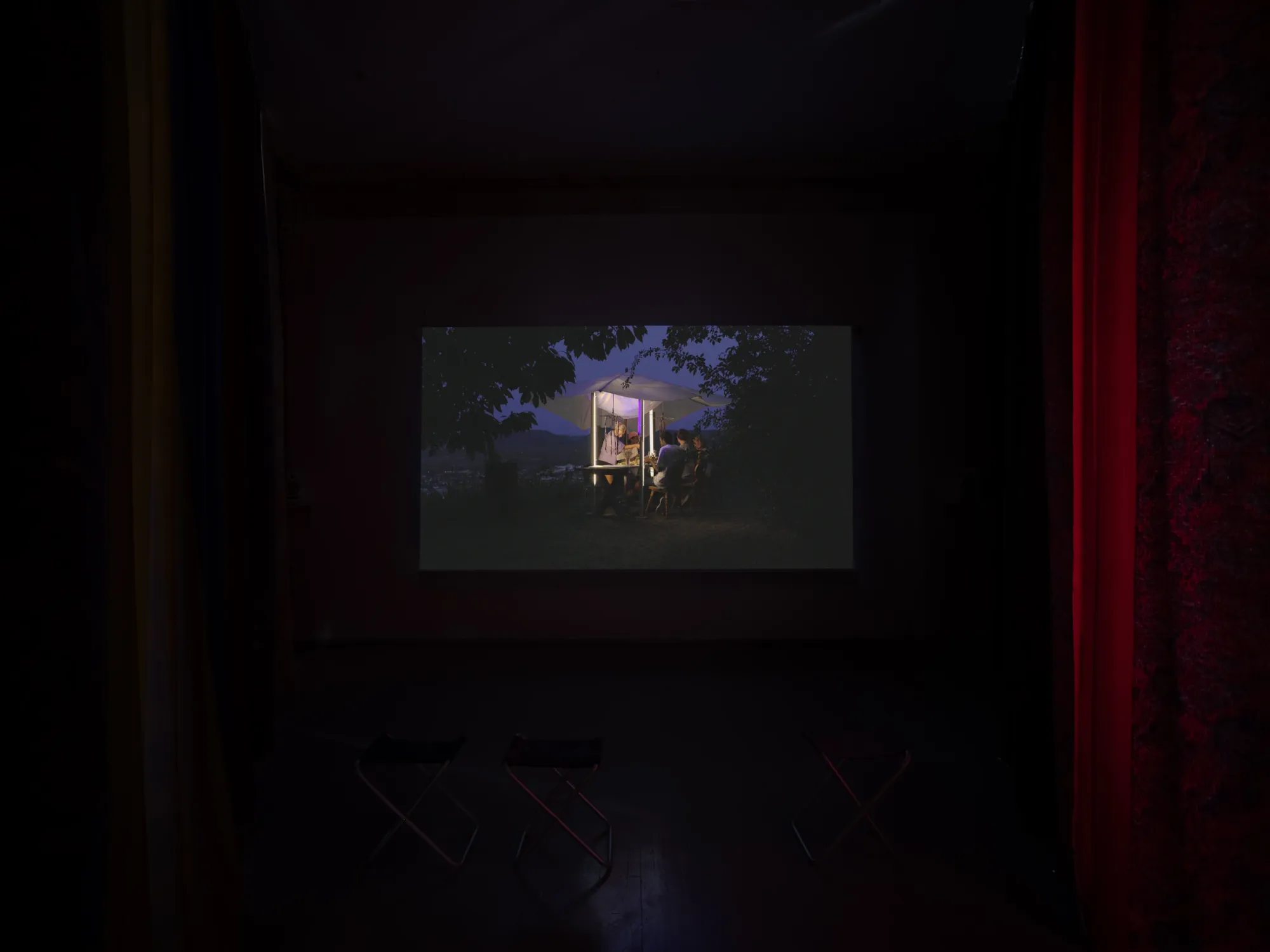
The Austrian Heuriger that Skeisgiela borrows was always a temporary institution, a household or farm opening seasonally for communal drinking, strangers at the same table, no reservation required. The video work places this tradition in a nocturnal landscape, with figures gathered under a canopy at dusk, a UV tube running alongside them, drawing whatever comes from the surrounding dark. Both the historical wine ritual and the biological trap are producing a shared condition, a signal, a warmth, a reason to approach.
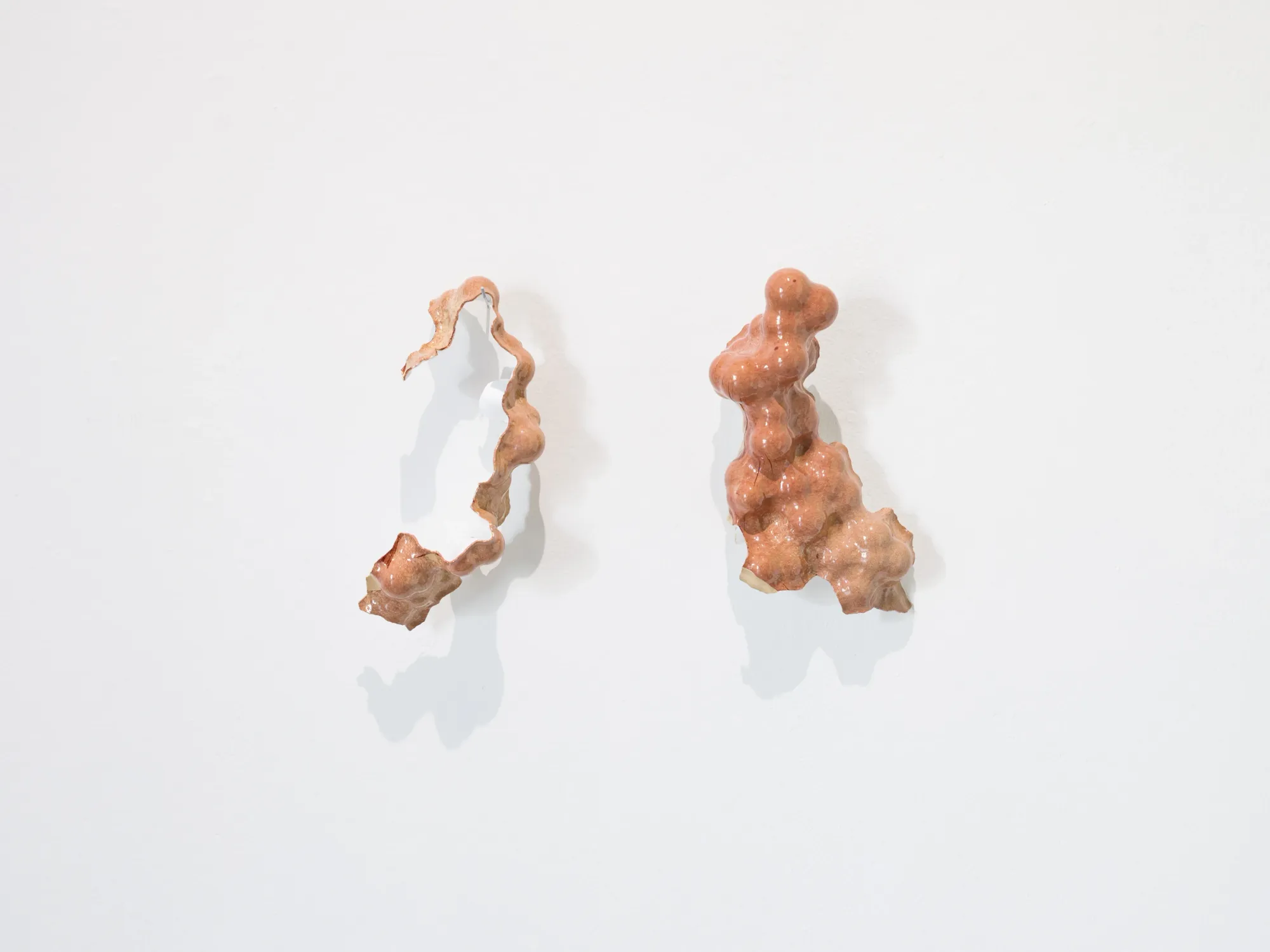
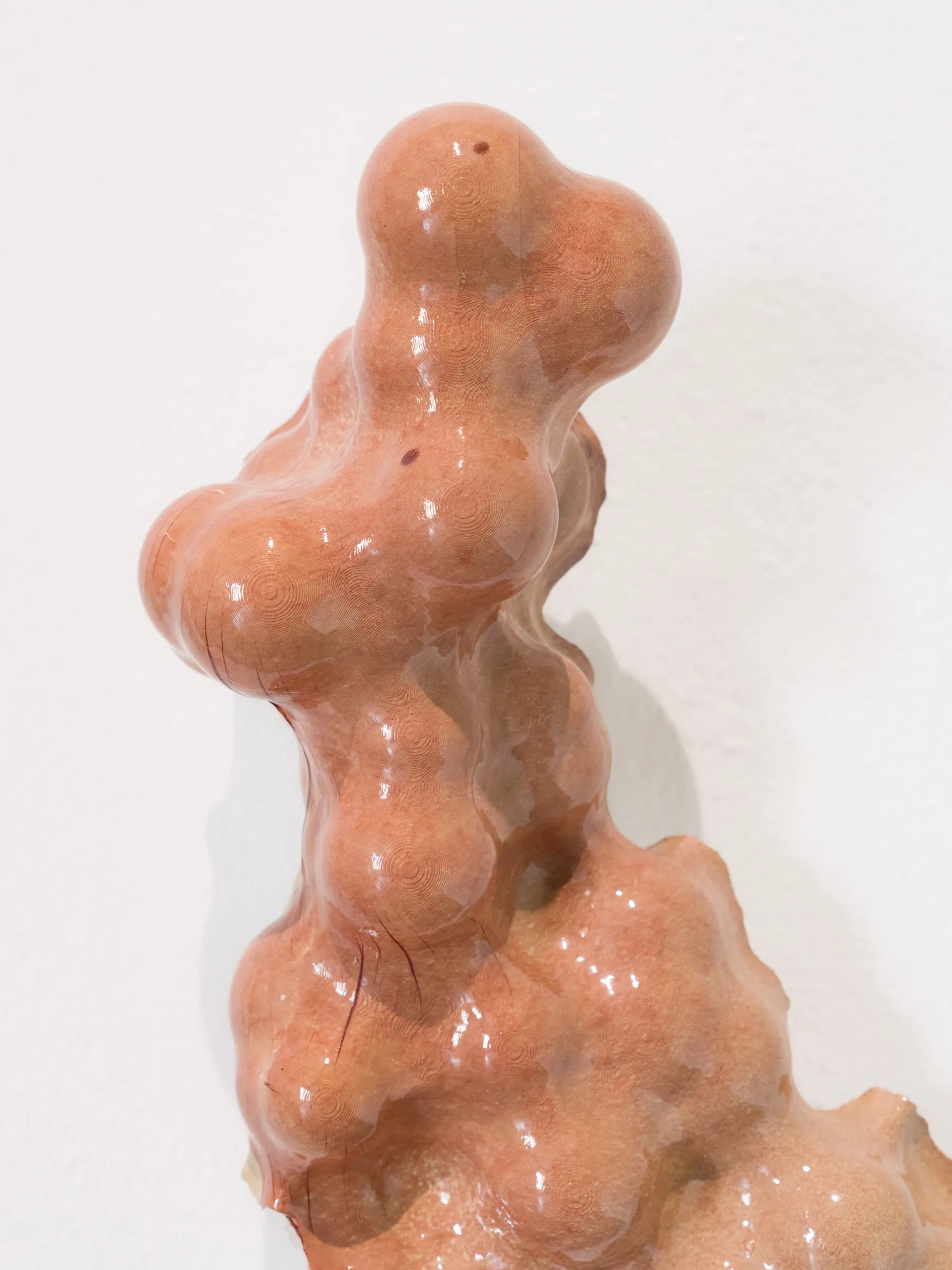
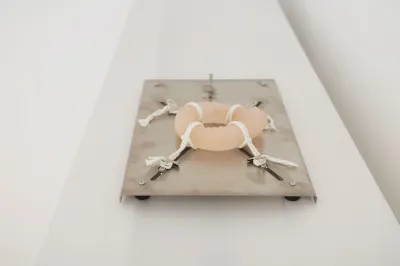
Two ceramic pieces hang in a smaller room, biomorphic wall objects in terracotta-pink glaze. Their surfaces carry the impression of pressure. They look like something that was formed by contact rather than by deliberate modeling. They are neither insect nor body, but they hold something of both.
Whether the visitor at the Heuriger is guest or subject the exhibition does not settle. What persists after the rooms is less an argument than a condition, a sense that the signal has already counted on your arrival, and that something in you had already decided before you knew.
Instagram of Laurynas Skeisgiela
Vartai Gallery on Instagram
About Catapult Contemporary - Art Platform Submission
This is a exhibition review published by Catapult — an independent editorial platform for contemporary art, based in Vienna. We publish exhibition reviews, artist features, interviews, and critical context, with a focus on emerging and mid-career practices from Europe and beyond.
catapult.art
Want to be featured? Submit your work →