Przemek Branas Sews a Treeline Out of Eucalyptus Leaves

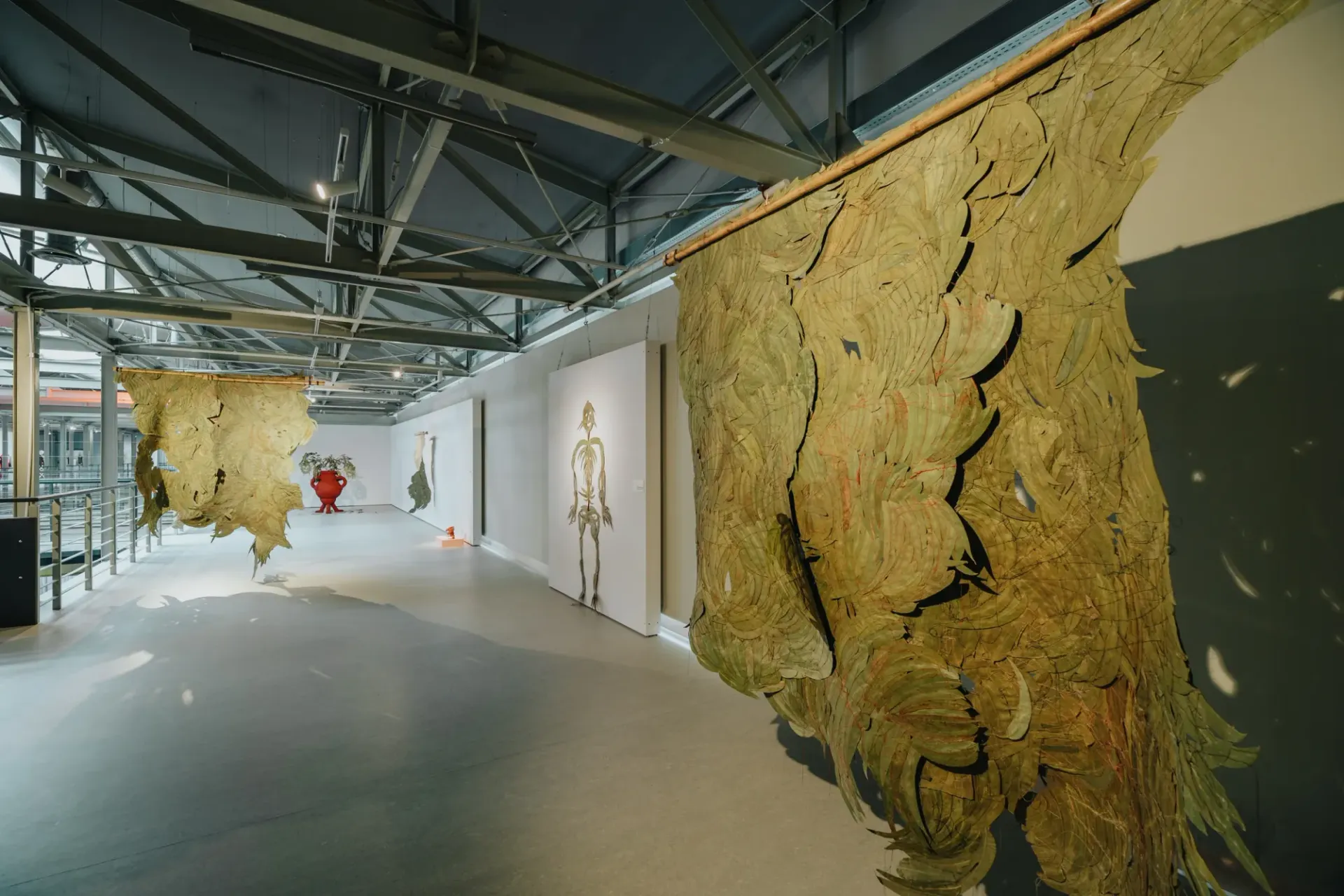
Central Museum of Textiles Presents Hungry Trees in Łódź
The Central Museum of Textiles presents Hungry Trees by Przemek Branas, curated by Marta Kowalewska, through March 14, 2027.
Przemek Branas
Hungry Trees
Central Museum of Textiles
Łódź, Poland
–
Piotrkowska 282, 93-034 Łódź
Marta Kowalewska
Kuba Szkudlarek, Przemek Branas
Courtesy the artist
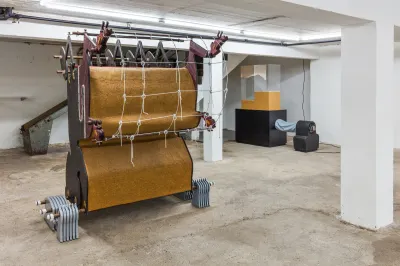
Eucalyptus leaves are not exactly a conventional material for sewing. Yet Przemek Branas has stitched them into large curtains that continue to shrink, dry and change throughout Hungry Trees at the Central Museum of Textiles in Łódź. One curtain contains faces or masks through which visitors can peer, becoming part of a landscape that refuses to stay still.
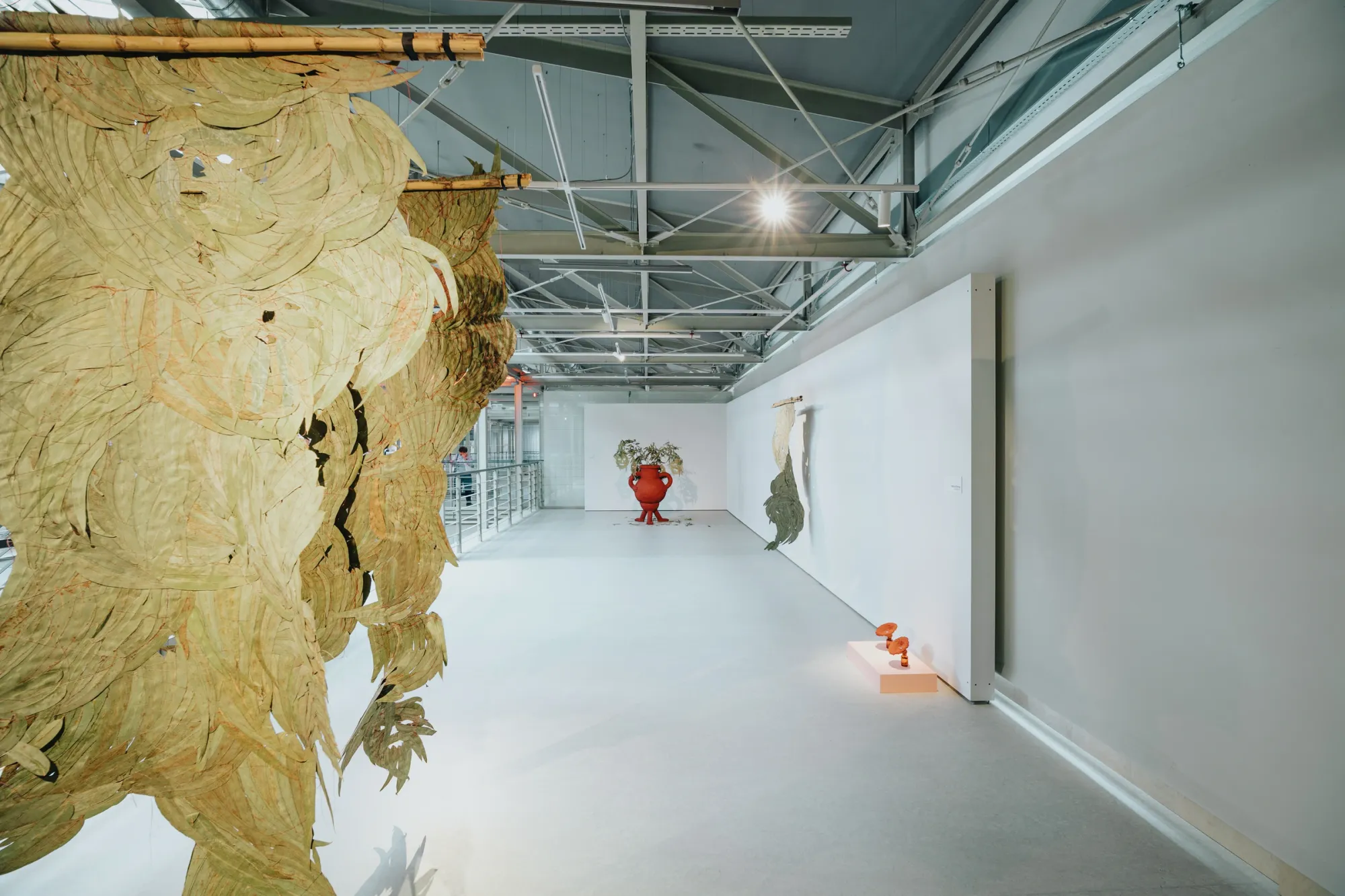
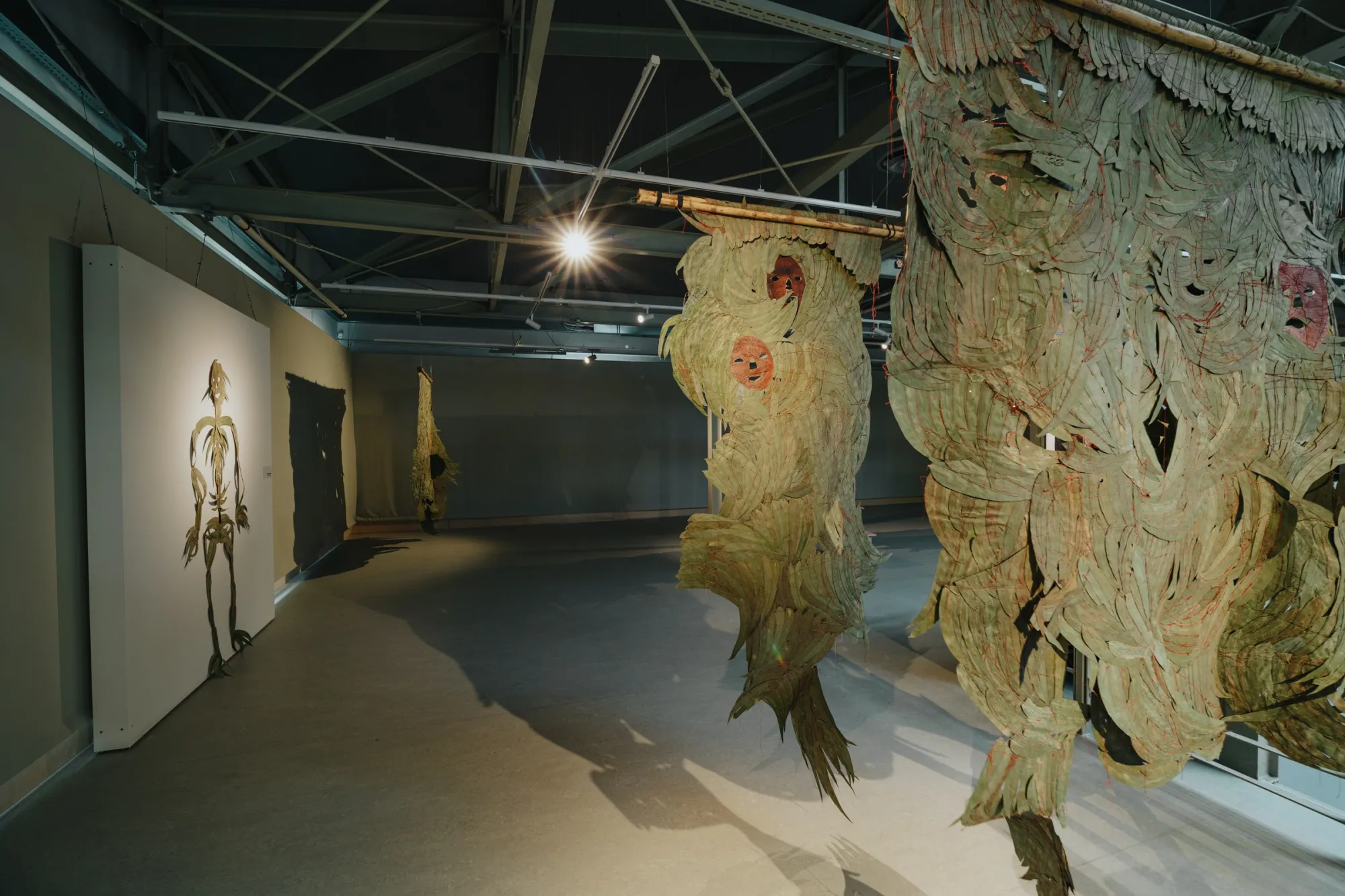
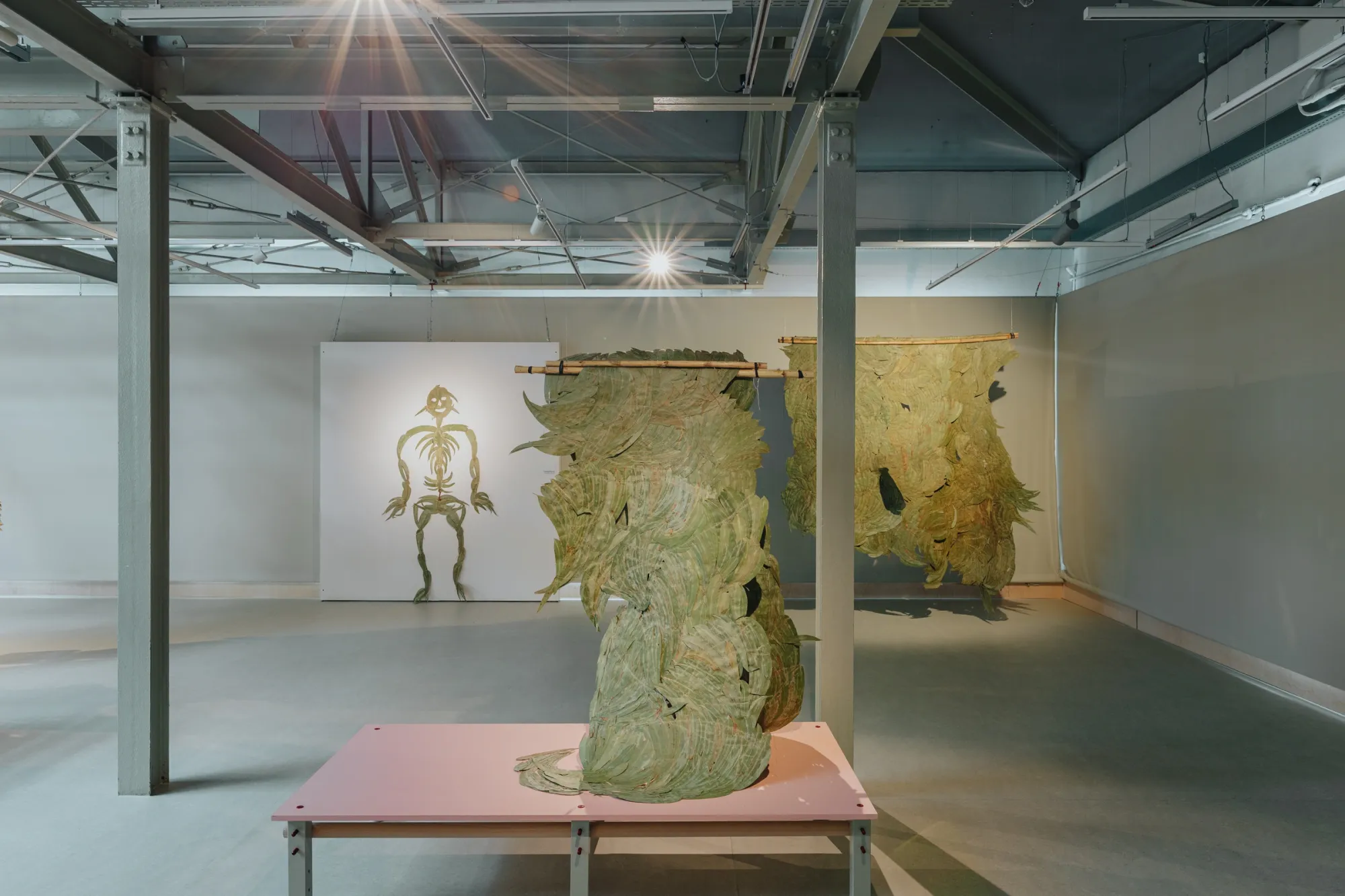
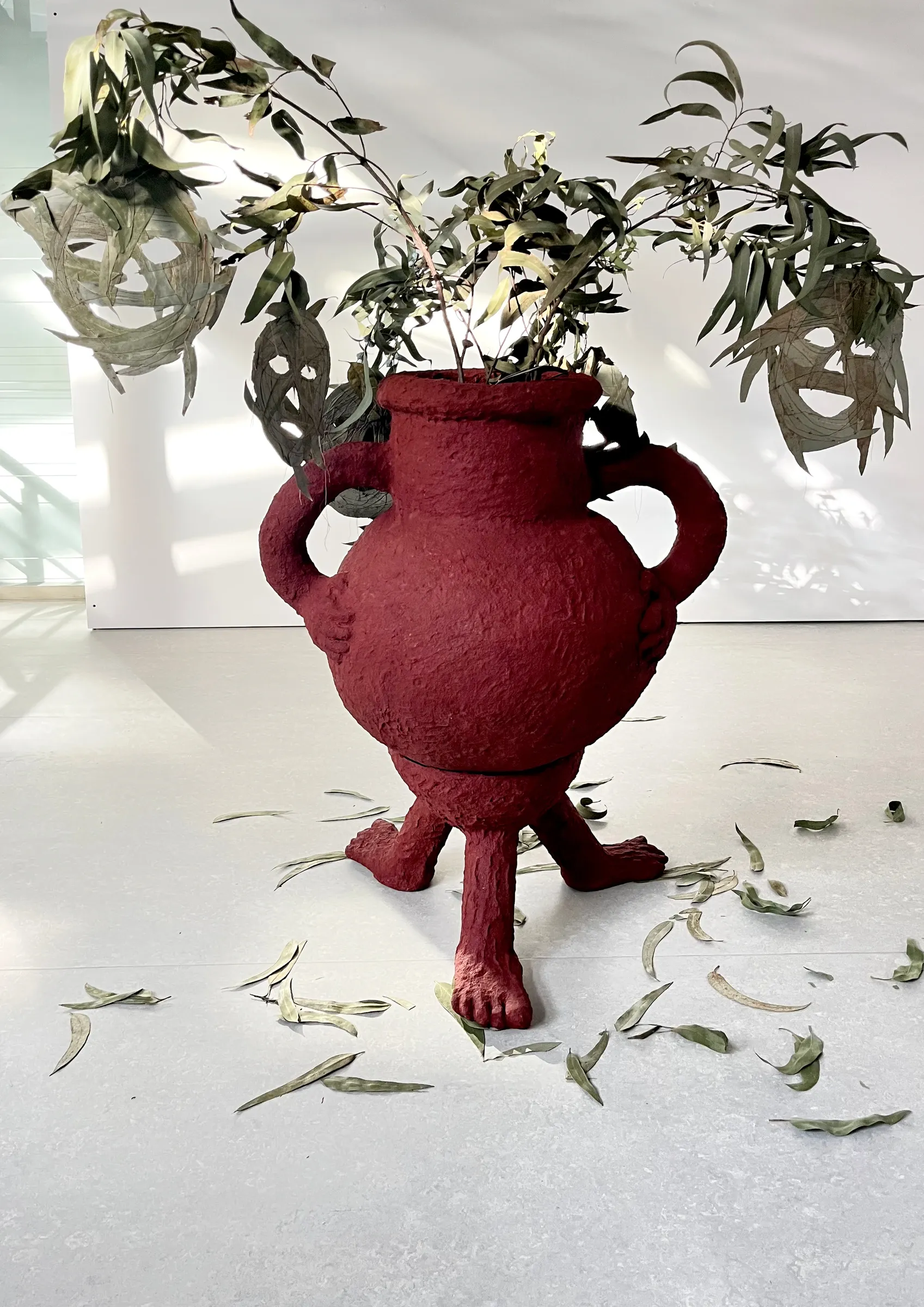
Curated by Marta Kowalewska, the exhibition brings together these shifting structures with Still Life, a papier-mâché vase with two hands, three legs and a keyhole, and I, Landscape, a scent combining eucalyptus extracts with the chemical signals plants release when damaged.
The photograph I Suck both opens and closes the exhibition. Below, Kowalewska's curatorial text takes a closer look at the ideas behind the works.
Exhibition Text by Marta Kowalewska
Leaves, a sewing machine, paper, fragrance. Simple materials and actions become building blocks for complex physical, social and cultural landscapes. This is all about process, manual effort, material mutability.
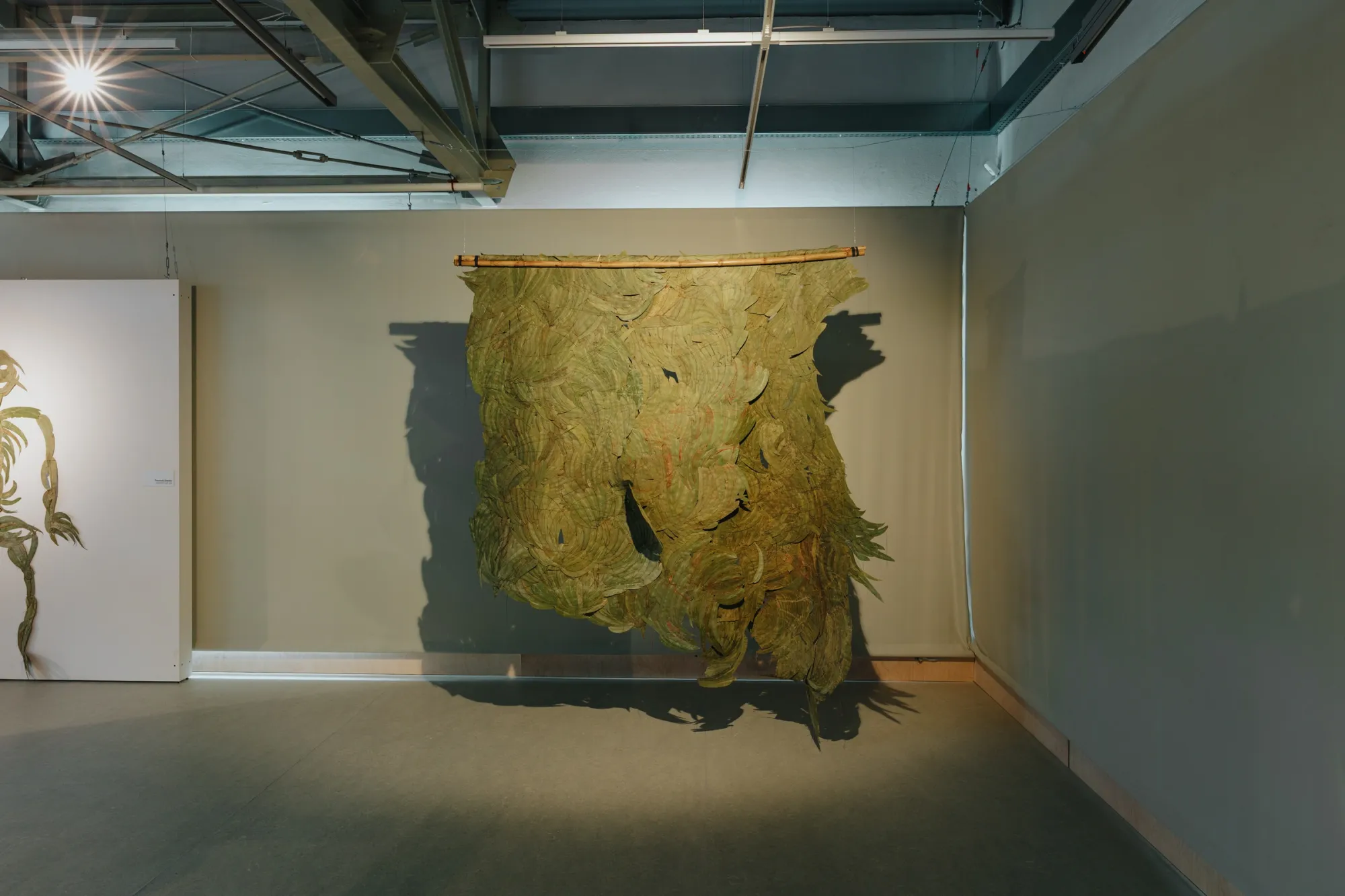
For a number of years, Przemek Branas’s practice has revolved around matter that doesn’t remain as is. His installations do not promise permanence. Making use of textiles, biological structures, smells, photographs, objects and performance, he brings to the fore invisible forces like work, exhaustion and dependencies, which shape the world around us.
This time, he invites us into an installation that undergoes change precipitated by light and moisture. It opens the door to a landscape in which things we know begin to breathe, emit smells and look. In a museum whose mission is to ensure continued preservation, this un-museum-like processuality becomes a central part of the story.
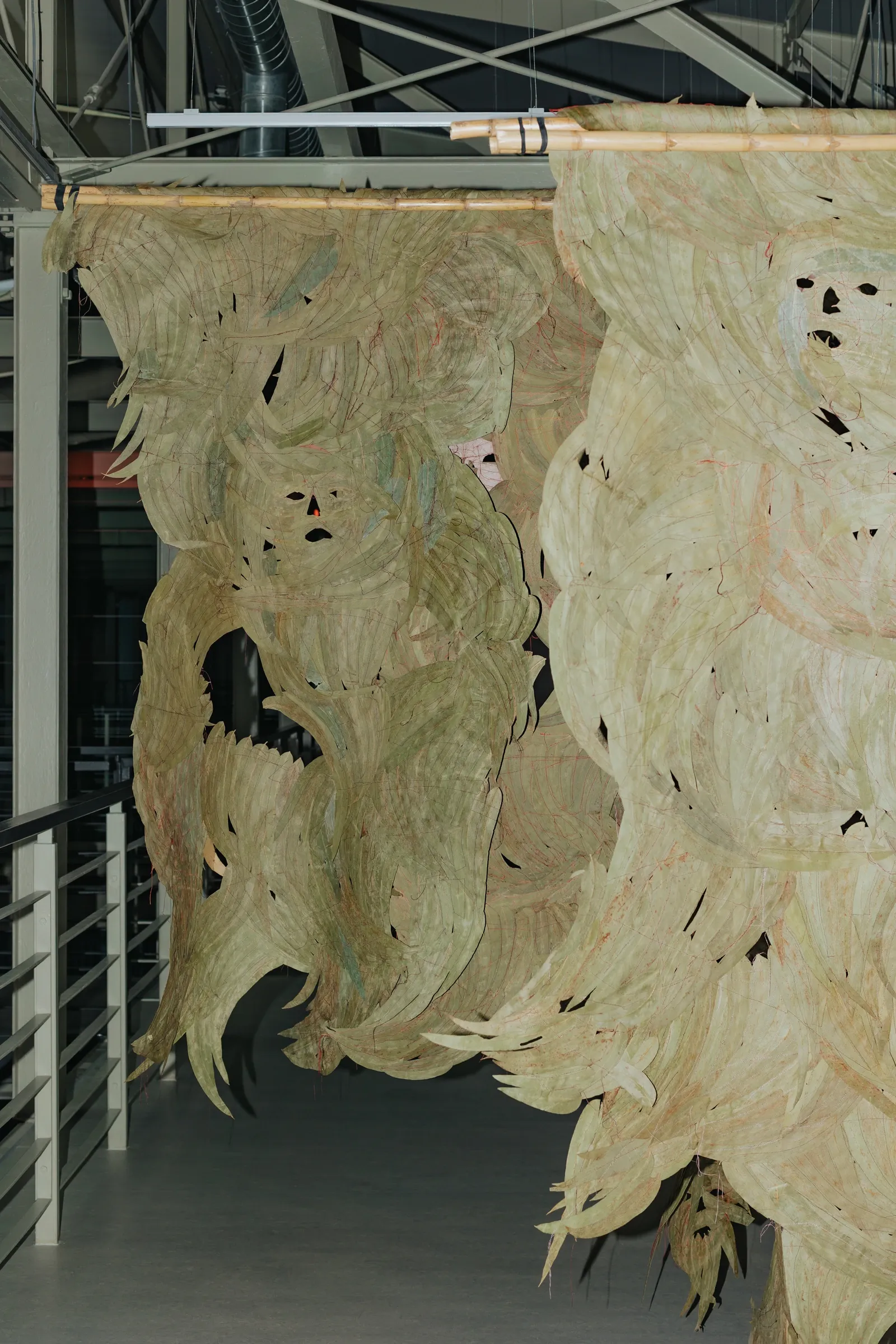
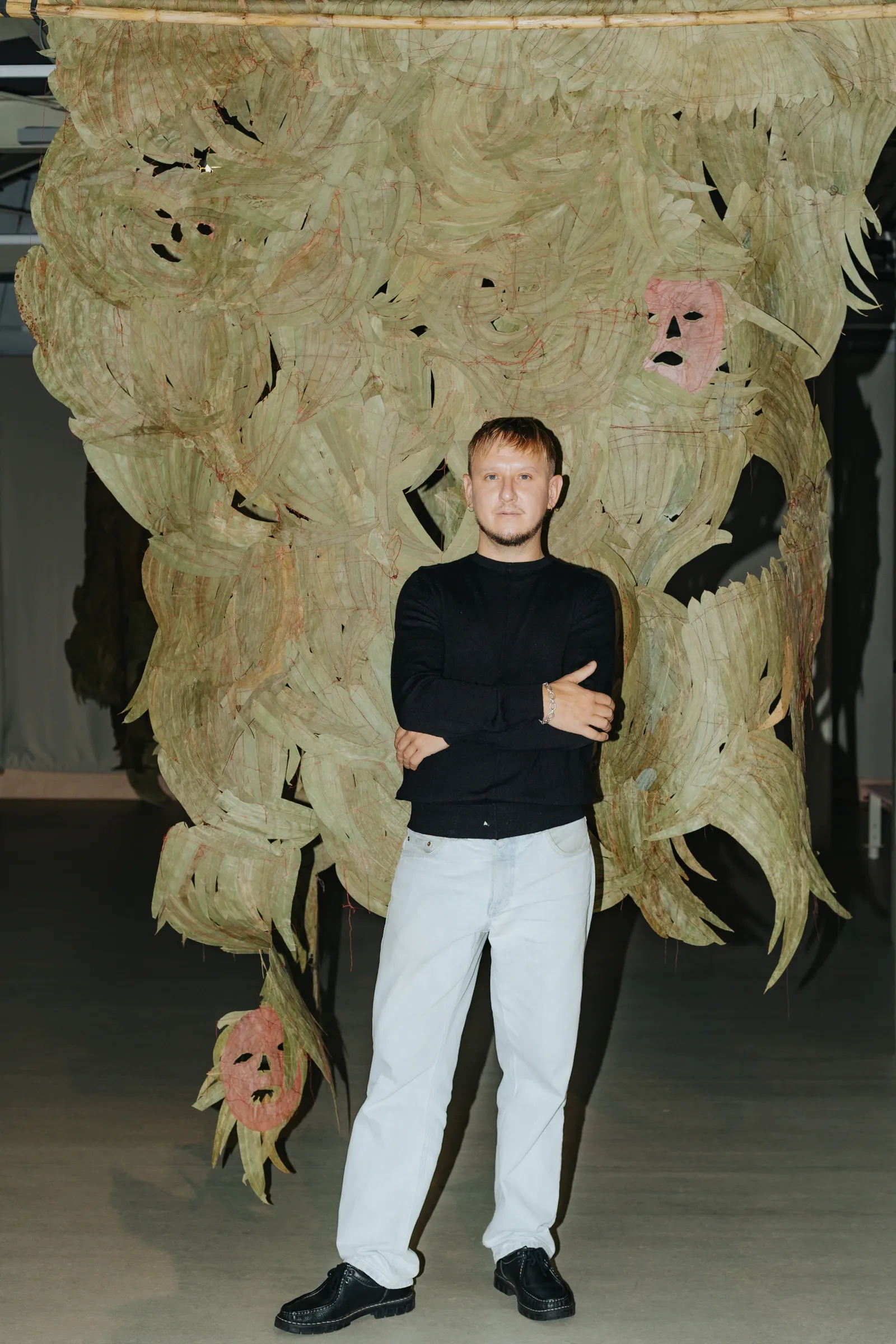
Branas dries, catalogues and sews together leaves left behind from the clearing of eucalyptus forests. They are assembled into curtains, membranes and objects whose form is never final. Moisture, light, shrinkage and time become their co-creators. The curtains hanging throughout the space form something of a treeline – a landscape.
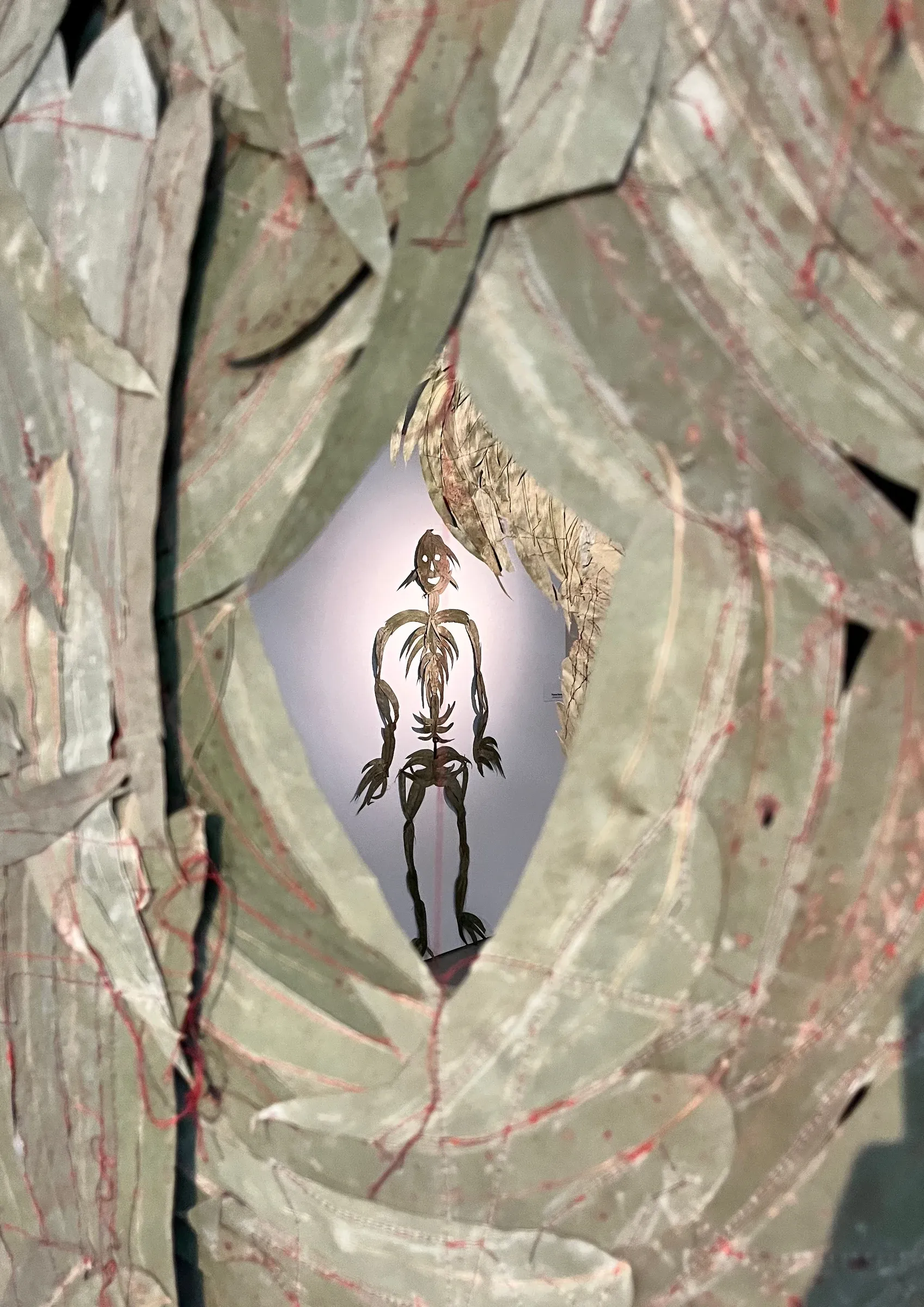
But, here a landscape is not a view – it is a structure. The treeline-like curtains create an expanse in which observing and being observed become mutually interdependent. Faces/masks sewn into one of them invite us to hide and peer out in secret. People become part of the landscape, just like plants, animals, smells, moisture and matter.
In this installation, smell acts as a sculpture. It comes from extracts of the bark, leaves and roots of the eucalyptus, a wetland plant, combined with a substance secreted by plants in situations of danger. It is invisible, but physically present: it fills the space, permeating it and making contact with the bodies around it. Branas treats smell as an alternative art language – a language that defies the dominance of vision and, at the same time, restores the material and social dimension of sensory experience.
The exhibition tells the story of a specific plant species – the eucalyptus – and of the people who planted, felled and processed it at various times in history. Brought to Europe as a fast-growing monoculture, the eucalyptus sucks up water and minerals from the soil. It has also been used to dry out wetlands.
Branas, however, does not turn it into a categorical villain. In his labyrinth of curtains, masks and fragrances, the artist traces out the consequences of decisions made in the 19th century, which are becoming apparent only today, and actions taken by people whose names have not gone down in history. The eucalyptus becomes a picture of the phenomenon of monoculture, which suffocates and smothers diversity. This is not a project about ecology. It is an invitation to talk, to experiment and to pose questions even with no easy answers in sight.
Presented in an old cotton factory in Łódź, Thirsty Trees oscillates between tension, coercion, curiosity and experiment, casting a dubious light on monoculture, memory and accountability for what is planted. Everyday labour is confronted with history, and with the fluid coexistence of invisibility and exposure, harm and benefit, permanence and decay, numbness and sensitivity. These are states that are hard to reconcile but also inseparable.
The exhibition refrains from proposing a single interpretation. Accompanying it are three voices – Paula Ferreira’s, Wojciech Szymański’s and Xavier Salomon’s – which situate the project in different constellations: of work and care, contemporary Polish disputes, art history and the landscape-painting tradition. Their perspectives form an additional landscape around Branas’s art, showing that meaning never arises solely from within a work itself.
This is an exhibition about matter at work. About landscapes that are never static. About textiles that don’t have to be durable. And about art that, rather than stabilising meaning, allows it to remain in motion.
Curator: Marta Kowalewska
Objects in the Exhibition
At the centre of the exhibition-installation is a series of objects: Curtains. The Curtains are machine-sewn from eucalyptus leaves (Eucalyptus globulus). The objects were made while the leaves were still fresh.
The structure and size of the fabrics are dictated by what is possible when working with leaves on a sewing machine.
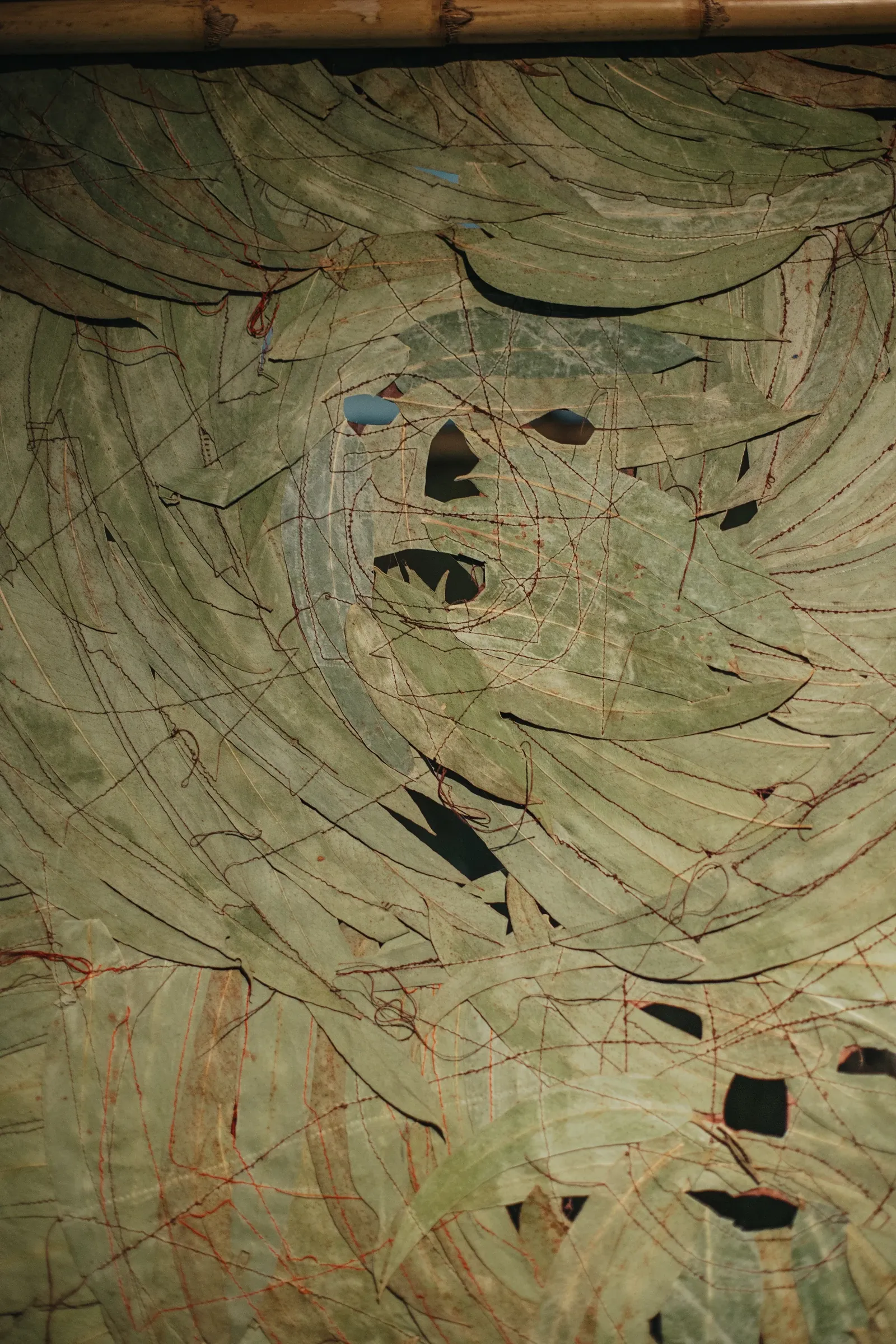
Their surface changes in response to external factors such as air temperature, humidity and UV radiation. The work is thus both a record of time and an object that is processual in multiple ways: first in the performative process of gathering, then in the labour at the sewing machine, and finally in the processual work that unfolds in the exhibition space.
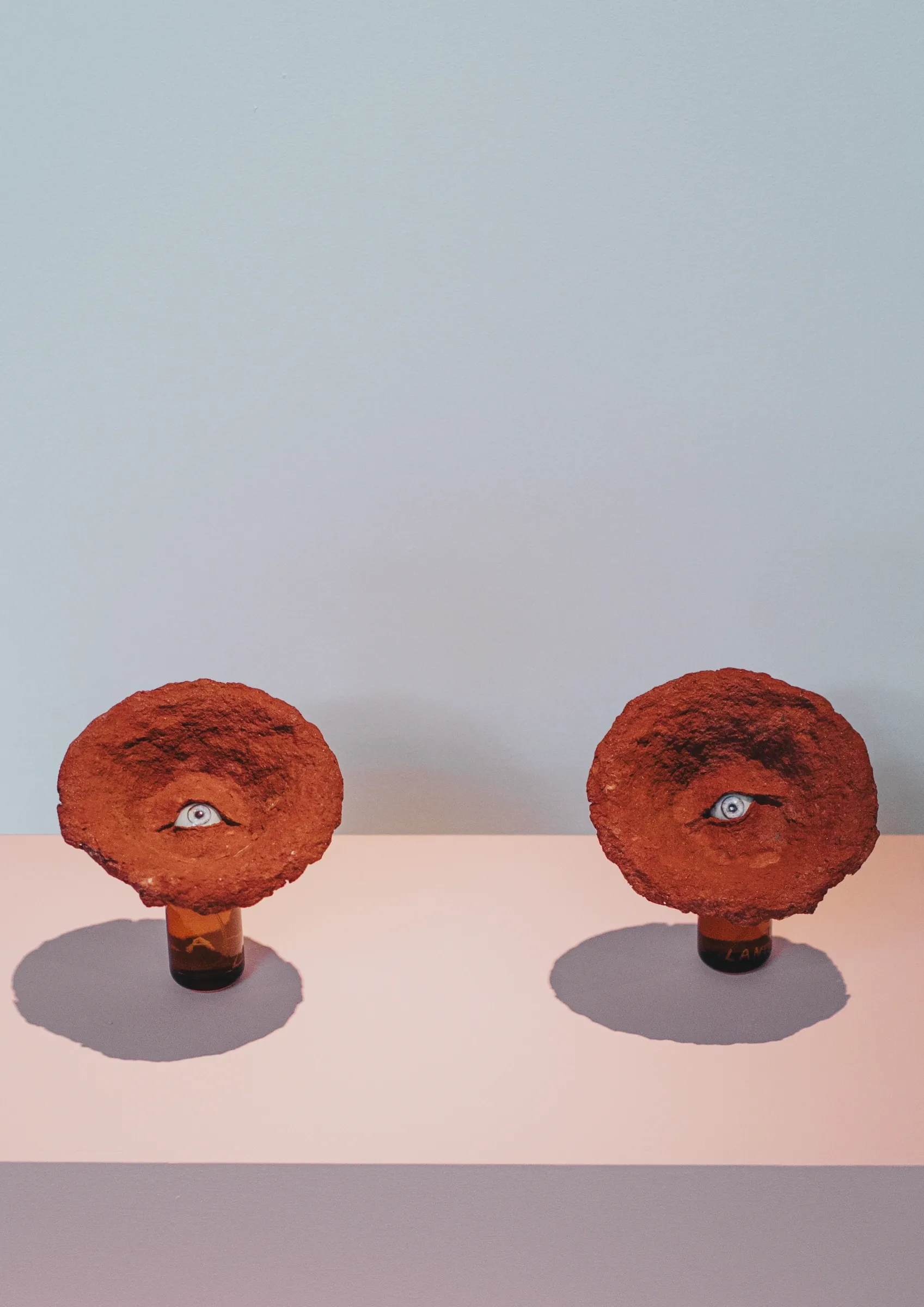
The Curtains are interwoven with objects and photographs, as well as with the olfactory installation I, Landscape. I, Landscape is an olfactory composition, enclosed in a 50 ml bottle topped with an eye-shaped stopper, building upon the properties and meanings of its ingredients..
At its heart lies eucalyptus: extracts from leaves, roots and bark. It is accompanied by GLVs (Green Leaf Volatiles), volatile organic compounds released by plants in response to tissue damage, such as cutting or biting, and to frost, drought and excessive sunlight.
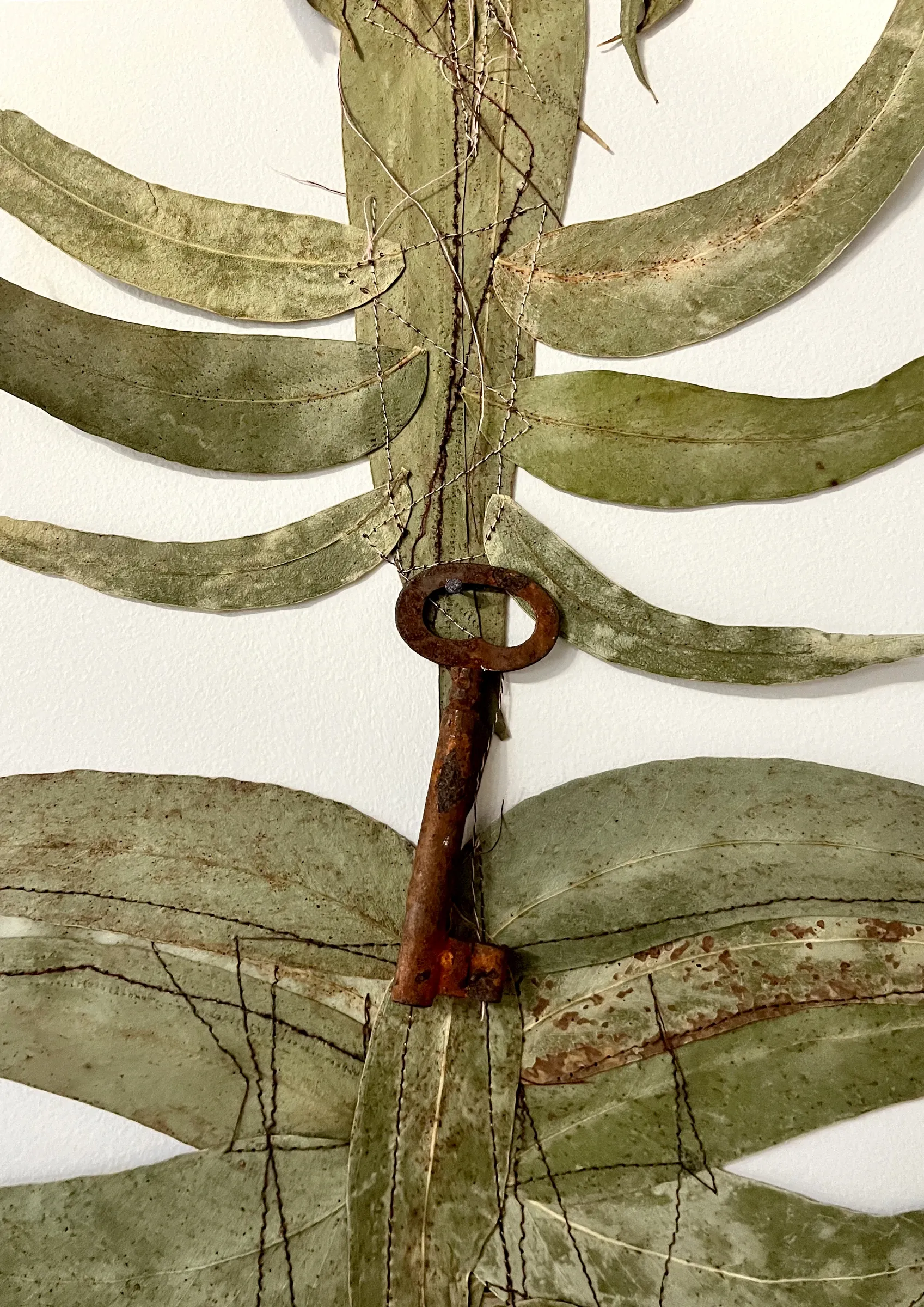
Humans perceive these as a pleasant, green scent of freshly cut grass, evoking images of meadows, summer and holidays. For the plant, it is an alarm signal: information about damage to its tissues and a chemical message to neighbouring plants, which in response begin to produce defensive substances. It is the scent of a plant’s pain and stress, which humans perceive as pleasant.
This is complemented by notes of dried hay and weathered grass, as well as essential oils evoking decaying vegetation, marshes, peat bogs and wetlands, such as Labrador tea (Rhododendron groenlandicum).
This group is enhanced by the essential oil of Helichrysum angustifolium, a plant capable of surviving in barren, harsh terrain, known as the everlasting flower: a flower that never wilts. The composition is rounded off by substances with a smoky, almost asphalt-like character, formerly used in medicine and tanning, and today evoking images of earth after a fire, charred wood and the acrid smell of burnt material.
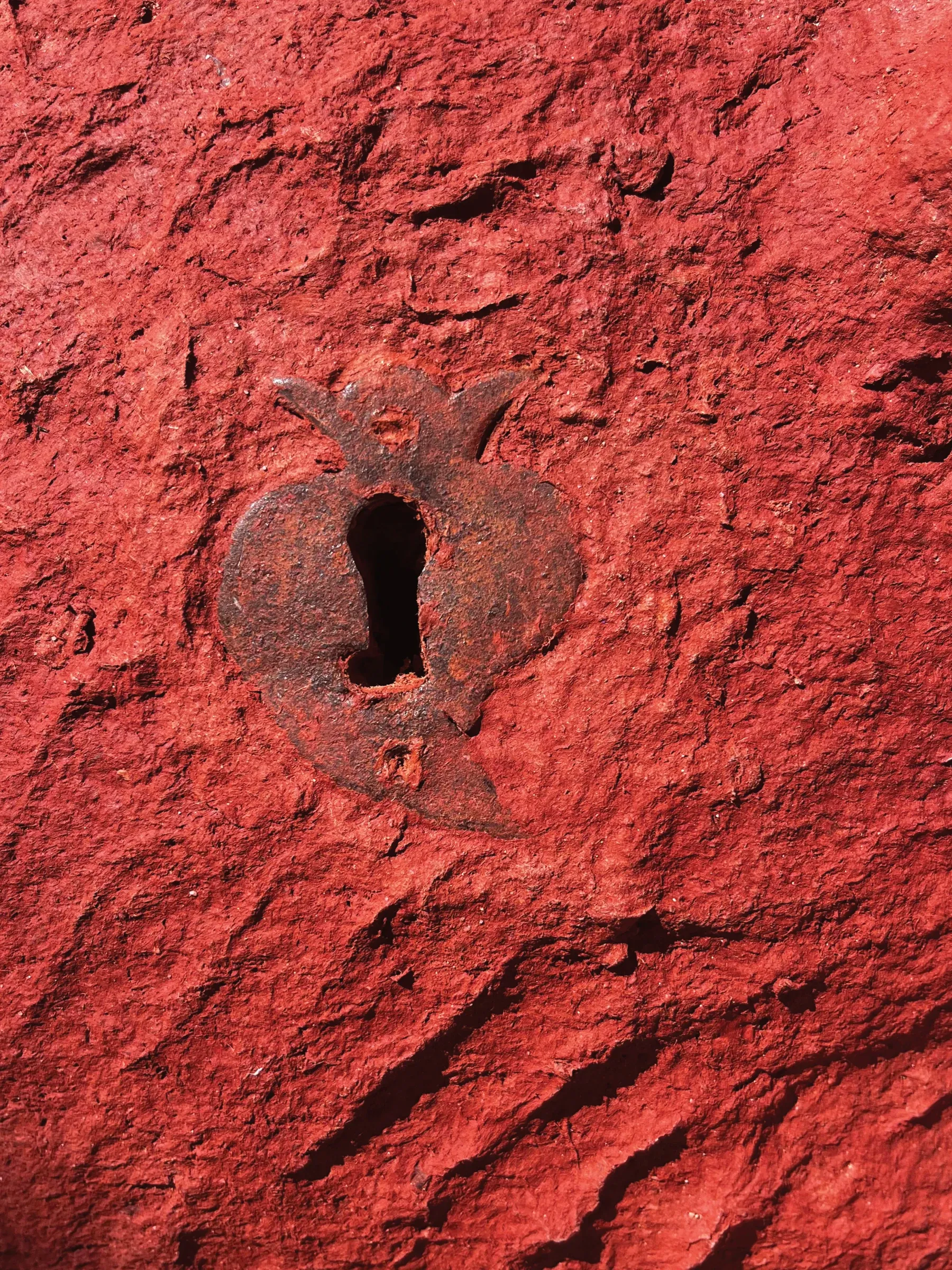
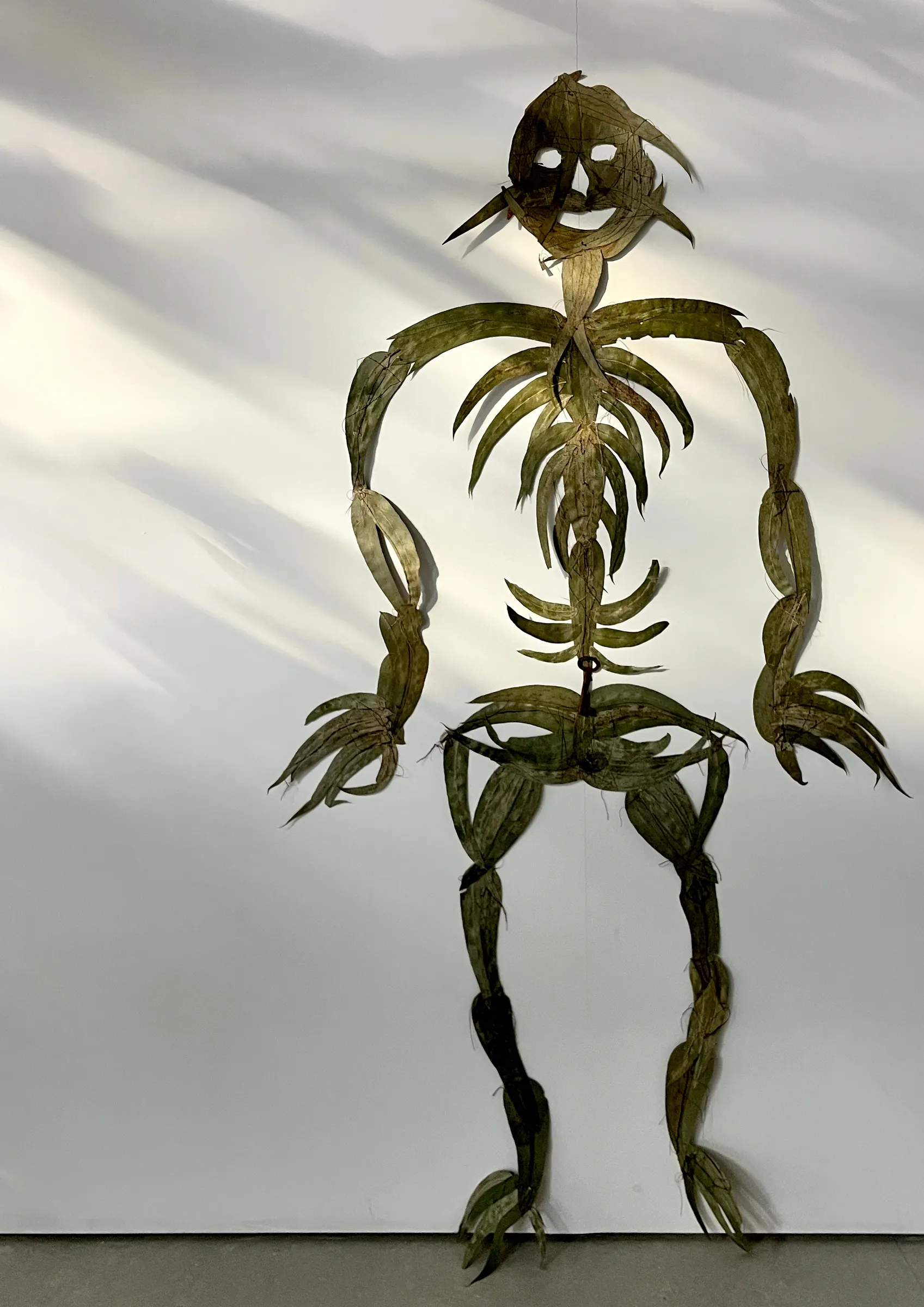
Also in the space is an oversized vase, Still Life: a vase-shaped object made of papier-mâché, a metaphorical multi-body of people, with two hands engaged in physical labour and three legs.
The still life of the title, a reference to painterly compositions, is completed by forms resembling human heads, made from stitched eucalyptus leaves and branches. This symbolic multi-body bears an old-fashioned keyhole, intended for the metaphorical opening of the body or bodies. On the underside of the sculpture is an acrylic eye, gazing into the ground.
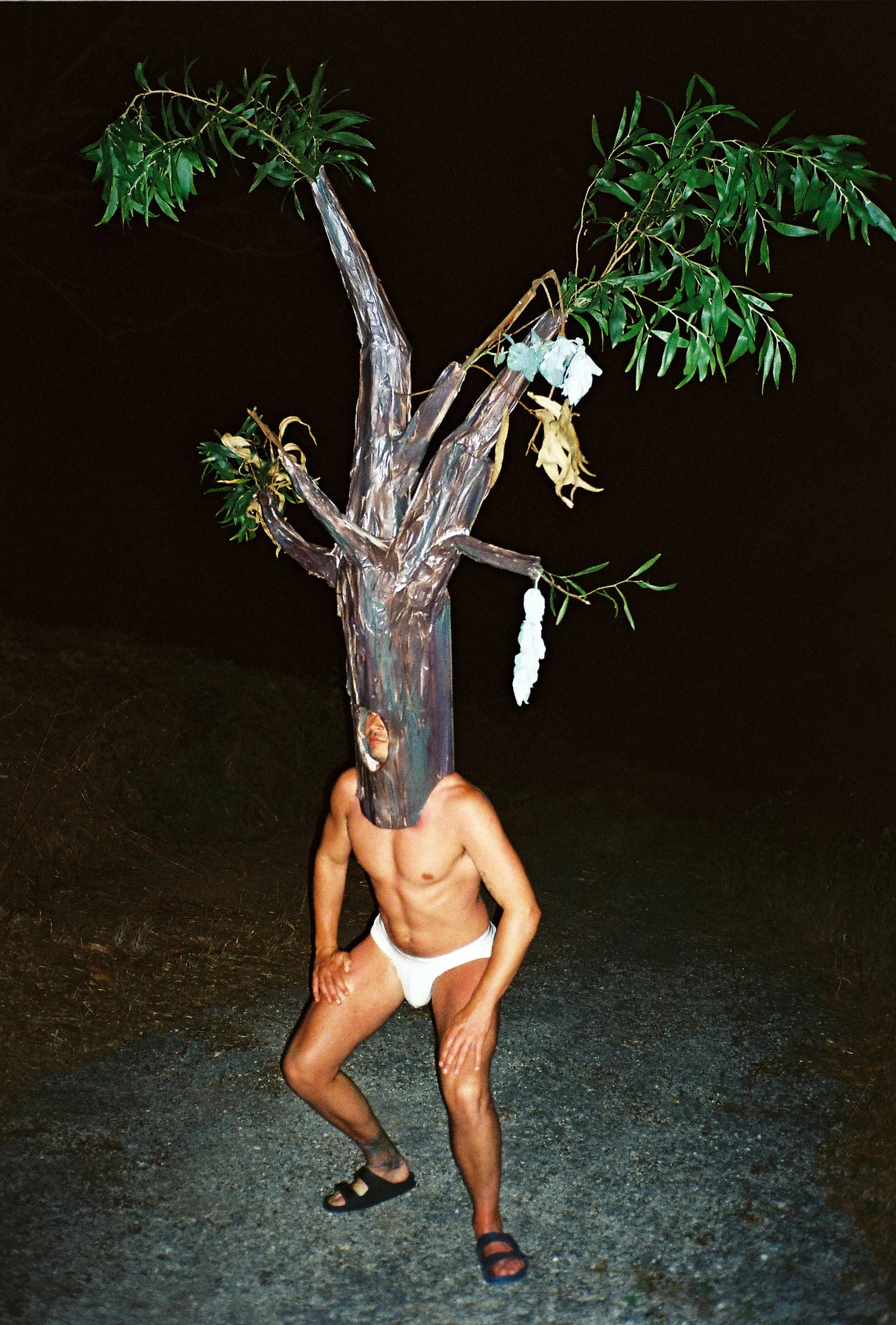
The exhibition both begins and ends with the photograph I Suck. This performative photograph shows a model wearing a mask made especially for the image.
The mask is a homemade tree form, as if taken from a school play in which a person turns into a tree. The title refers to the voracious way eucalyptus trees (and monocultures in general) suck up water, but also to the English expression meaning “I’m no good at anything.”
Born in Jarosław, Poland, in 1987, lives and works in Portugal. Works across performance, installation, video, objects, photography, sculpture and olfactory pieces, and studied at the Academy of Fine Arts in Kraków and the University of the Arts in Poznań.
Website
Curated Hungry Trees and wrote the exhibition text. Together with Bukola Oyebode-Westerhuis she curated the 18th International Triennial of Textile at the Central Museum of Textiles in 2025.
About Catapult Contemporary
This is an exhibition review published by Catapult Contemporary, an independent editorial platform for contemporary art, based in Vienna. We publish exhibition reviews, artist features, interviews, and critical context, with a focus on emerging and mid-career practices from Europe and beyond.
catapult-platform.art ·
Instagram
Want to be featured? Submit your work →
No spam, no sharing to third party. Only you and me.