A Shelter That Hardens Under Sustained Stress
Sophie-Luise Passow, Vienna: Abstract Painting on Linen
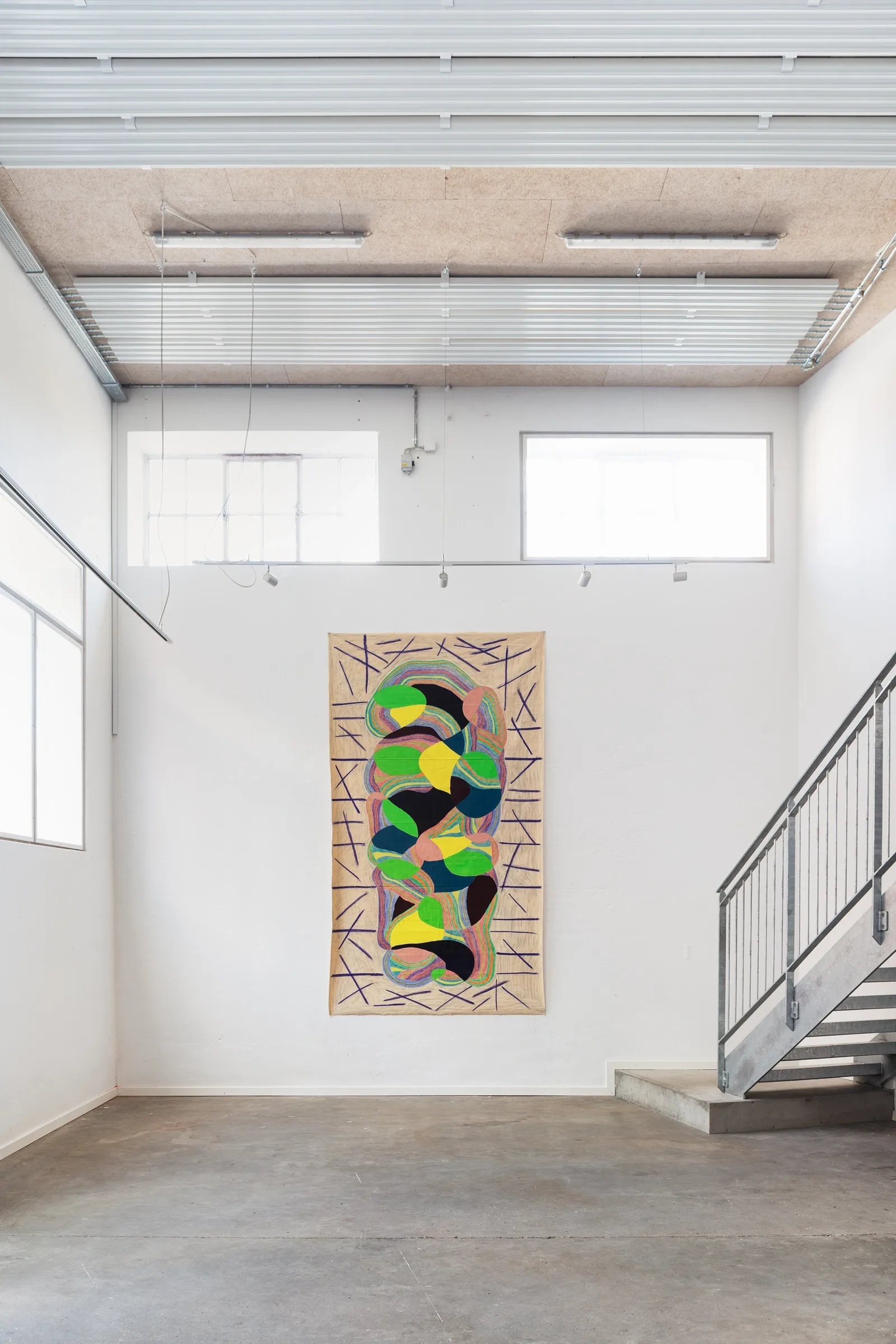
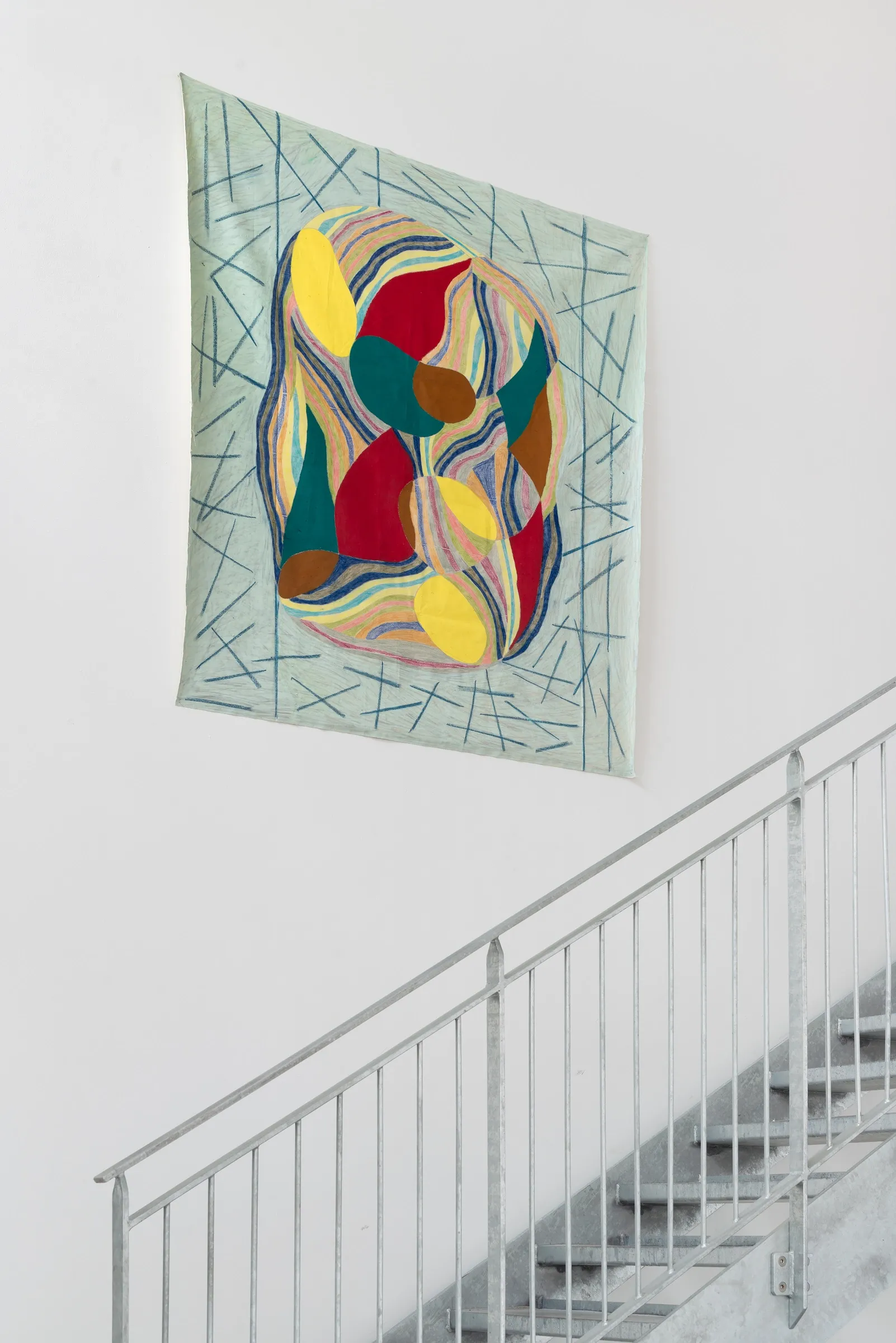
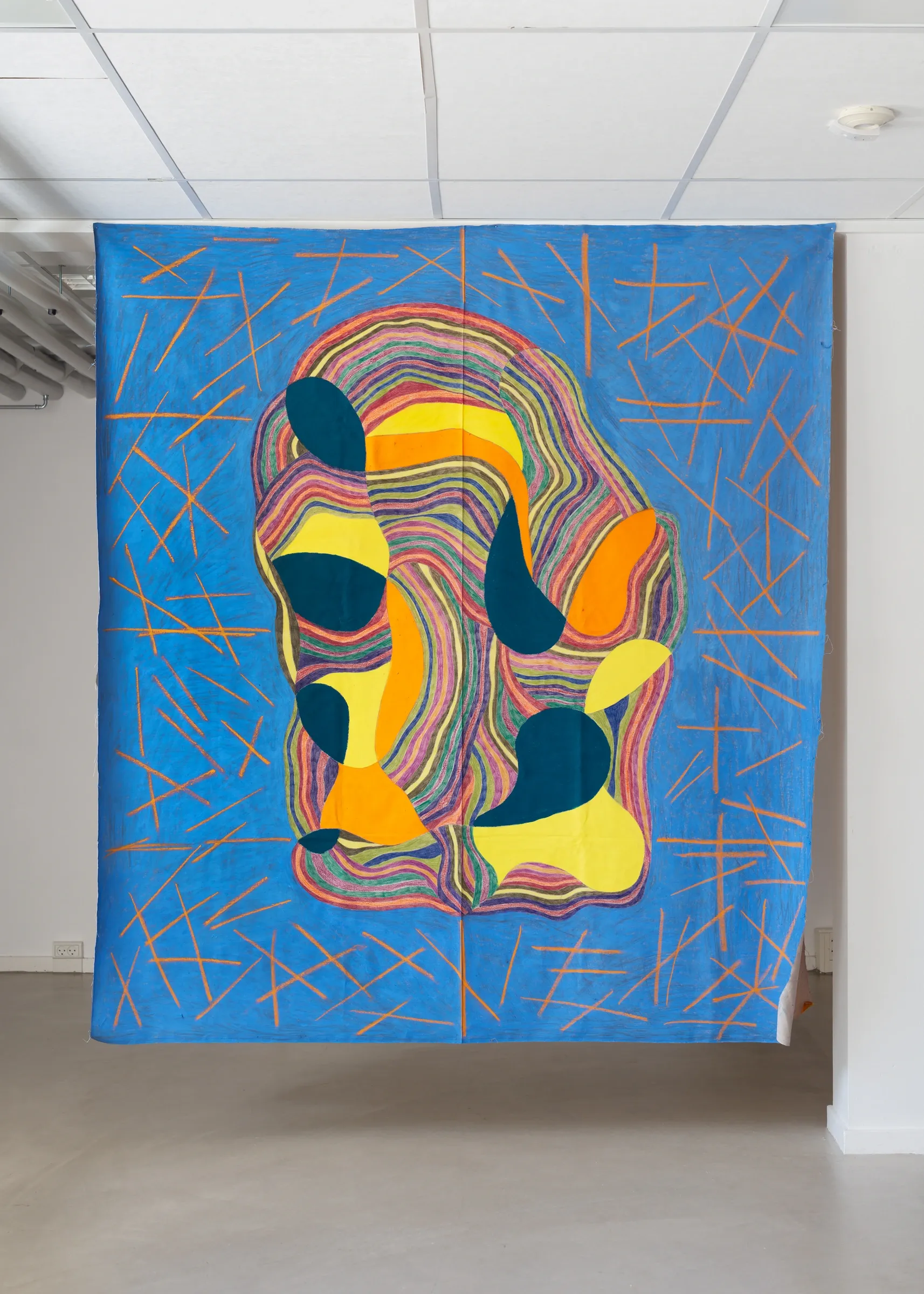
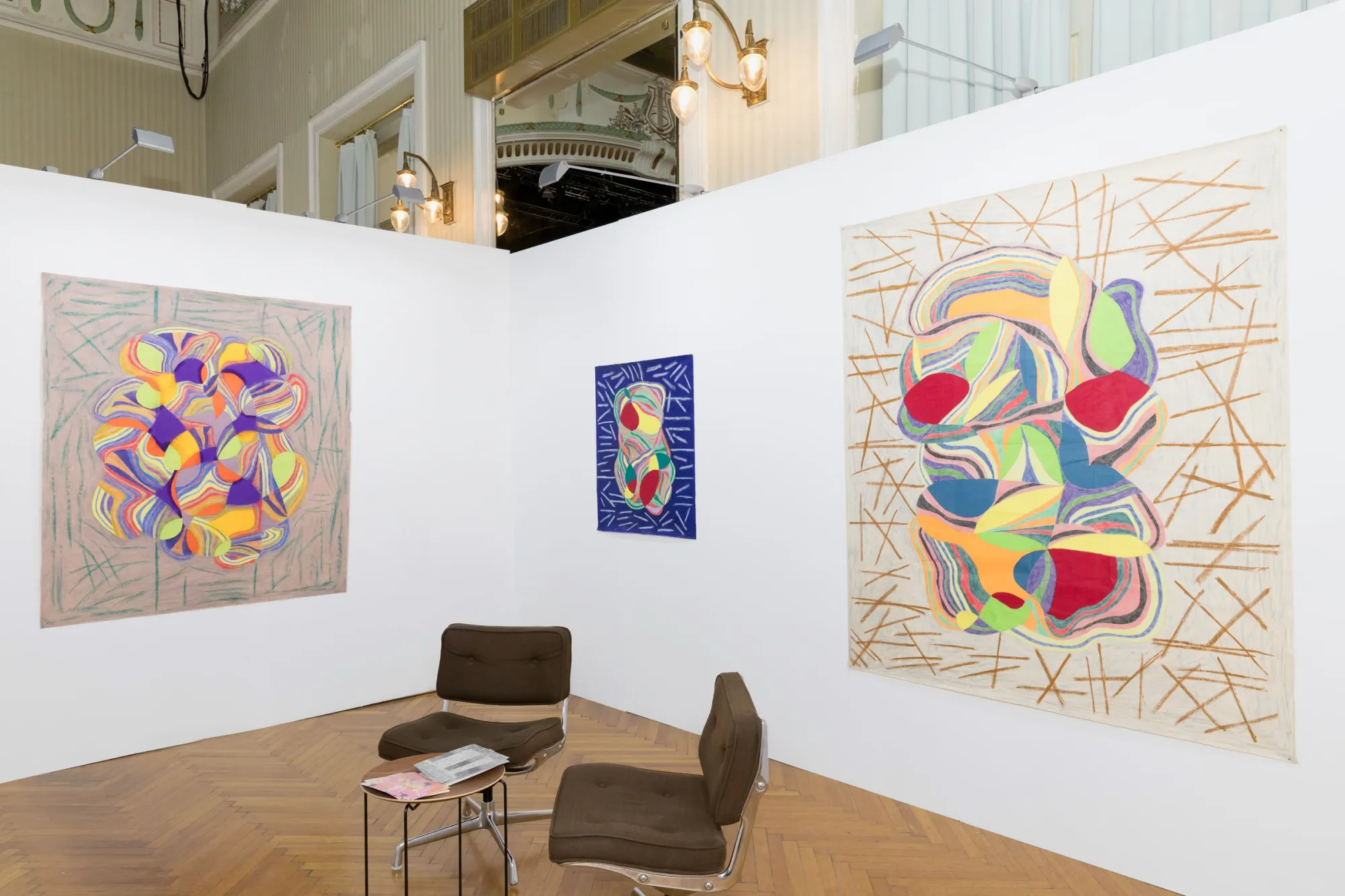
The linen is not stretched. It hangs from its top edge, sometimes flat against the wall, sometimes free in the room, and it keeps the creases of having been folded and rolled.
What protects can also set hard. These paintings stay in the moment before that happens, and do not say which way it will go.
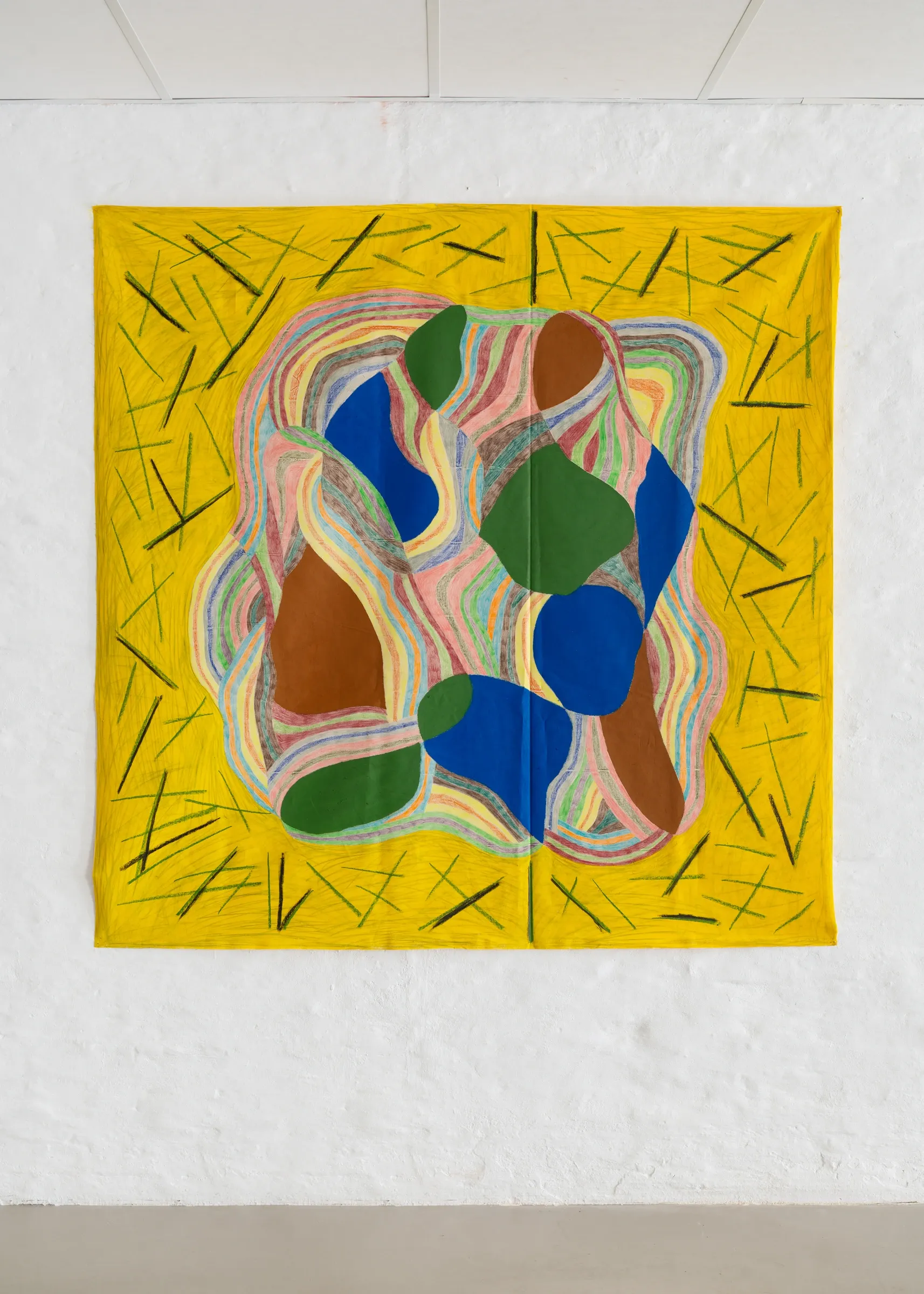
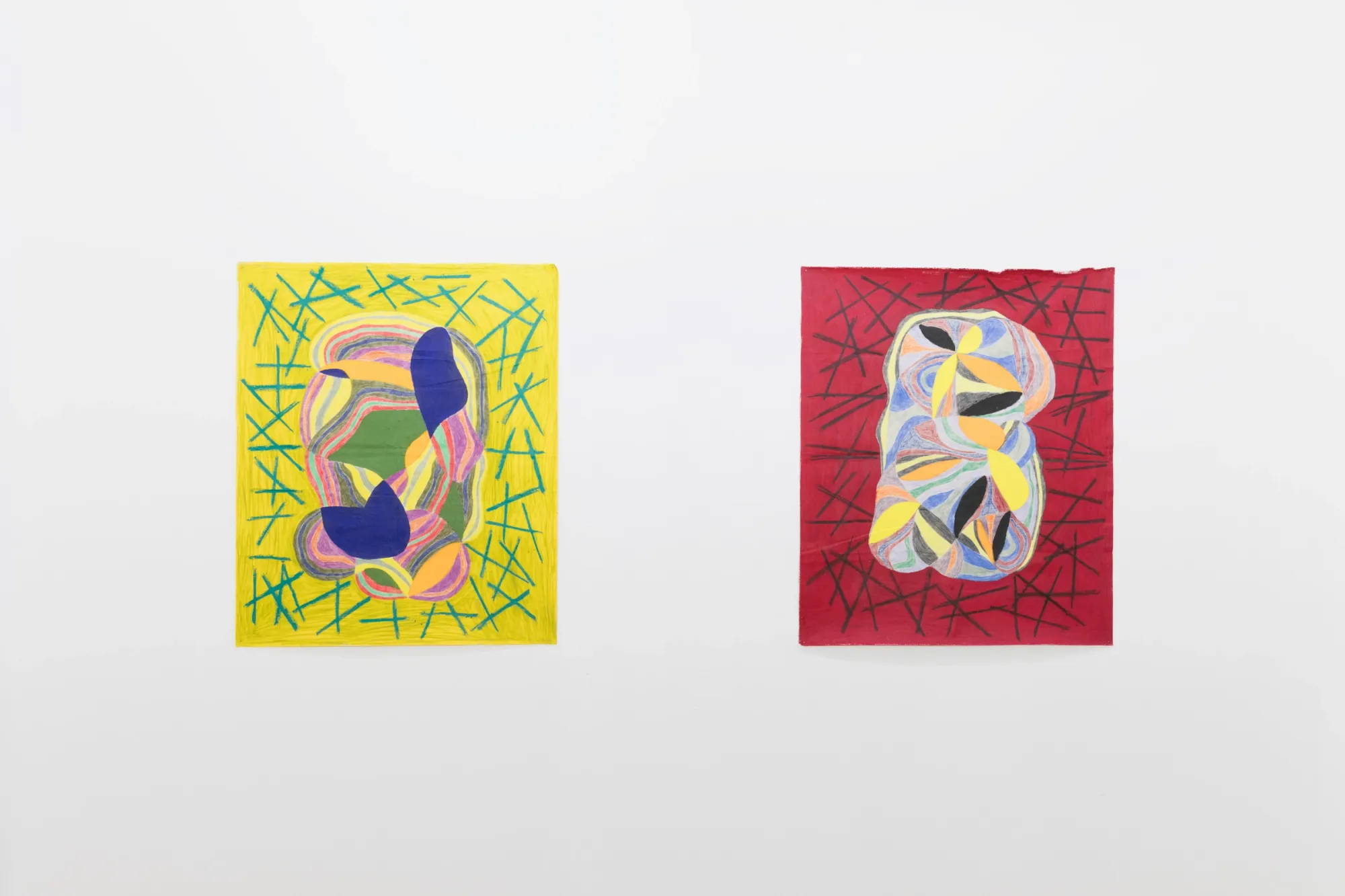
Across a saturated ground runs a scatter of loose strokes, like sticks dropped on a floor.
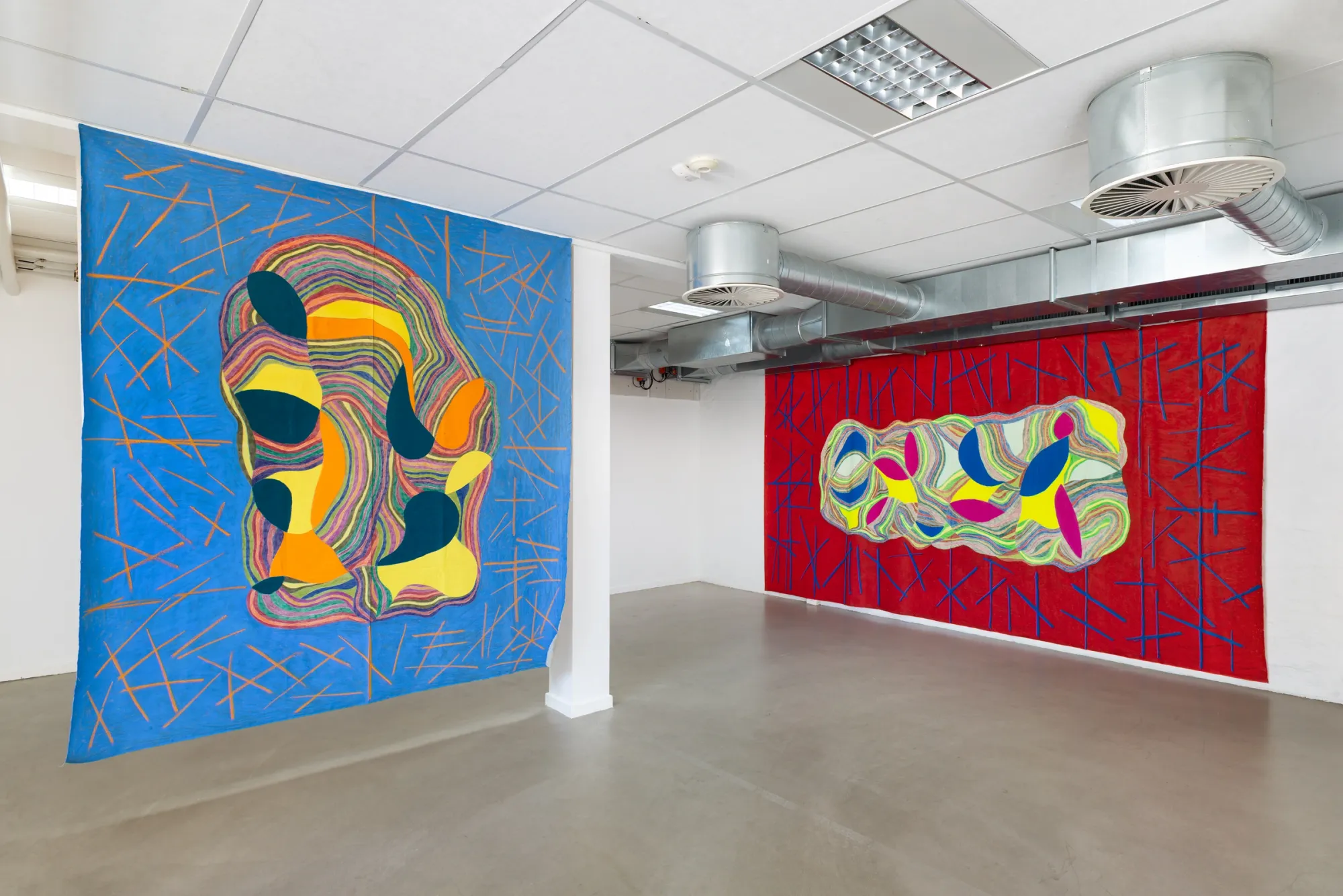
At the centre sits a dense body of banded lines in pastel and pencil, and inside that body a few flat, opaque shapes: drops, leaves, lenses, something between an organ and a seed.
Vienna, 1994
Painting, drawing, printmaking, textile, pastel and pigment on linen
Drawing and Printmaking, University of Applied Arts Vienna, diploma 2022
Gallery Statement, Galerie Crone, Parallel Vienna, 2026 (solo)
A Granule of Stress, CANTINA, Aarhus, 2026 (solo)
Stress Granules, Aarhus Billedkunstcenter, 2026 (solo)
Empty Places, Crowded Hearts, Crone Berlin, 2026
Galerie Crone, Vienna and Berlin
@sophielou_passow
Jacob Friis-Holm Nielsen, Uwe Walter, Carmen Alber, Sophie-Luise Passow (studio)
Courtesy the Artist + Galerie Crone, Berlin Wien
The pictures are abstract, but they are not neutral. Each one repeats the same grammar of outer field, membrane and core, and the repetition is part of the point. What changes from canvas to canvas is pressure.
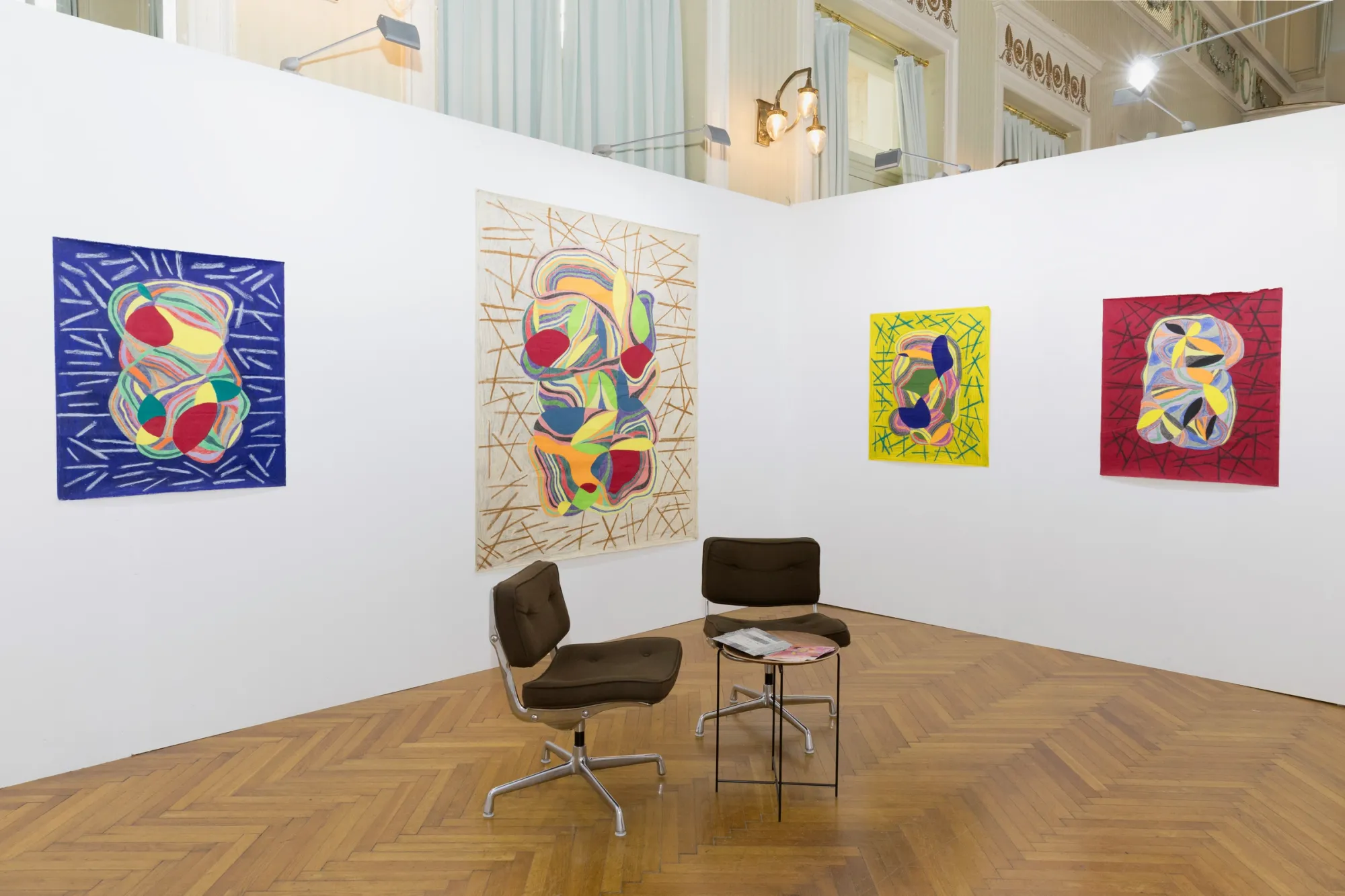
How tight the bands pull. How much room the centre is given. How many of the small shapes crowd into it.
Made from Below
The works are often made on the floor. According to the text Galerie Crone published for her 2026 presentation at Parallel Vienna, Passow works on the linen with the full use of her body, applying pigment directly and building up delicate layers of pastel.
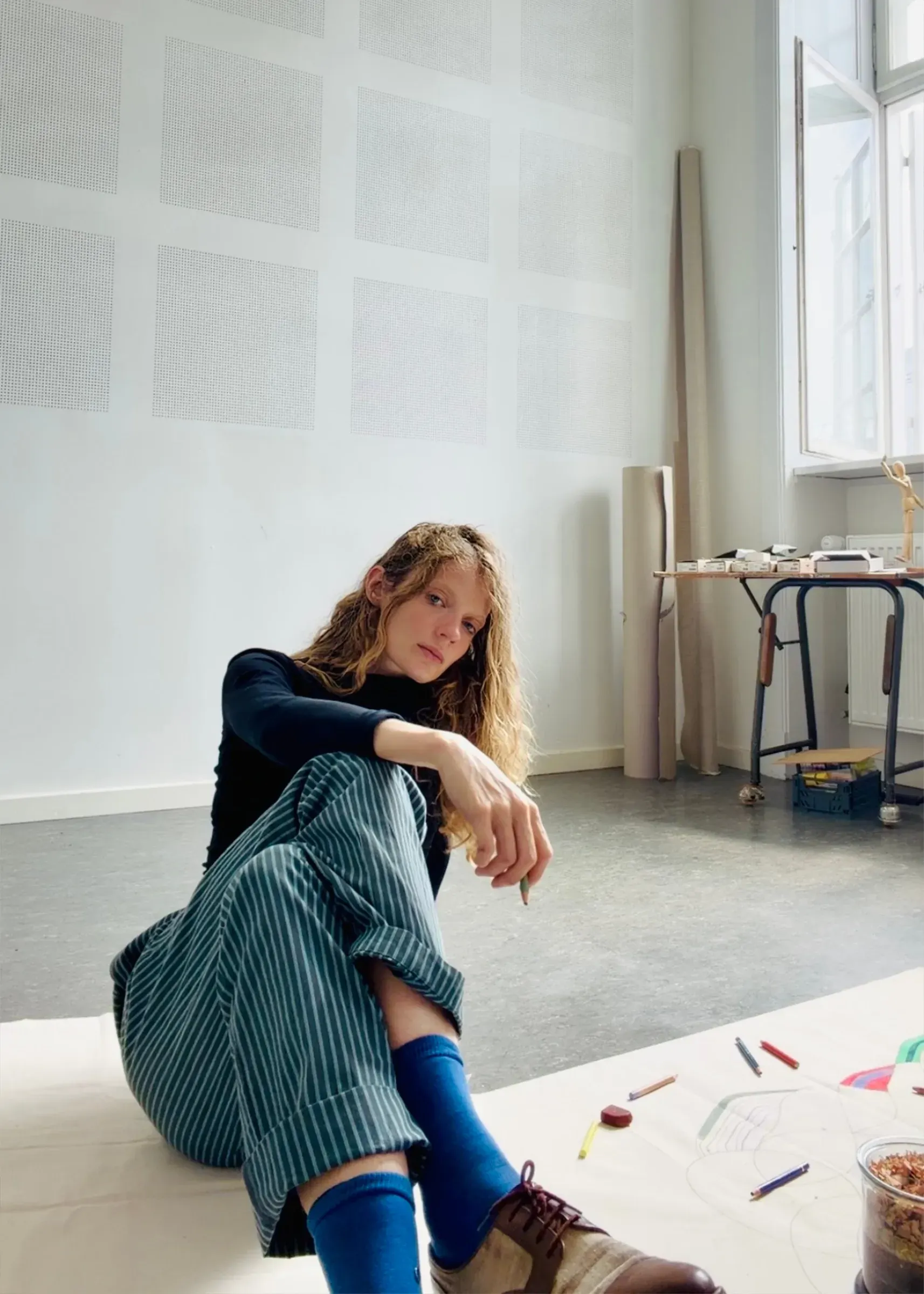
A studio photograph shows exactly that situation, the artist sitting on a pale sheet on the floor with coloured pencils scattered around her feet.
It changes how the works read on the wall. The banded lines do not look plotted. They drift, swell and thin out the way a line does when the arm drawing it is also carrying weight.
Up close, the colour of a single band shifts along its length, pink into grey into ochre, so the dense centre starts to look less like one form than like a sediment, laid down over time. The solid shapes sit on top of this, flat and painted. A different speed entirely.
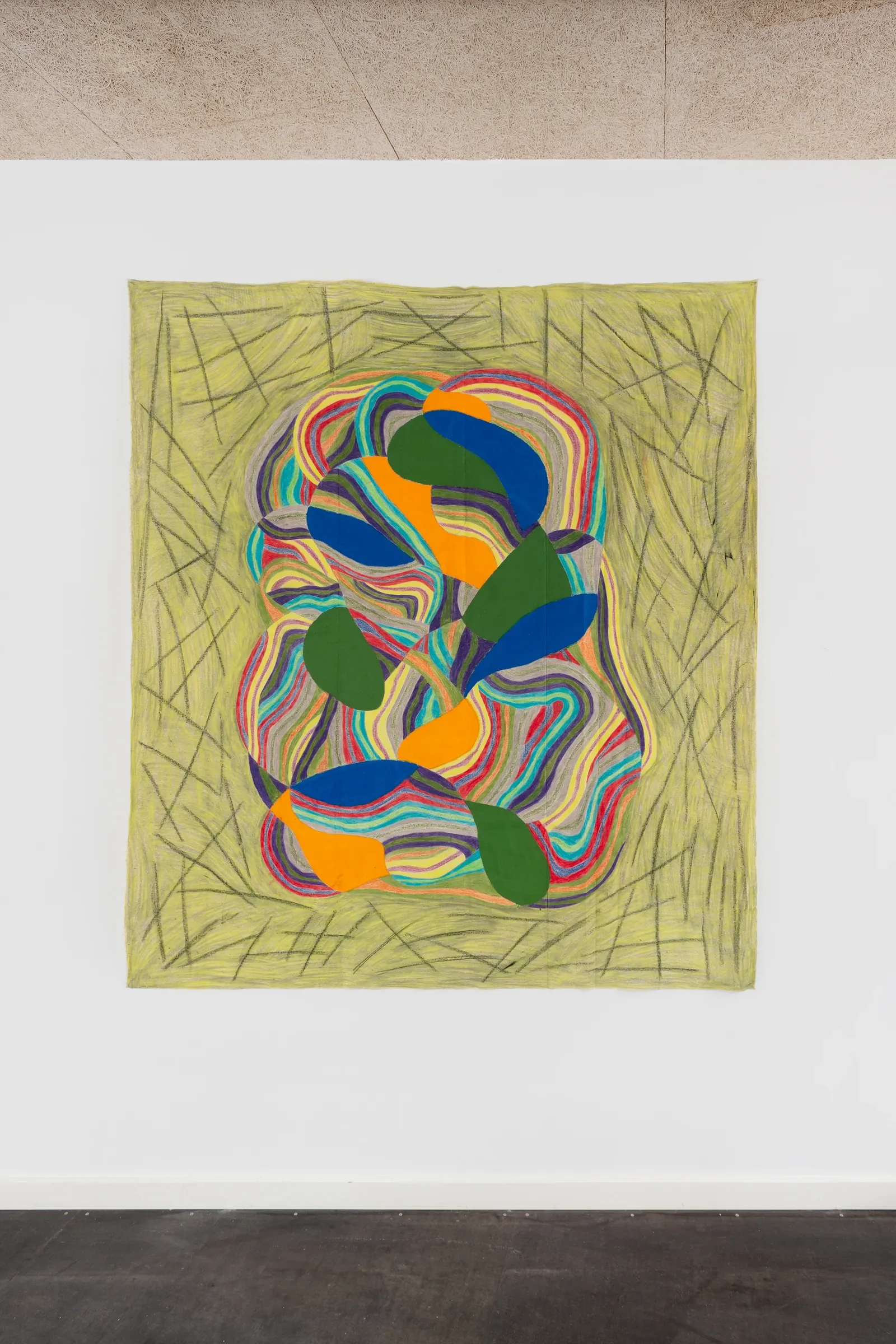
The work reproduced on the gallery handout, FHL1 (Four and a Half LIM Domains Protein 1), 2026, lists the full range of materials, pastel and oil pencils, oil paint, pastel chalks and wax on linen.
The title is the name of a protein. A dry, technical name for a painting that is anything but dry, and the gap between the two seems intended.
Stress Granules
The biological reference is specific. Her recent series takes its subject from so-called stress granules, which the gallery text describes as a temporary protective mechanism that hardens under sustained stress. Something that shelters and something that stiffens, in the same structure, depending only on how long the pressure lasts.
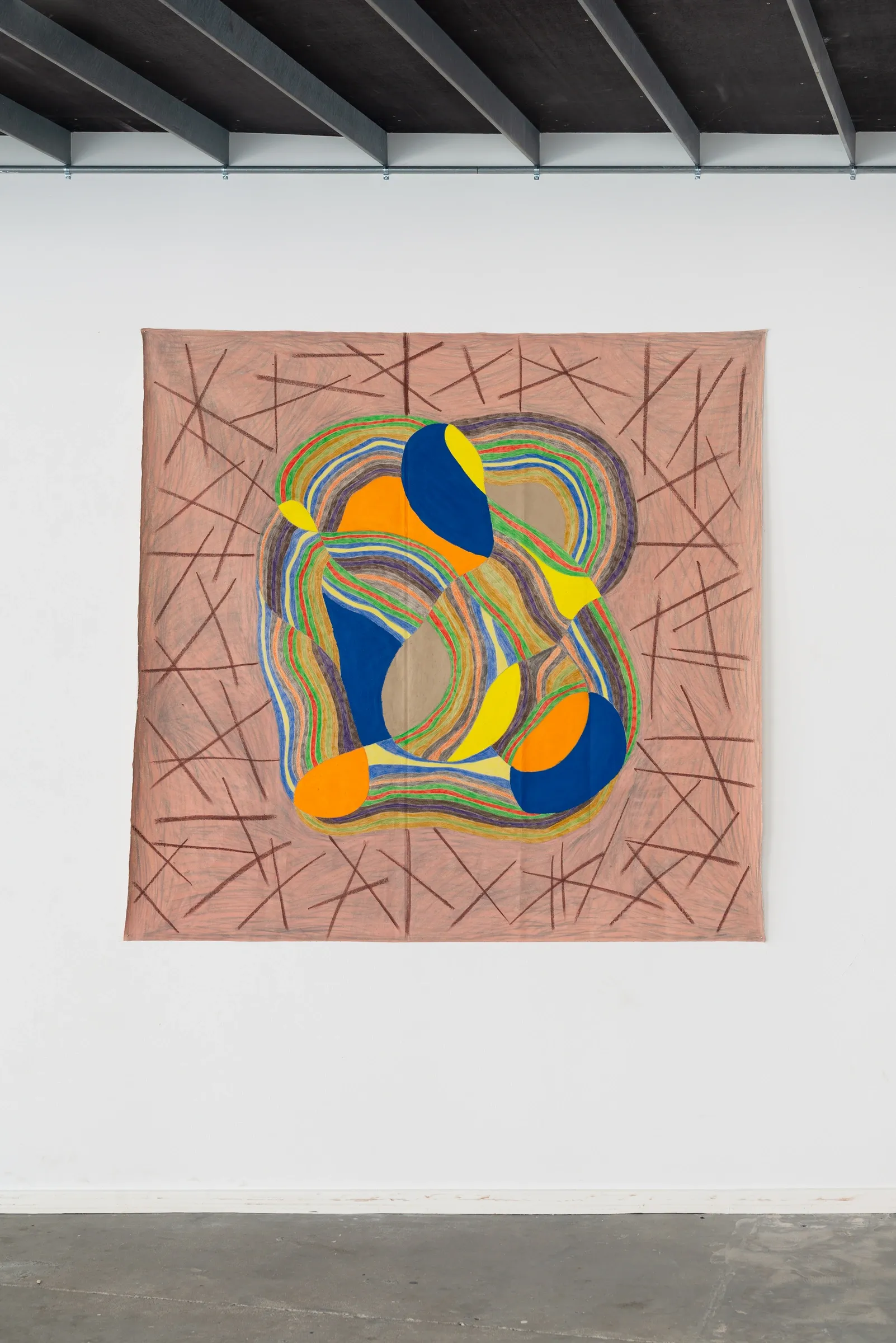
Read against that, the layout of the paintings starts to make sense. The scattered strokes of the outer field look like interference, pressure from outside. The banded mass looks like a boundary under strain. The opaque shapes inside are the part you cannot see into. None of this is illustration.
There is no microscope image behind these works, at least none that is shown, and the colour is far too loud for a laboratory. What carries over from the science is a structure, the idea that resilience and rigidity might be one process, seen at two different moments.
Earlier exhibition titles point the same way. Organisms at Kunst-Felzl and Living Chimeras at Atlas, both solo shows in Vienna in 2024, and Cellular Landscapes, her solo presentation in the Artist Statement section of Parallel Vienna that same year, suggest a vocabulary that has been building for a while rather than one themed series.
The exhibition text for Living Chimeras explicitly connected genetic chimerism with maternal-fetal conflict, placing the biological language of the current series within an earlier line of inquiry.
Four Rooms in One Year
2026 put the work into very different spaces, and each one changed it.
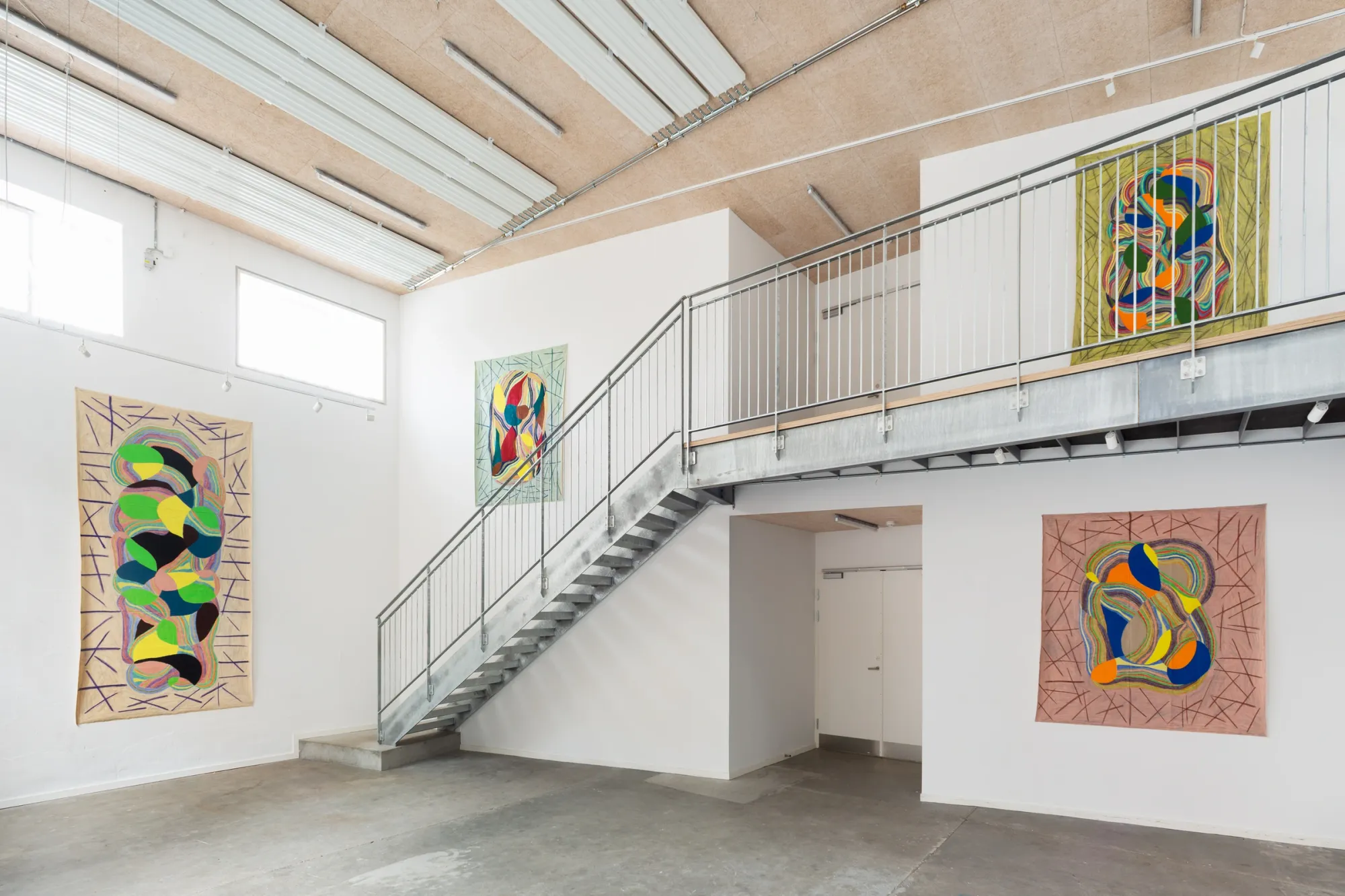
At Aarhus Billedkunstcenter, the solo exhibition Stress Granules used a tall white hall with a steel staircase and a mezzanine. The works hung at different heights, one above the stairs, one on the upper level, so that seeing the show meant climbing through it. The paintings read almost as banners there, vertical and light.
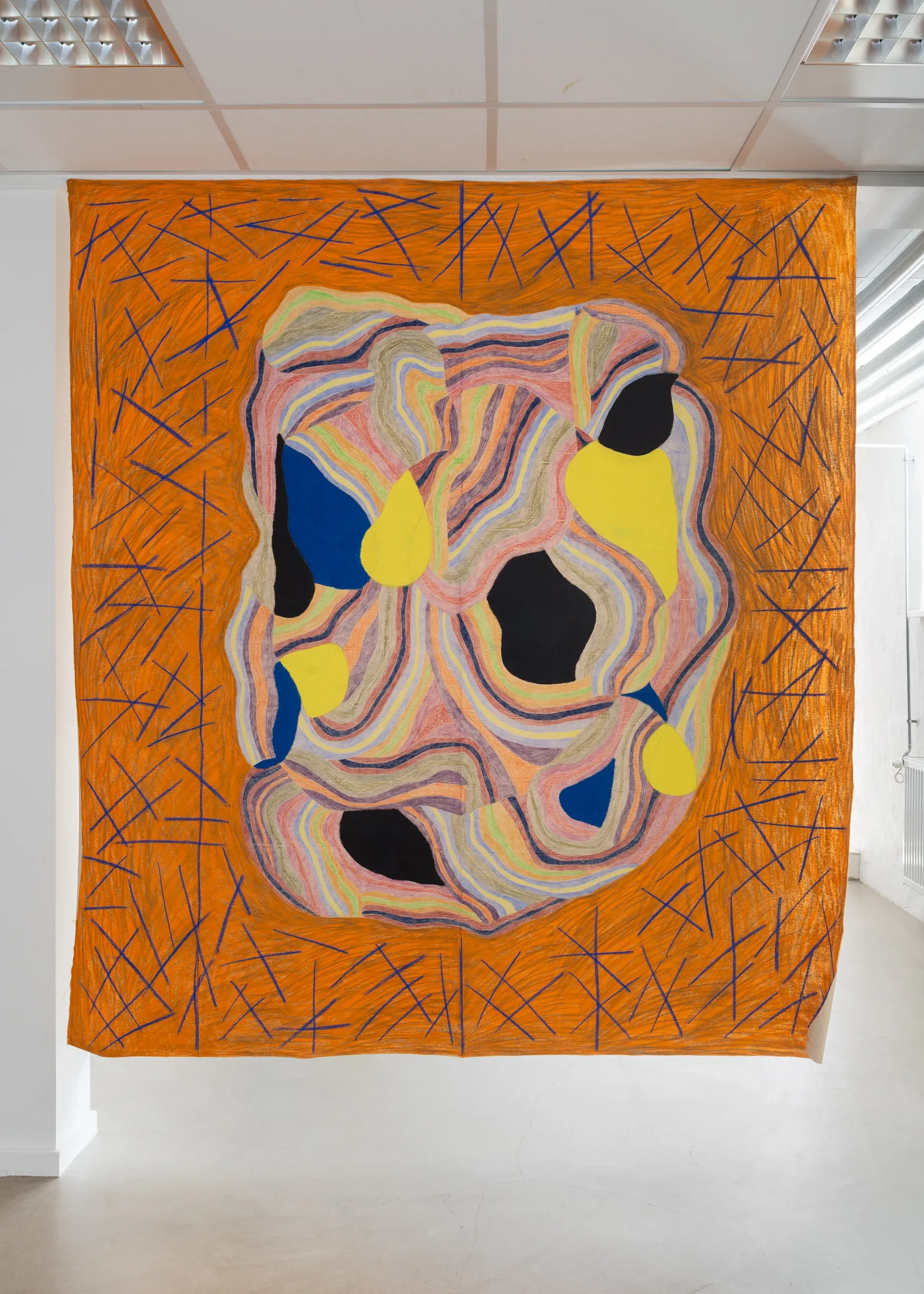
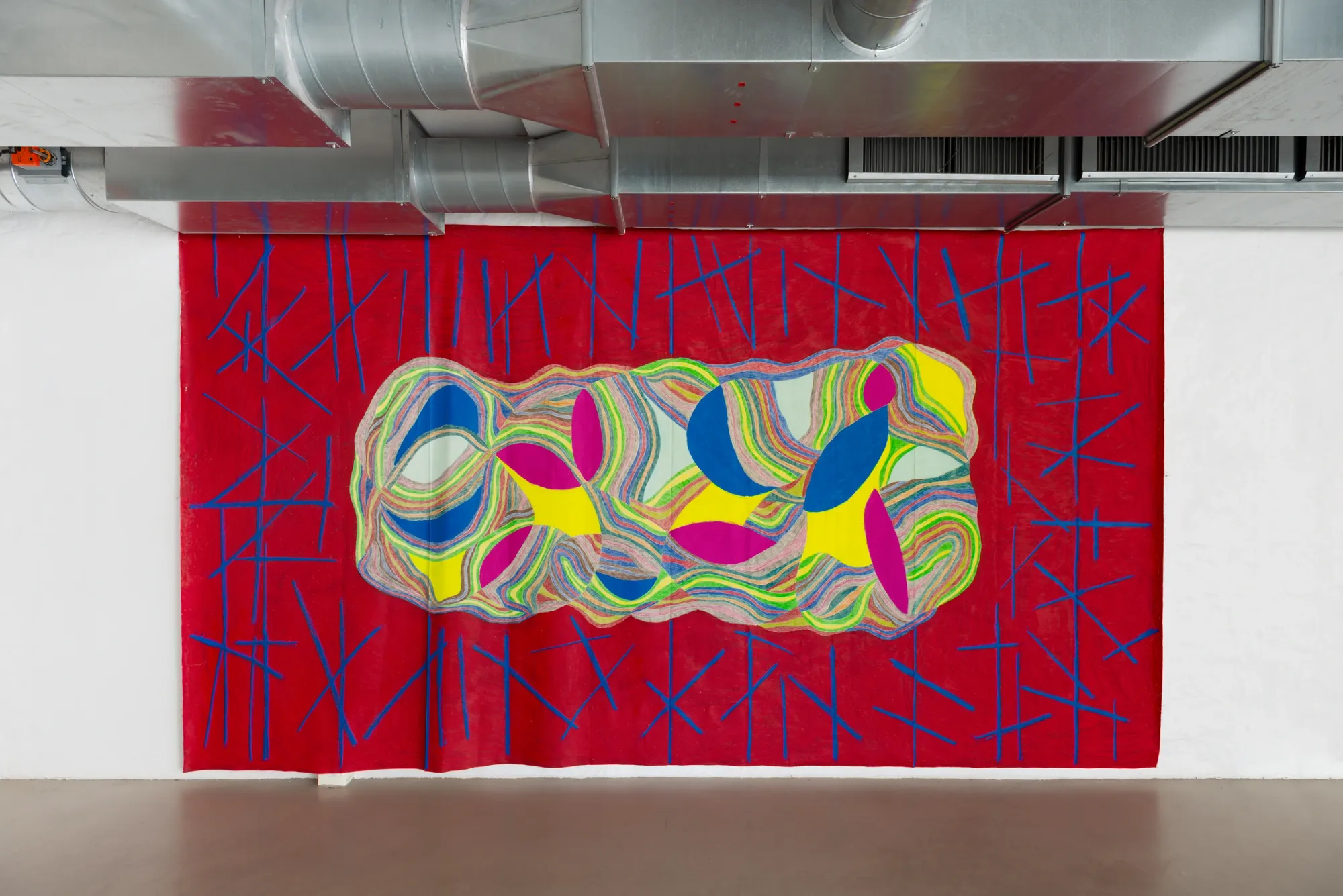
At CANTINA, an artist-run space at Godsbanen in Aarhus operated by members of the studio community Corporum, A Granule of Stress took a lower room with exposed ventilation ducts. Some of the linens hung free in the space, the floor visible beneath them.
A wide red work filled nearly an entire wall under the ducts, its central mass stretched sideways like something under compression. Of the four presentations, this is the one where the paintings behave most like cloth. The same venue also included Passow in Home is where your heart is in 2026.
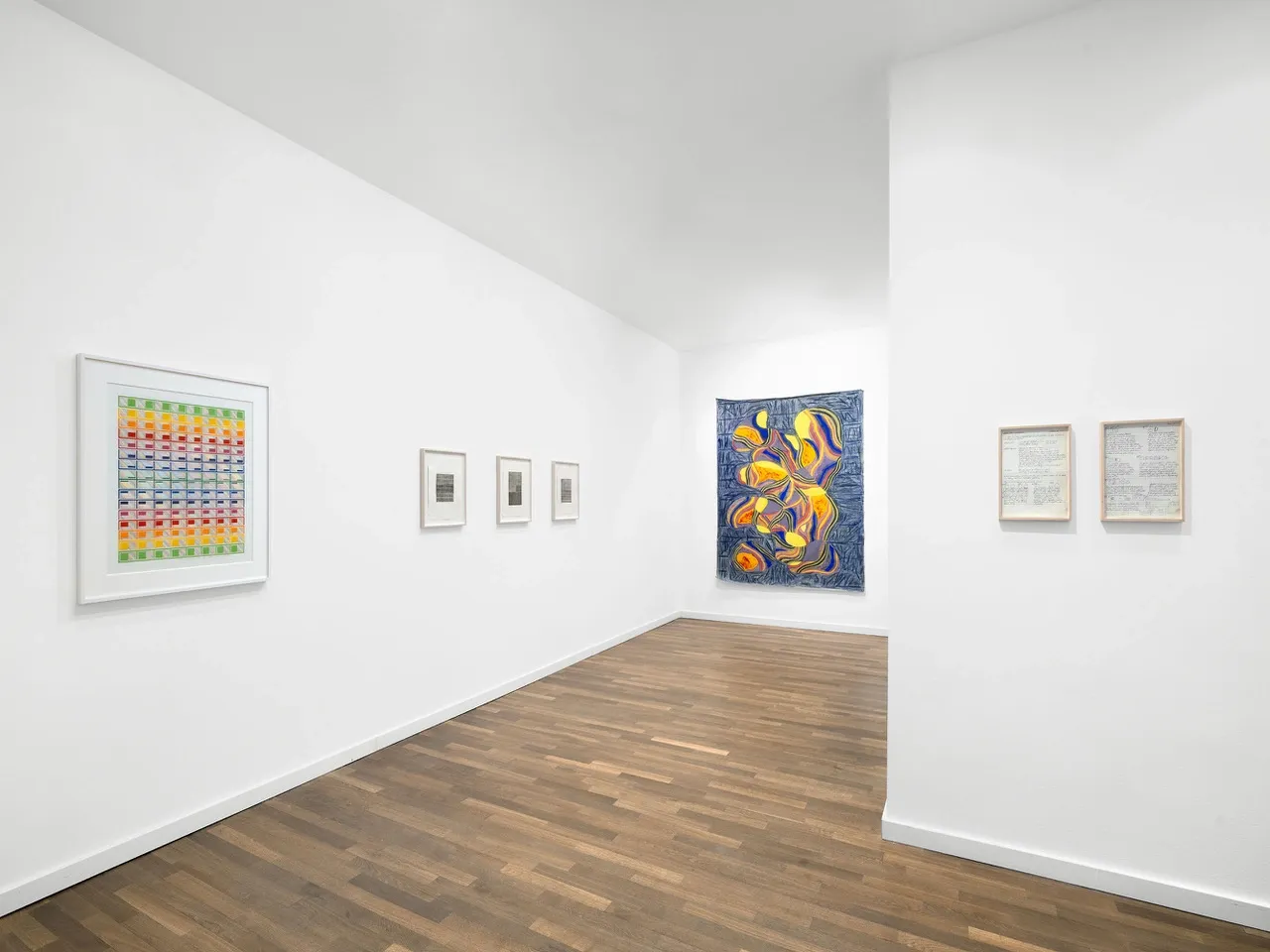
In Berlin, Crone Berlin included her in Empty Places, Crowded Hearts, 27 June to 15 August 2026, a group exhibition that brought works from the 1970s and 1980s into dialogue with contemporary positions. Passow shared the show with Hanne Darboven, Sylvie Fleury, Channa Horwitz, Charlotte Posenenske and Rosemarie Trockel, among others.
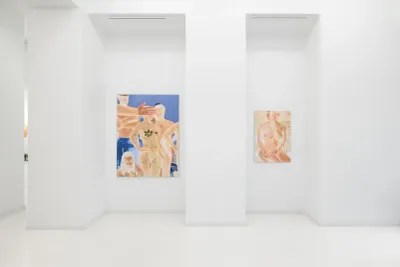
In the installation view, a blue-grounded work hangs at the end of a white room. Next to that serial, conceptual generation, her looser repetition sits closer than expected. Both are systems, but Passow's keeps the physical effort of making visible.
In September, Galerie Crone gave her a solo booth in the Gallery Statement section of Parallel Vienna, 9 to 13 September 2026. White partition walls inside an ornate historic hall, herringbone parquet, lamps above the booth edges. The works were smaller here, some hung in pairs, and the saturated grounds, deep blue, yellow, red, cream, held their own against the ornament around them.
From the Print Room to the Floor
Born in Vienna in 1994, Passow studied in the Drawing and Printmaking class at the University of Applied Arts Vienna, which she joined in 2020 after transferring from photography.
Her diploma work, Bitte Warten, 2022, was already made in soft pastel on linen. Her work has also travelled through artist publishing, with the AAIP (Artists As Independent Publishers) presentations at mumok in Vienna, Weserburg Museum in Bremen and Tokyo University of the Arts.
The printmaker's logic is still there, a ground prepared before anything happens on it, a motif that repeats, an image built in layers. What has changed is scale, and the body. The line is no longer something the hand makes at a table. It is something the whole person has to move through.
One of the Aarhus works, orange, with black openings in its centre among yellow drops, hangs from the ceiling at CANTINA, away from any wall. There is space behind it. For now, it looks soft.
Parallel Vienna is an annual art fair in Vienna. Its 2026 edition took place from 9 to 13 September at the Otto Wagner Areal, where Galerie Crone presented Passow in the Gallery Statement section.
Website · Instagram
Similar topics
Candy Bassas Paints Bathers Who Never Fully Leave the Dark
Krys Huba Paints the Woman Who Slept With the Lights On
Ruo-Hsin Wu: Floating in the Dark