Dorota Gawęda and Eglė Kulbokaitė Set a Table Where Every Chair Holds the Same Face
roam projects Presented I Think My Body No Longer Belongs to Me in Berlin
roam projects e. V. presented I Think My Body No Longer Belongs to Me, a collaboration with Tallinn-based Tütar Gallery curated by Triin Metsla, on view through September 26, 2026.
A body does not have to be taken to stop belonging to its owner. It only has to be priced, copied, or kept young for long enough.
Ownership of a body is usually taken for granted. Most of the time nobody asks who holds the title. The question only comes up when something else starts making claims on it, a state that needs soldiers, a feed that needs faces, an industry that needs the body to stop ageing on schedule.
What makes those claims hard to see is that they rarely arrive as force. They arrive as habits, as images, as small corrections a person makes on their own. By the time the body feels borrowed, the loan has already been signed.
Angela Maasalu, Dorota Gawęda, Eglė Kulbokaitė, Eva Gold
Body Shares by Pire Sova and Netti Nüganen, September 9, 2026
roam projects e. V.
Berlin, Germany
–
Thu–Fri 4–7 pm, Sat 2–5 pm and by appointment
Lindenstraße 91, 10969 Berlin. Entry at the back corner of the building facing the W. Michael Blumenthal Akademie des Jüdischen Museums Berlin
Triin Metsla
Tütar Gallery, Tallinn
Andreas Baudisch. Video stills: Dorota Gawęda, Eglė Kulbokaitė
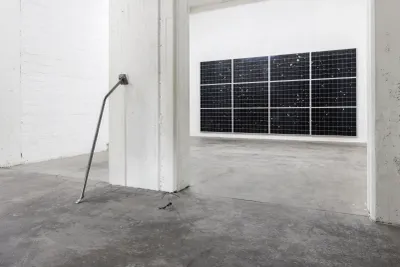
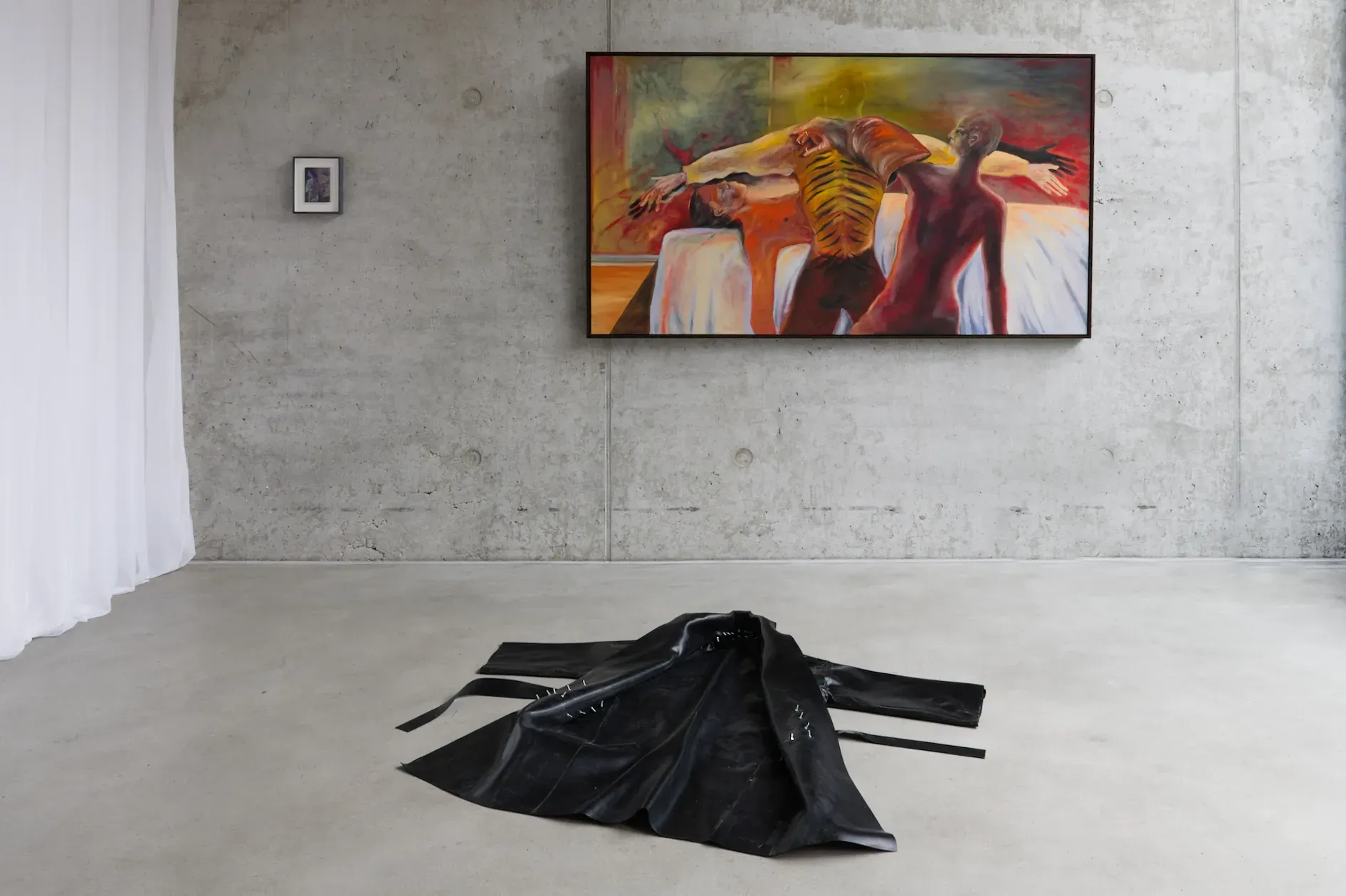
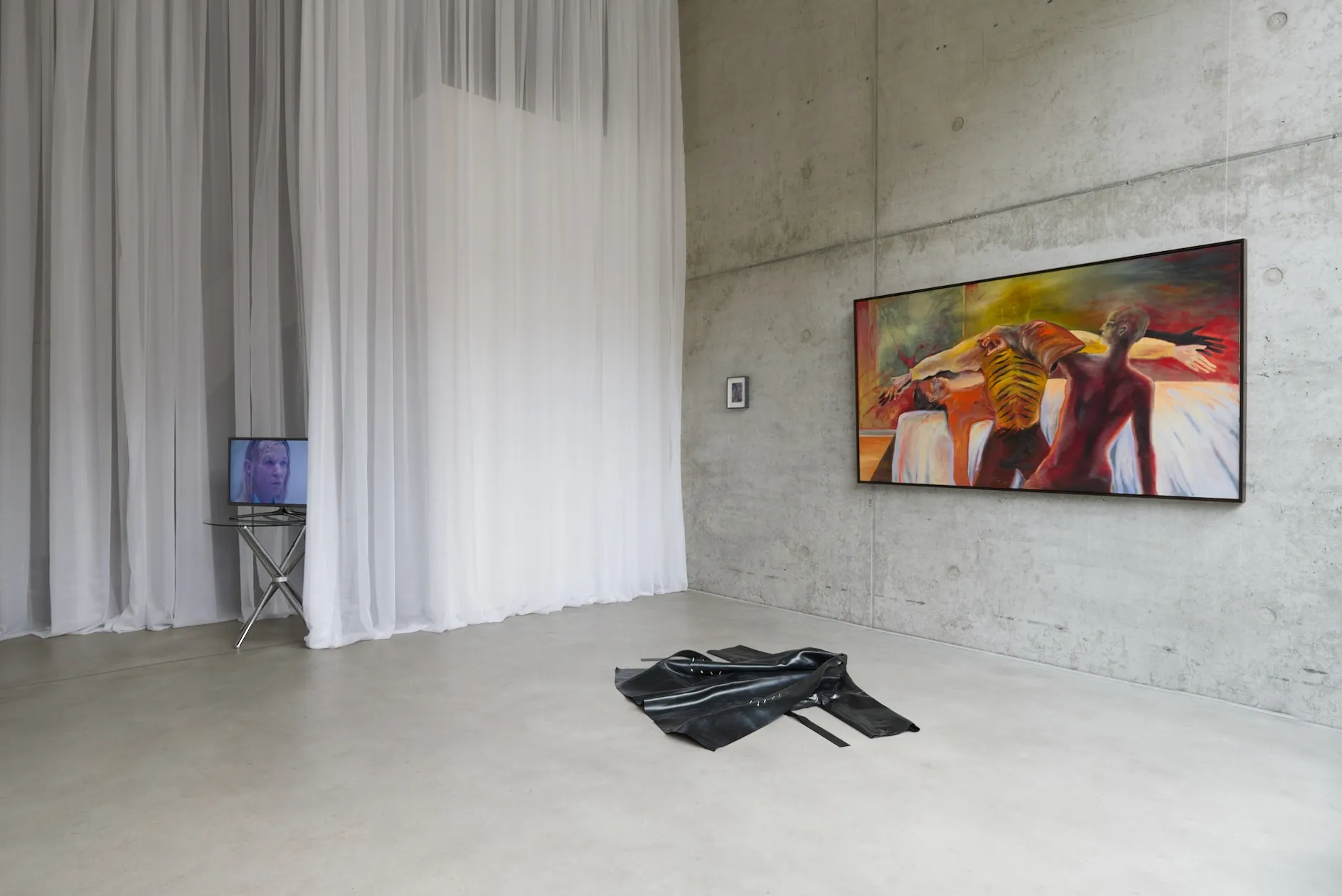
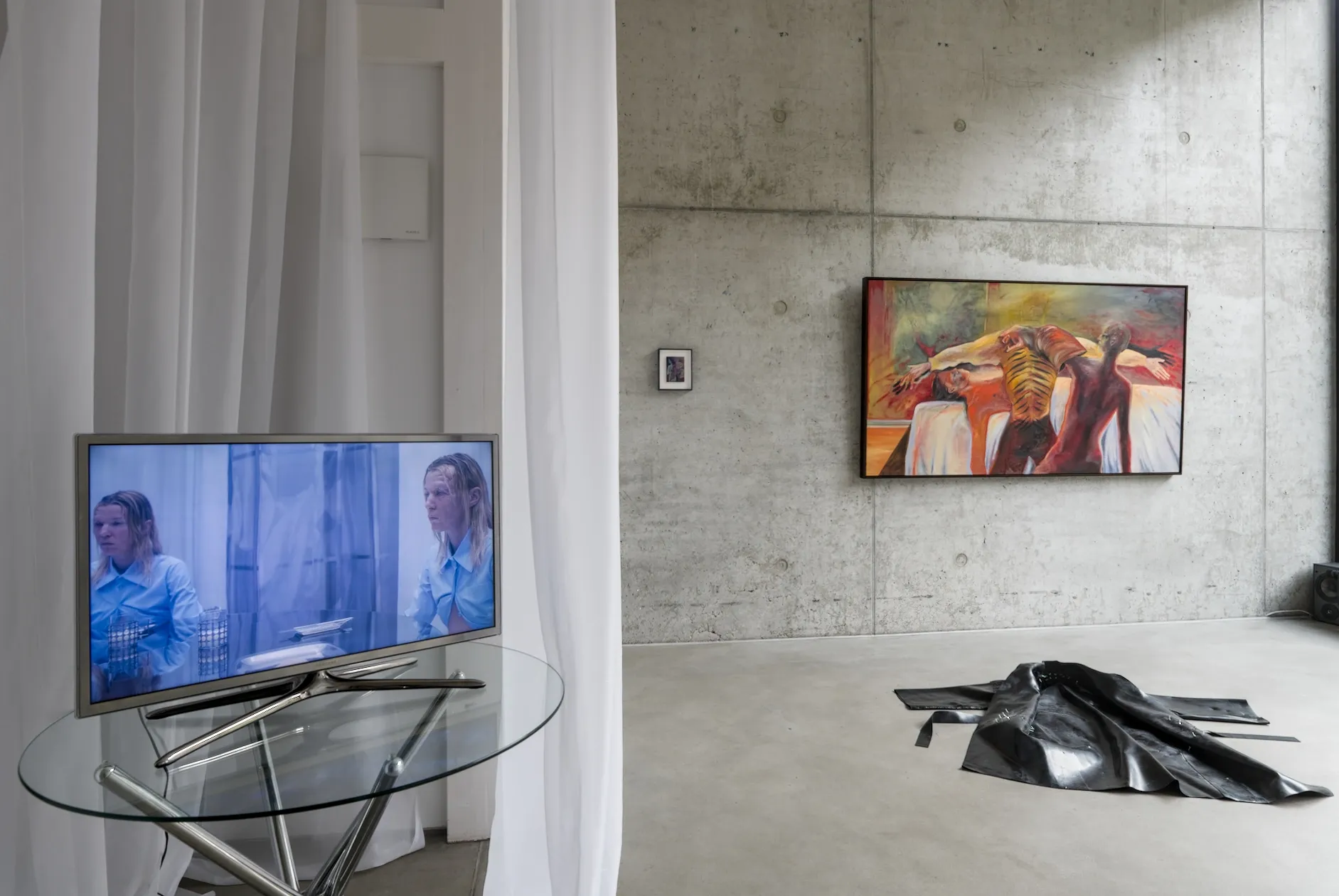
roam is a small project space in Kreuzberg, run since 2022 as a non-profit association with a focus on exchange between Estonia and Germany. For Berlin Art Week it hosted Tütar Gallery from Tallinn. The room does nothing to soften the work. Concrete walls, concrete floor, and a tall wall of white curtain that splits the space into a front room and a screening corner.
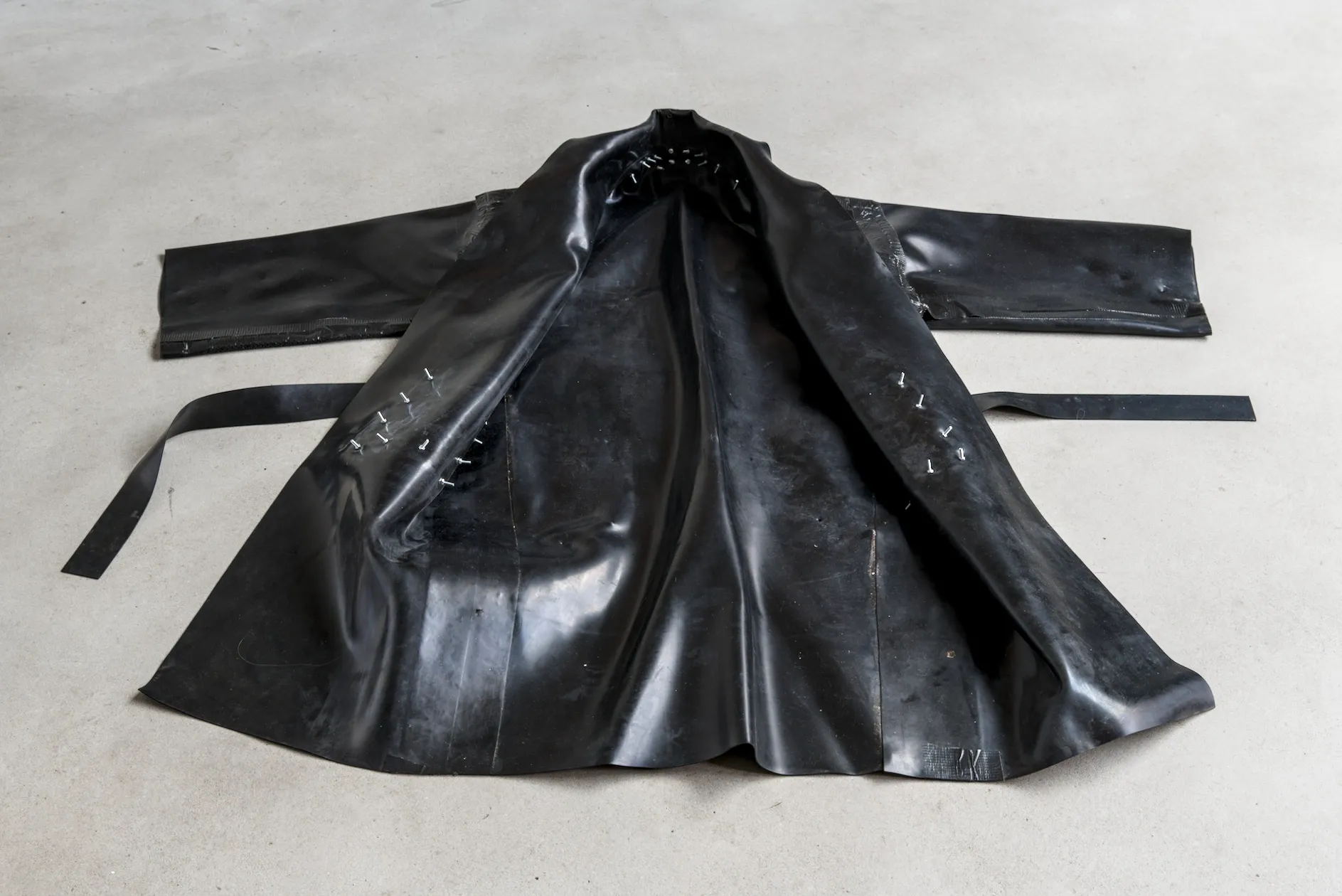
The first thing on the floor is Eva Gold's A changed man (The Perv), a coat that lies flat and open, cut from vulcanised rubber and held together with bolts and gaffer tape, the belt stretched out to either side. The title gives it a former wearer, and an accusation. No one is wearing it, and at first it looks discarded. After a while it looks more like a skin that was taken off and left where it fell.
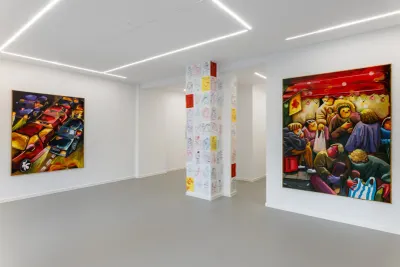
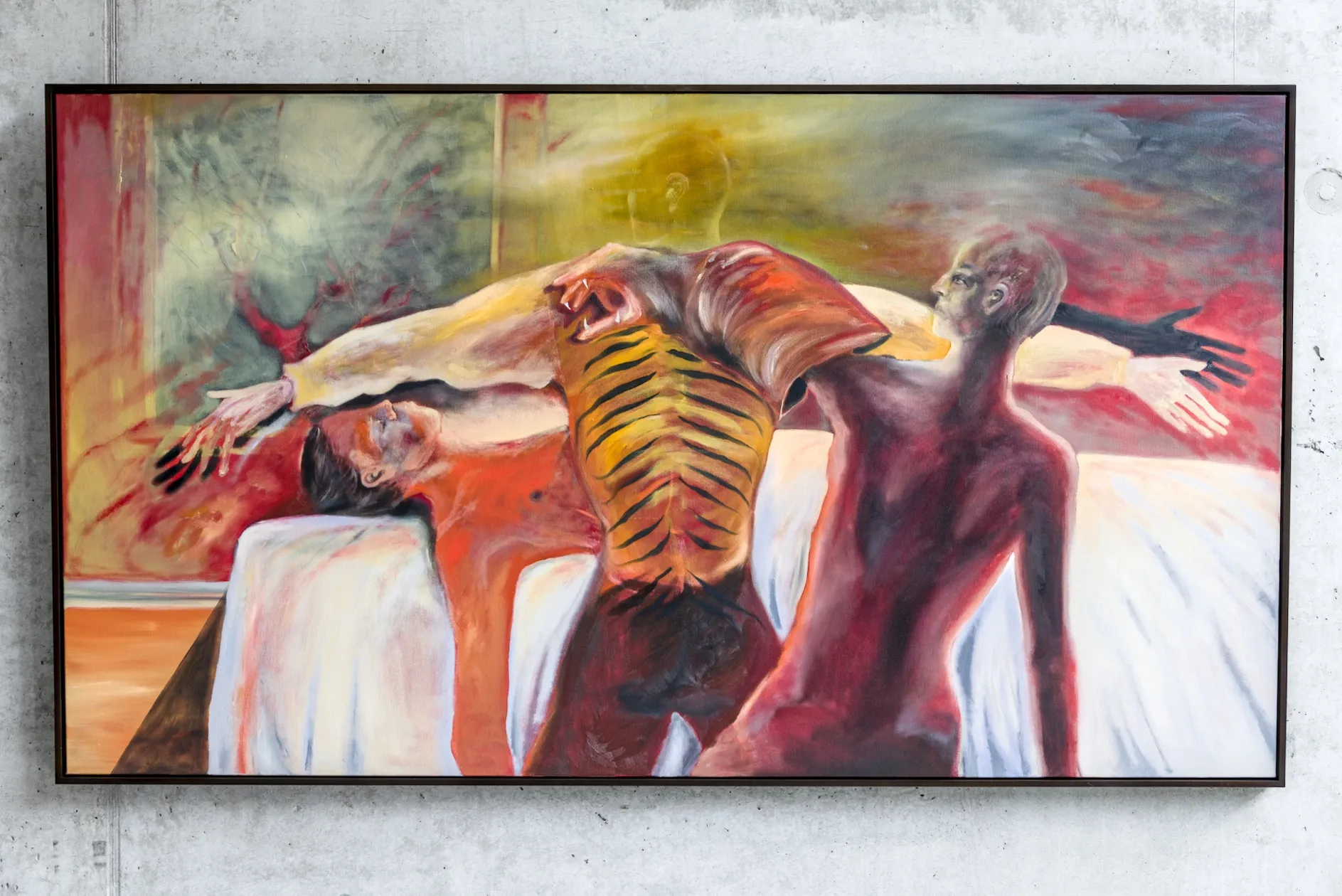
Above it hangs Angela Maasalu's Thinking about the news, a large oil on canvas. Figures lean and stretch across white-sheeted tables. One arches backward with its arms flung wide, one is reduced to a torso striped in yellow and black, a third stands in deep red, turned half away.
The colour runs hot, orange into crimson. It is hard to say whether the scene is an operation, a meal or a performance, and the painting does not settle it.
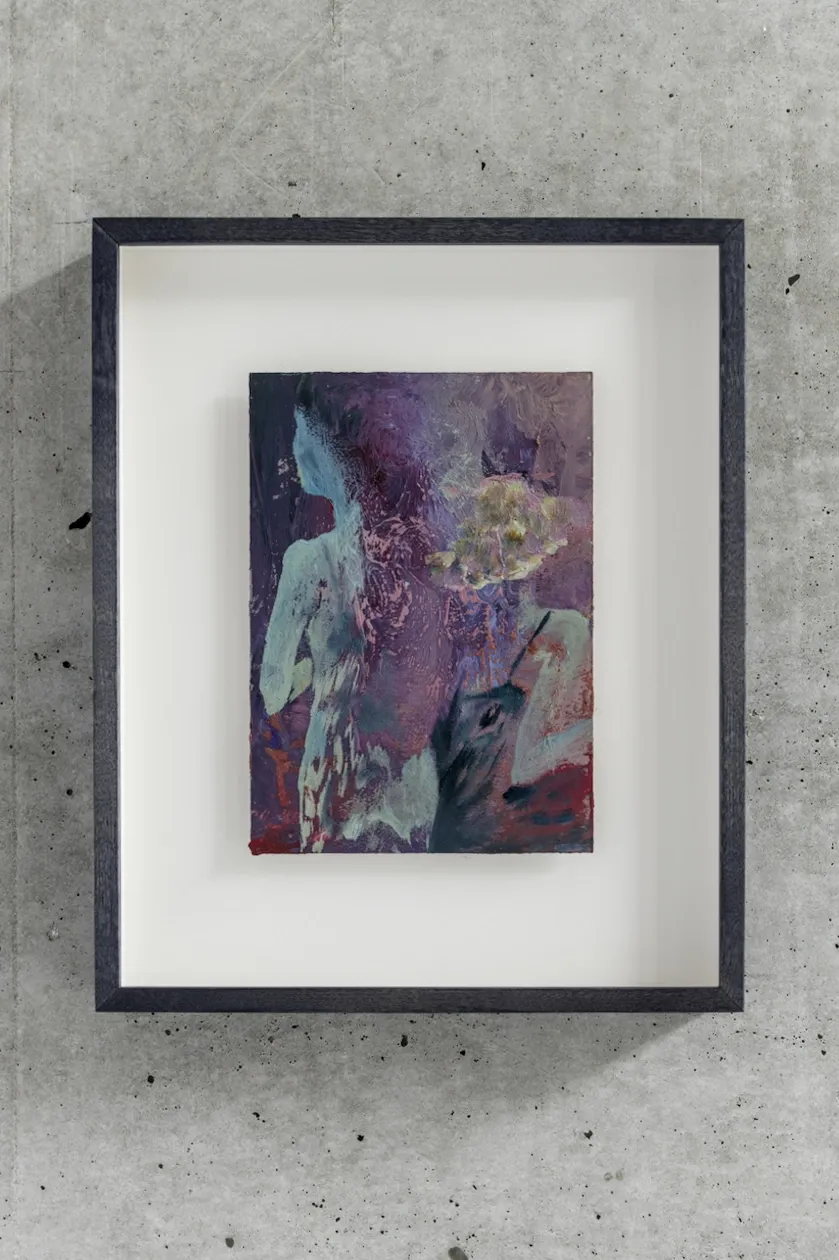
A much smaller Maasalu, Siren call, hangs further along in a deep frame, oil on cardboard, violet and bruised, a pale figure seen from behind.
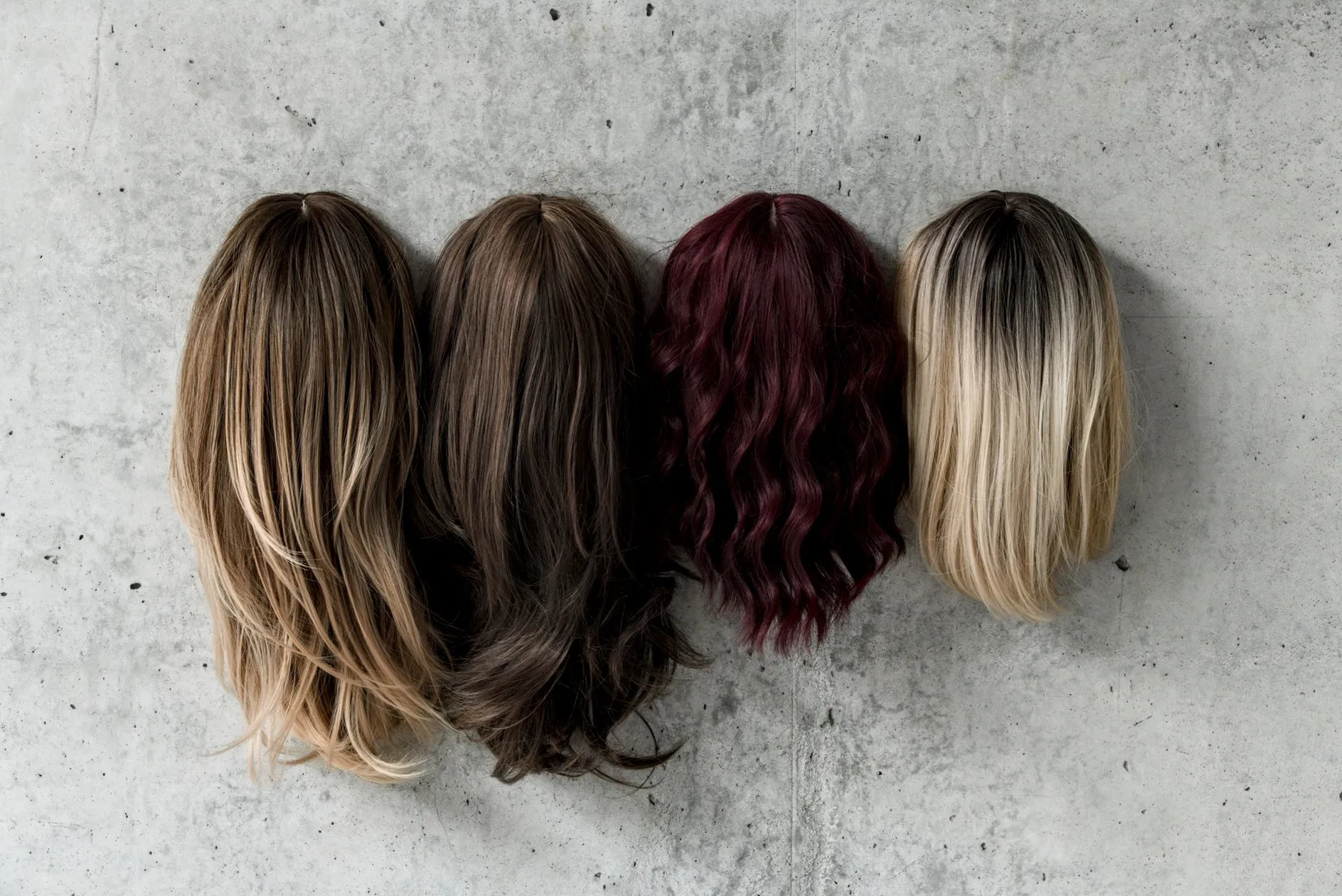
Around the corner hangs Gold's Goodnight, Jessica: four wigs side by side on the concrete, honey blonde, brown, dark wine red, and a bleached blonde with dark roots.
Up close they are just stock, hair bought to replace or improve what grew. From a distance they read as a row of heads turned toward the wall.
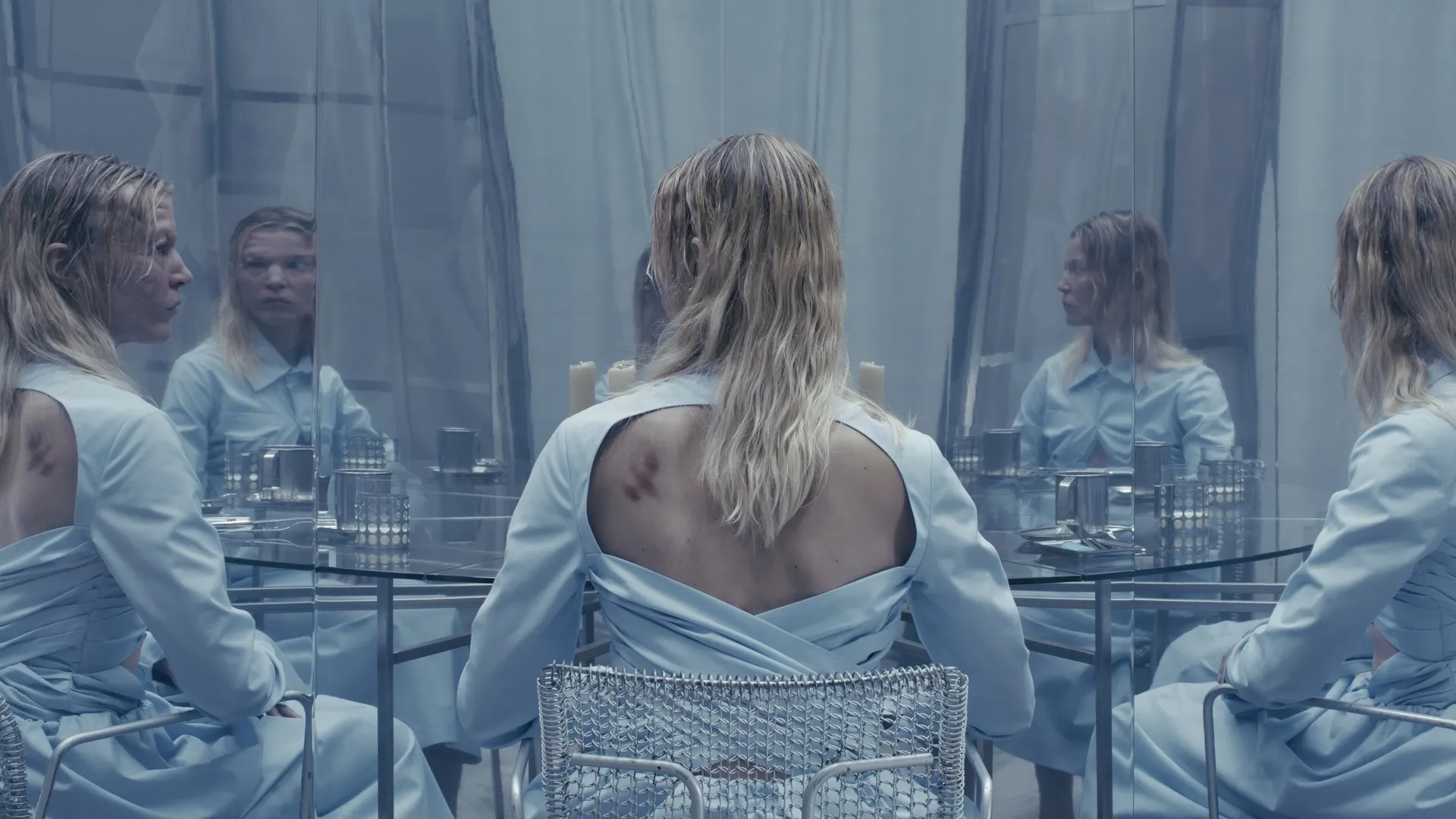
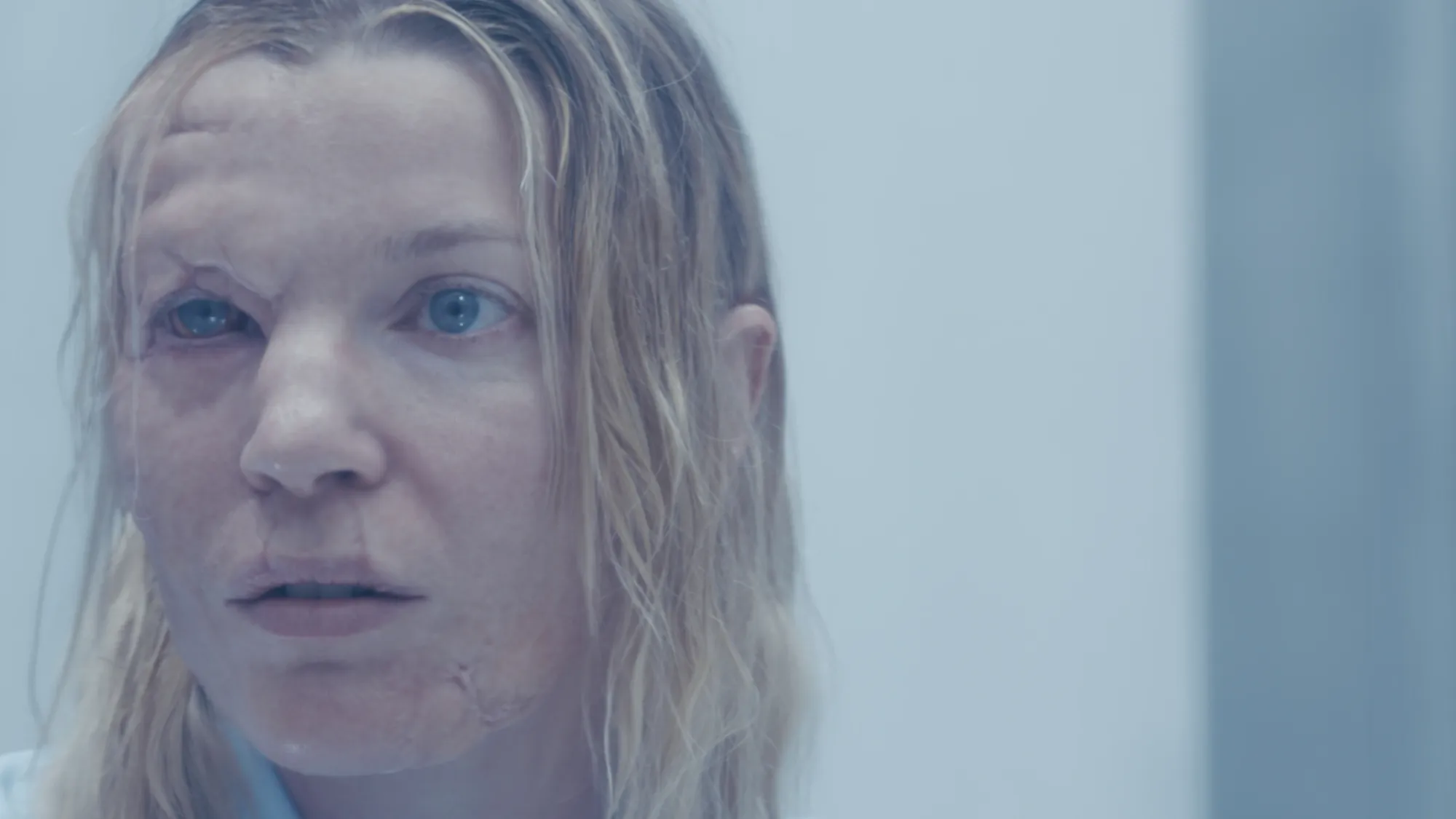
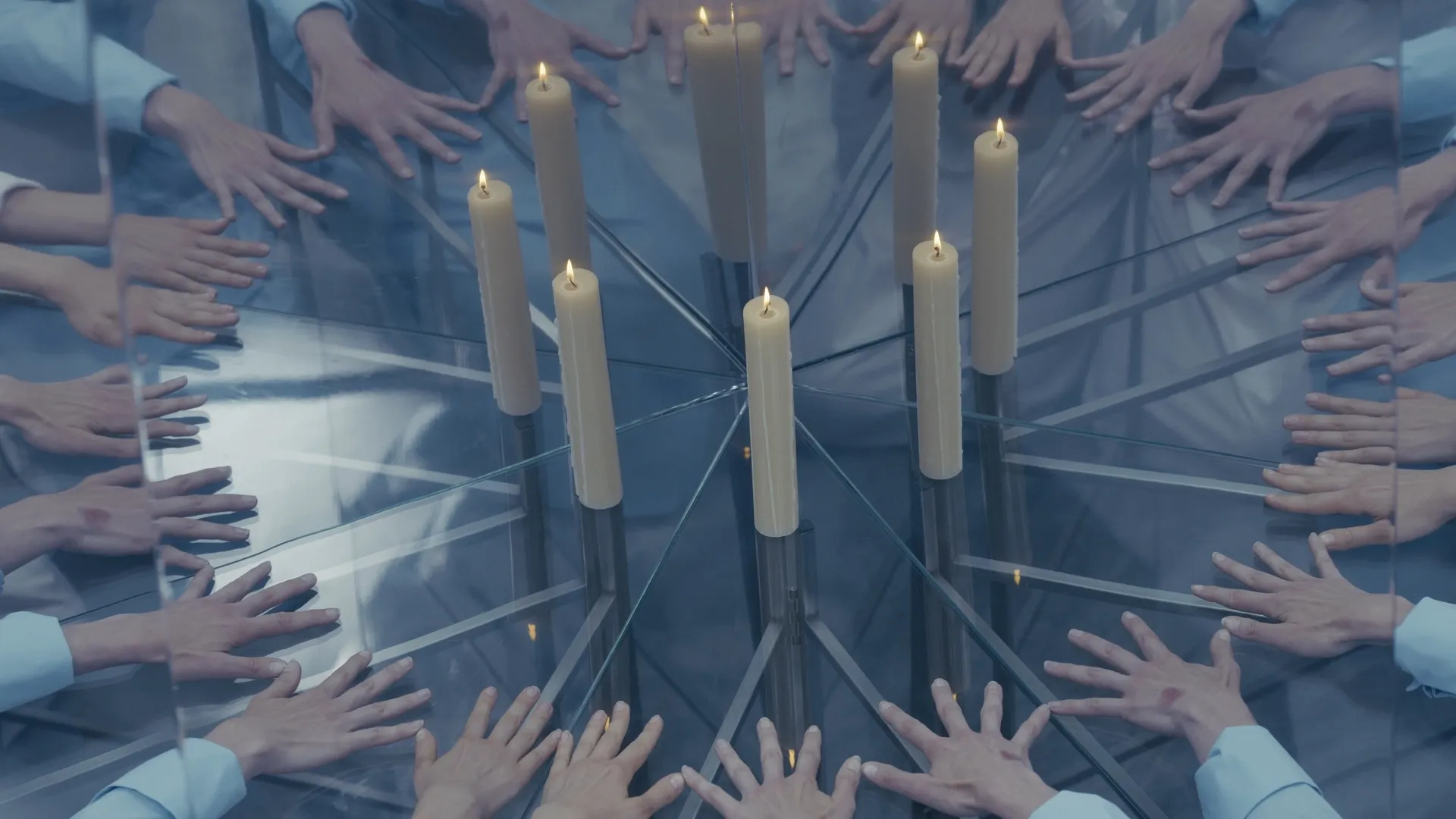
Behind the curtain, on a monitor set on a glass table, runs Spit and Image 1 by Dorota Gawęda and Eglė Kulbokaitė. A single woman in a pale blue shirt sits at a table with candles at its centre, and the mirrored room returns her from every side. In a close-up, her face carries fine scars along the brow and jaw. Another frame shows hands pressed flat against glass, many of them, in a ring. The glass table under the monitor repeats the one on screen, a small decision that pulls the viewer into the seating plan.
The press text names war, reproductive expectation, digital fragmentation and the promise of longevity as pressures on the body. None of that needs introducing now. What the show adds is how quietly those pressures work. Nothing here is violent in the obvious sense. The opening night made the economy literal: Pire Sova and Netti Nüganen made prints with their own bodies and sold them as shares in an improvised auction modelled on livestock sales.
The coat was still on the floor when one left, arms out, belt undone. It did not look abandoned. It looked unclaimed, and in that room that was the uncomfortable part: the body was never missing, it was only waiting for someone to name a price, or hanging on a wall in four shades.
Non-profit association running a project space in Kreuzberg, founded in 2022, with a focus on cultural exchange between Eastern Europe and Germany.
Website
About Catapult Contemporary - Art Platform Submission
This is an exhibition review published by Catapult — an independent editorial platform for contemporary art, based in Vienna. We publish exhibition reviews, artist features, interviews, and critical context, with a focus on emerging and mid-career practices from Europe and beyond.
catapult-platform.art · Instagram
Want to be featured? Submit your work →